

The Definitive Guide to Garage Door Safety Tips for Families
If you’re looking for Garage Door Safety Tips for Families with Children and Pets , here are the most important rules to follow right now:
Why Garage Door Safety Tips for Families with Children and Pets Could Prevent a Serious Accident
If you’re looking for Garage Door Safety Tips for Families with Children and Pets, here are the most important rules to follow right now:
- Mount wall controls at least 5 feet off the ground so toddlers can’t reach them.
- Test your auto-reverse system monthly by placing a 2×4 flat on the floor under the closing door — it must reverse immediately on contact.
- Test photo-eye sensors monthly by waving a broom handle through the sensor beam while the door closes.
- Keep remotes out of reach — store them like car keys, not on coffee tables or in toy boxes.
- Enforce a strict no-play zone around the garage door while it’s in motion.
- Visually check for pets near the door path before closing — sensors don’t always detect small, fast-moving animals.
- Never allow children to touch springs, cables, tracks, or panel joints — these are the most dangerous components on any garage door.
- Call a professional immediately if your door fails any safety test — do not keep using it.
Your garage door is the largest moving part in your home. Depending on the style and material, it can weigh anywhere from 125 to 400 pounds — and it opens and closes roughly 1,500 times a year. That’s a lot of chances for something to go wrong, especially in a household with curious kids or unpredictable pets.
The numbers are sobering. Garage door accidents cause between 20,000 and 30,000 injuries every year across North America. Over 12,500 of those happen in the United States alone. More than 7,000 people suffer pinching injuries annually — serious enough in many cases to result in finger amputations. And an average of 2,000 people are crushed by garage doors every year, with children making up a significant portion of that figure.
Here in Victorville and across the High Desert, these risks don’t disappear — they compound. The desert heat, dust, and temperature swings that define our climate accelerate wear on springs, sensors, and cables faster than in more moderate regions. A safety system that worked fine last winter may not be working properly today.
A 2013 Consumer Product Safety Commission study found that 40% of safety systems on garage doors made after 1993 were not functioning correctly. That means nearly half of homes with relatively modern doors may have a safety feature that has quietly stopped working — and most homeowners have no idea.
I’m Jason Henderson, founder and CEO of Good Golly Garage Doors, and I’ve built my career around helping High Desert families understand and address exactly these kinds of hidden hazards — making Garage Door Safety Tips for Families with Children and Pets a core part of how my team approaches every service call. In the guide below, I’ll walk you through everything you need to know to protect the people and animals you love most.
Essential Garage Door Safety Tips for Families with Children and Pets
Protecting our loved ones begins with clear home rules and smart daily habits. Because about 80% of U.S. homes have a garage, the garage door is often the main entryway for busy families coming and going from school, work, and sports activities. However, because it operates automatically with the touch of a button, we often forget that it is a massive piece of heavy machinery operating overhead.
To build a culture of safety at home, we recommend following two basic physical layout guidelines right away: the 5-Foot Control Rule and the 6-Inch Sensor Rule. The 5-foot control rule dictates that all wall-mounted push buttons and exterior digital keypads must be installed at least 5 feet (1.5 meters) off the garage floor. This keeps operation controls completely out of reach for curious toddlers while keeping them accessible for adults and taught older kids. The 6-inch rule requires photo-eye sensors to be installed no higher than 6 inches off the ground to detect small legs and pet paws.
Enforcing a strict “no-play zone” in and around the garage doorway is another foundational step. Children should treat the area directly beneath and immediately adjacent to the moving tracks as completely off-limits. Remotes should never be treated like toys; store car remotes secured out of reach, just as you would handle car keys. Lastly, teach your children access code privacy — codes should be treated like secret passwords and shielded whenever typed into an exterior keypad. For more detailed family guidelines, check out our full Garage Door Safety Tips 2026 resource.
Core Garage Door Safety Tips for Families with Children and Pets
When establishing daily routines, implementing a strict “hands-off policy” for specific door components is critical. Kids naturally love to explore textures and moving mechanisms, but garage doors present extreme mechanical hazards.
Here are the core rules every child in your home should know:
- Hands Off the Panels and Joints: Panel section joints act like giant pairs of scissors when the door bends along the top curve of the track. Teach kids never to touch or place fingers between door sections, whether the door is stationary or moving.
- Stay Clear of Tracks and Rollers: The side tracks and steel rollers move rapidly and can easily trap loose clothing, shoelaces, hair, or fingers.
- Never Race the Door: Running into or out of the garage while the door is closing causes over 2,000 injuries every year. Teach kids to “stand back and stay still” until the door has completely stopped moving.
- Supervised Entry: Young children should never enter or exit the garage through an operating overhead door without direct adult supervision.
Creating Childproof Zones and Remote Control Rules
Childproofing your system involves both physical adjustments and smart feature usage on your opener. If your wall control panel includes a “Lockout” or “Vacation Mode” switch, switch it on whenever the garage won’t be in active use, such as overnight or while out on vacation. This disables all hand-held remote signals, preventing children from accidentally triggering the door from inside the house.
Emergency release cords — the bright red cord dangling from the opener trolley — also require caution. While designed to allow manual operation during power outages, dangling handles can attract toddlers who want to pull them. Tie the release cord so the handle hangs higher than five feet off the ground, ensuring it remains accessible to adults in an emergency without becoming an irresistible plaything for children.
Critical Safety Features and Testing Procedures
Modern garage door safety relies on two vital backup systems mandated by federal law on all openers manufactured after January 1, 1993: the contact auto-reverse system and photoelectric safety sensors. Together, these systems provide dual-layer protection against crushing injuries.
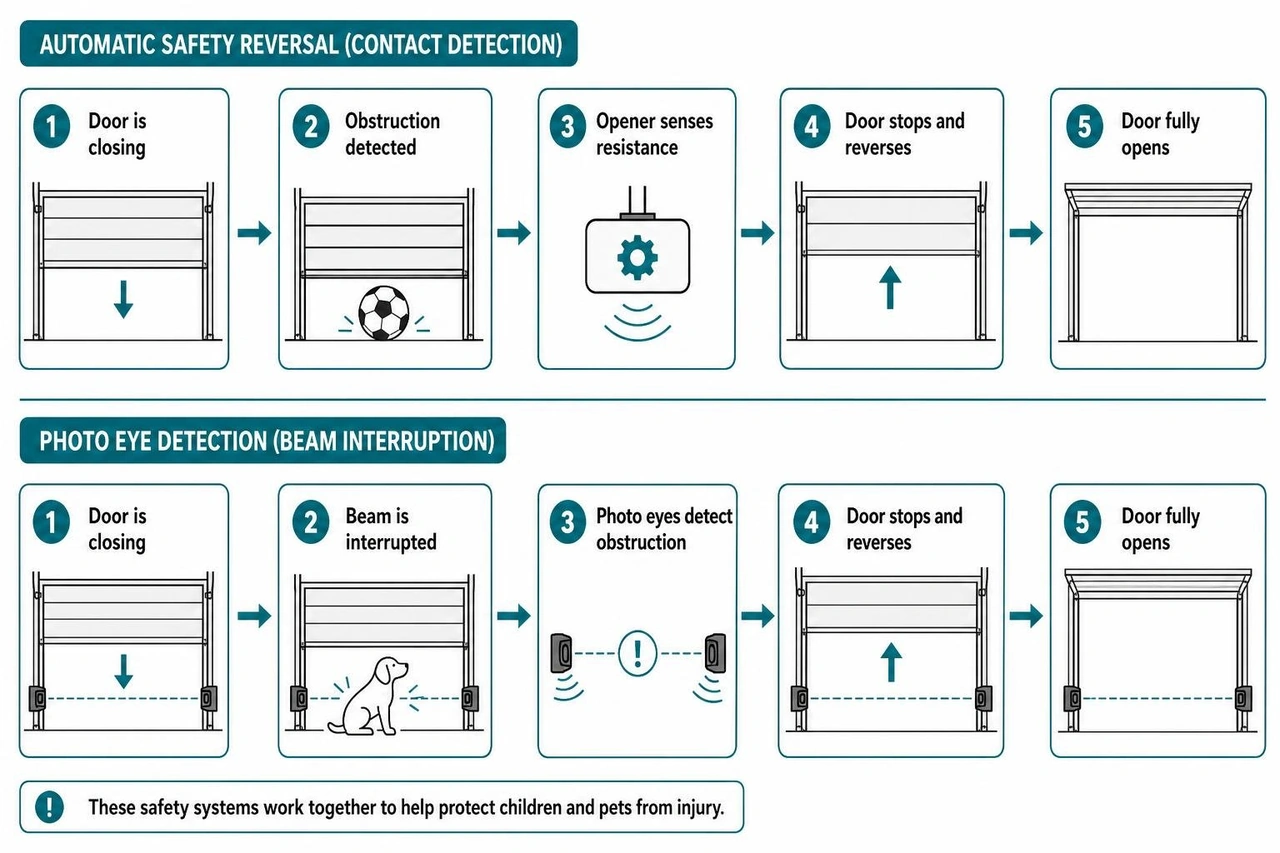
However, mechanical force settings can drift over time due to High Desert dust accumulation, track wear, or temperature extremes in regions like Hesperia and Apple Valley. That is why testing your safety systems every single month is essential. To learn how to execute these tests thoroughly, read our step-by-step guide on How to Test Your Garage Door Safety Features.
Testing Photo-Eye Sensors and Auto-Reverse Systems
Testing both safety features takes less than five minutes each month and provides complete peace of mind.
- The 2×4 Auto-Reverse Contact Test: Place a standard 2×4 board of wood flat on the garage floor directly under the path of the closing door. Stand back and press the wall control button to close the door. When the bottom section of the door contacts the flat board, the door must immediately stop and reverse back to the fully open position within two seconds. If the door crushes into the wood without reversing, the opener force limits are out of balance and require professional adjustment.
- The Non-Contact Sensor Test: Open the garage door completely, then push the button to close it. As the door closes, wave a long-handled broom through the invisible light beam passing between the two photo-eye sensors located near the bottom of the tracks. The closing door should instantly stop and reverse upward.
- Sensor Alignment & Maintenance: Ensure photo-eye lenses are mounted no higher than 6 inches above the floor. Wipe the lenses monthly with a clean, dry micro-fiber cloth to clear away Victorville dust and spiderwebs that can block the optical beam.
For detailed assistance with sensor issues, explore our comprehensive Garage Door Safety Sensor Guide 2026.
Smart Tech and Garage Door Safety Tips for Families with Children and Pets
Modern smart garage door openers add an incredible layer of awareness for parents and pet owners. By connecting your garage door opener to a smartphone application, you gain continuous oversight of your home’s largest entry point.
Key benefits of smart technology for family safety include:
- Real-Time Push Notifications: Receive instant alerts on your phone whenever the door is opened or closed, letting you know when kids arrive home safely from school.
- Remote Status Monitoring: Check whether the garage door was left open accidentally while you are at work or away in Lake Arrowhead or Big Bear.
- Scheduled Auto-Close: Program your opener to automatically close if left open for longer than a specified duration.
- Integration with Home Security: Sync door status with smart cameras to view live video feeds whenever motion is detected around the garage opening.
While “timer-to-close” features add convenience, ensure the opener sounds an audible warning beep and flashes its light before closing to give family members and pets plenty of time to clear the area. Review our complete Smart Garage Door Guide 2026 for more on upgrading your system.
Identifying Dangerous Garage Door Components
Understanding which garage door components carry the highest risk helps families establish effective safety rules around the house.
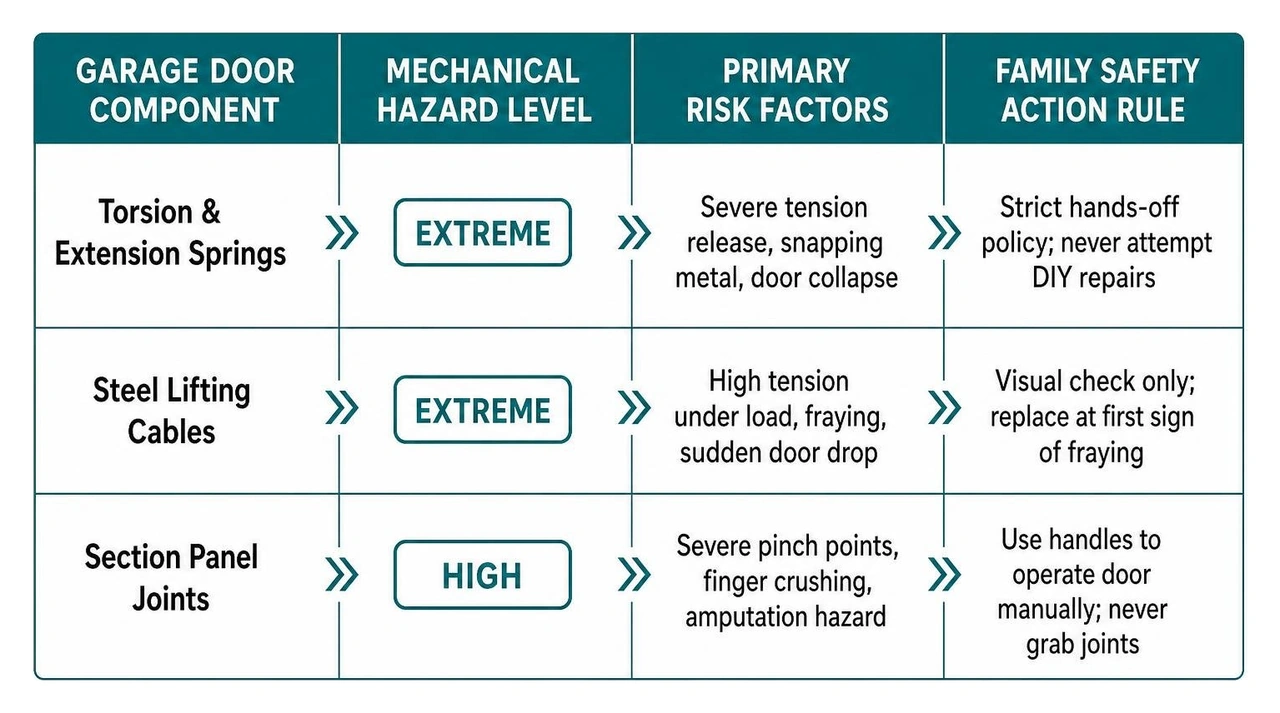
| Garage Door Component | Mechanical Hazard Level | Primary Risk Factors | Family Safety Action Rule |
|---|---|---|---|
| Torsion & Extension Springs | Extreme | Severe tension release, snapping metal, door collapse | Strict hands-off policy; never attempt DIY repairs |
| Steel Lifting Cables | Extreme | High tension under load, fraying, sudden door drop | Visual check only; replace at first sign of fraying |
| Section Panel Joints | High | Severe pinch points, finger crushing, amputation hazard | Use handles to operate door manually; never grab joints |
| Moving Tracks & Rollers | High | Entrapment of fingers, hair, and clothing | Keep clear when door is in motion; keep free of debris |
| Photo-Eye Sensors | Low (Electrical) | Alignment drift, blocked beam causing door failure | Monthly cleaning and alignment checks |
High-Tension Springs and Steel Cables
The springs mounted above or alongside your garage door do the heavy lifting, balancing a 125 to 400-pound door so it can be lifted with just 8 to 10 pounds of force. Because these springs store intense mechanical energy, they represent the single most dangerous hardware system on your door.
When a spring snaps or a steel cable frays and breaks, the immense tension is released instantly. This can throw heavy steel parts across the room or allow the door to crash down uncontrolled. Always watch for the Signs Your Garage Door Spring Is About to Break, such as loud bang noises, visible gaps in coil windings, or a door that moves sluggishly.
Section Joints, Tracks, and Pinch Points
Every year, over 7,000 pinching injuries occur because hands or fingers get caught in door panel joints or moving tracks. As door panels roll through the curved portion of the track overhead, the gap between sections opens and closes tightly.
Children who rest their hands on the door panels while waiting for it to open can easily trap their fingers. Always make sure your door is equipped with pinch-resistant section design handles or pull handles positioned safely away from panel joints.
Best Practices for Protecting Pets in the Garage
Pets — especially curious puppies, small dogs, and outdoor cats — face unique risks around garage doors. Because small pets are lower to the ground, move quickly, and don’t understand the danger of moving machinery, extra precautions are necessary to keep them safe.
Sensor Placement and Pet Barriers
Standard photo-eye sensors are mounted 6 inches above the floor. While this height effectively detects young children, very small pets or animals lying flat on the floor can sometimes slip underneath the beam unnoticed.
To maximize pet safety:
- Strict 6-Inch Height Limit: Ensure your sensors are set no higher than 6 inches. Lower is generally better for detecting small animals.
- Secondary Pet Sensors: Some homeowners choose to install a secondary pair of low-profile photo-eye sensors 2 to 3 inches above the floor specifically for detecting cats and small toy dog breeds.
- Use Pet Barriers: When keeping the garage door open for ventilation while working inside, set up a sturdy pet gate or barrier across the entry to prevent dogs from darting out underneath.
- Keep Sensors Clear: Prevent pet bedding, toys, or leashes from drifting into the sensor path, which can cause erratic door behavior. Read our Garage Door Safety Sensor Blocking Tips for quick troubleshooting tricks.
Preventing Leash Entanglements and Run-Under Hazards
Leash entanglement is a critical hazard that many dog owners overlook. If a dog’s leash is caught on a bottom door bracket or panel handle while the door is opening, the pet can be quickly pulled upward off its feet.
Always unclip long training leads or retractable leashes before letting your dog walk near an operating garage door. Furthermore, train your dogs to sit and stay away from the threshold until the door has completely finished its full cycle and come to a complete stop. Always take a quick visual glance along the floor threshold before pressing your remote button to close the door.
When Safety Tests Fail and Why Professional Repair Is Essential
If your garage door fails either the 2×4 auto-reverse test or the broom sensor test, or if you notice hardware grinding and jerking, discontinue automatic operation immediately. Continuing to operate a door with failing safety features puts your children, pets, and vehicles at severe risk.
Warning Signs of Failing Hardware
Keep an eye out for these clear warning indicators:
- Unbalanced Door Weight: When disconnected from the opener via the emergency cord, a properly balanced door should stay suspended mid-way up (3 to 4 feet off the floor). If it crashes down, the spring tension is dangerously low.
- Noisy or Jerky Operation: Loud squeaking, popping sounds, or jerky mechanical movement signal track misalignment, worn rollers, or uncalibrated opener force limits.
- Uneven Lifting: A door that rises higher on one side than the other indicates worn steel lifting cables or failing spring balance.
- Delayed Response: Slow response times from remotes or wall panels often point to opener logic board errors.
For comprehensive maintenance routines, review our complete Garage Door Maintenance Guide Homeowners.
The Dangers of DIY Garage Door Repairs
While checking light lenses and clearing cobwebs are great tasks for homeowners, major mechanical repairs — especially spring replacement, cable re-spooling, and bottom bracket adjustments — should never be performed as DIY projects.
Garage door springs operate under hundreds of pounds of continuous mechanical torque. Attempting to loosen or replace them without specialized winding bars, heavy-duty clamps, and professional field experience frequently results in severe physical trauma, fractures, or lacerations.
Knowing Garage Door Repairs That Are Too Dangerous for DIY saves lives and prevents catastrophic home damage.
Frequently Asked Questions About Garage Door Safety
How High Should Wall Controls and Keypads Be Mounted?
Wall control buttons and exterior keypads should always be mounted at least 5 feet (1.5 meters) above the floor. This height ensures that adults and older kids can comfortably access the controls while keeping them safely out of reach of toddlers and young children who might be tempted to use them as toys.
How Often Should I Test the Auto-Reverse and Photo-Eye Sensors?
You should test your garage door auto-reverse feature and photo-eye sensors at least once a month. Running a simple 2-minute routine — placing a 2×4 board flat under the closing door and waving a broom handle across the sensor beam — ensures that these critical life-saving mechanisms are in perfect working order year-round.
What Should I Do if My Garage Door Fails a Safety Test?
If your garage door fails either safety test, stop using the automatic opener immediately. Disconnect the opener by pulling the red emergency manual release handle, keep the door closed, and call a qualified professional garage door technician for service. Do not attempt to adjust high-tension springs or internal opener force settings on your own.
Conclusion
Your home’s garage door should provide daily convenience, security, and shelter — never fear or physical risk for your family. By following these Garage Door Safety Tips for Families with Children and Pets, setting clear household boundaries, and performing monthly safety checks, you can comfortably protect the people and pets who mean the most to you.
High Desert weather conditions in Victorville, Adelanto, Oak Hills, Phelan, and surrounding mountain communities like Crestline and Wrightwood put unique demands on garage door hardware. Regular professional maintenance keeps every safety feature operating smoothly through hot summers and chilly winter nights.
When you need trusted, expert help ensuring your garage system is completely child- and pet-safe, turn to our local team at Good Golly Garage Doors. Whether you need a 26-point safety inspection, sensor alignment, spring repair, or an opener upgrade, we’re here to keep your family protected. Contact us today for reliable /victorville-ca/garage-door-repair and expert service tailored to your home!

Need Garage Door Help ASAP?
We answer the phone 24/7 for emergency spring, track, panel, and opener repairs, so you can reach a real person any time. Our technicians arrive in clearly marked service vehicles carrying common replacement parts, and most jobs can be completed the same day. If the door appears unstable or unsafe, keep people and pets clear and let our team handle the repair.