

Best Garage Door Materials for the Las Vegas Desert Heat
Heavy-gauge triple-layer insulated steel and composite faux-wood overlays perform best in the Las Vegas desert climate, offering the highest resistance to…
Environmental Challenges: How the Mojave Desert Tests Garage Doors
Heavy-gauge triple-layer insulated steel and composite faux-wood overlays perform best in the Las Vegas desert climate, offering the highest resistance to thermal warping, intense UV radiation, and abrasive blowing sand. Living in Southern Nevada offers stunning desert vistas, but the local environment is notoriously brutal on exterior building components. When our technicians assess garage doors across Summerlin, Henderson, and Paradise, we consistently observe the toll taken by the Mojave Desert. Between searing summer afternoons exceeding 110°F, high-elevation solar radiation, and fine blowing silt, standard doors engineered for mild coastal or midwestern climates quickly fail.
Understanding how heat causes garage door panels to warp starts with looking at the extreme forces acting on your door every single day. A standard garage door represents the single largest opening in your home’s thermal envelope. When subjected to severe desert heat conditions, inferior materials break down, sag, lose their color, and transfer staggering amounts of heat directly into your home.
Diurnal Temperature Swings and Solar Radiation
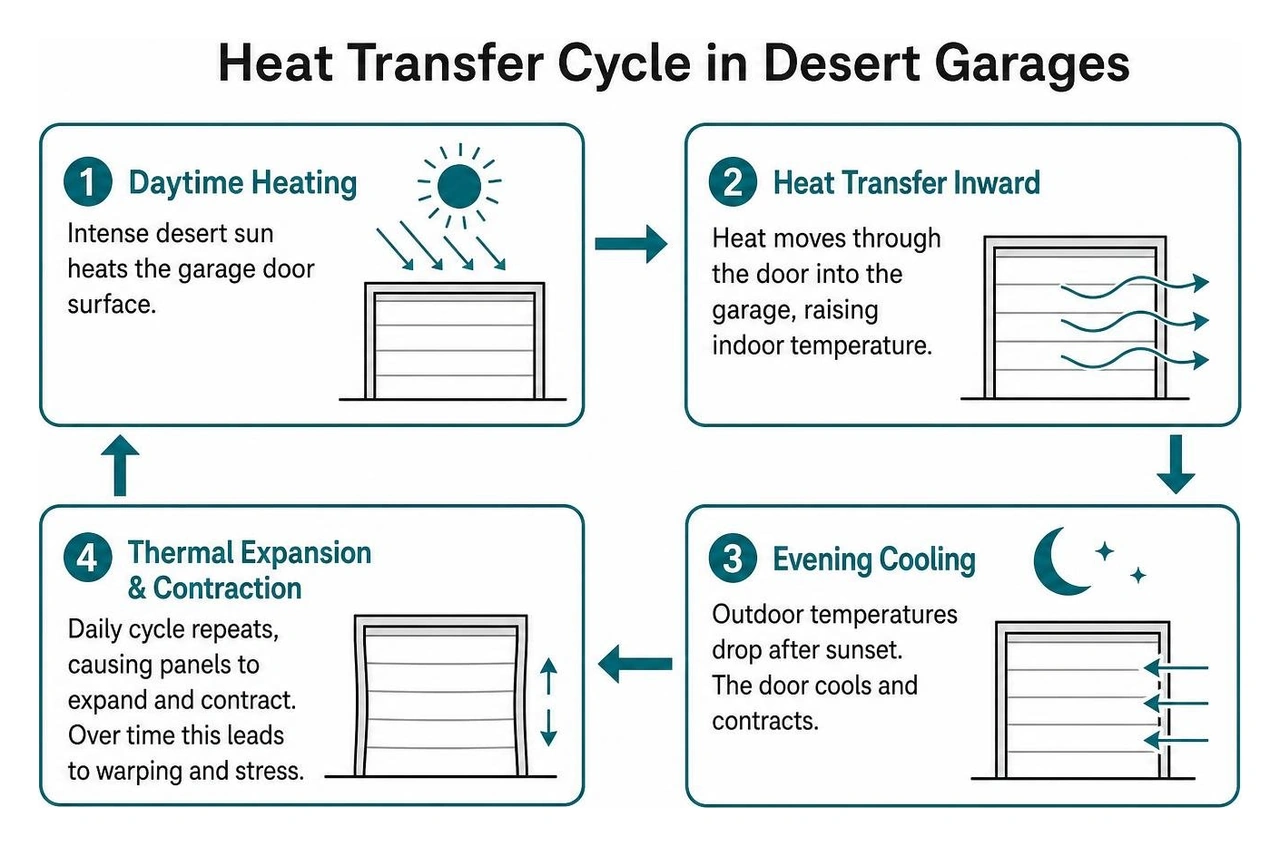
One of the most destructive aspects of the desert climate is the diurnal temperature swing—the rapid fluctuation between daytime peaks and nighttime lows. In the Las Vegas Valley, a scorching 115°F afternoon can plunge by 40°F to 50°F once the sun sets over the Spring Mountains.
This drastic shift causes continuous thermal expansion and contraction in exterior panels. When unreinforced metal panels heat up rapidly during the day, the outer skin expands while the cooler interior remains stable, leading to a loud popping or flexing condition known as “oil canning.” Over time, this constant mechanical movement loosens factory fasteners and compromises structural integrity.
Compounding this thermal stress is solar radiation. Because Southern Nevada sits at an elevated desert plateau, UV radiation is roughly 20% to 30% more intense than at sea level. Direct desert sunlight acts as an energetic assault on surface finishes, breaking down clear coats, cracking unshielded plastics, and driving surface temperatures above 160°F on darker surfaces.
Abrasive Dust and Mechanical Strain
Extreme thermal cycles are only part of the equation. Desert microbursts and seasonal windstorms sweep fine quartz dust and alkali silt across the valley floor. This airborne grit behaves like natural sandpaper, wearing away exterior paint finishes and infiltrating every exposed moving part.
Fine dust mixes with traditional wet lubricants, forming an abrasive grinding paste inside tracks, roller bearings, and hinge pivots. Left unchecked, this grit accelerates mechanical wear, strains your opener motor, and degrades perimeter bottom astragals and vinyl side seals until they become brittle and crack. Maintaining your garage door in the Las Vegas desert climate requires using high-temperature synthetic lubricants and ensuring your hardware is reinforced against severe desert wind loads.
Material Evaluation: What Garage Door Materials Hold Up Best in the Las Vegas Desert Climate
Choosing the right material requires weighing structural rigidity, thermal resistance, and long-term durability against the sun. While certain materials excel in humid or freezing zones, Southern Nevada demands a very specific set of physical properties.
Here is how the most common options compare when evaluating the best garage door materials for desert climates:
| Material Type | Heat & UV Resistance | Structural Rigidity | Thermal Insulation Performance | Maintenance Requirement | Recommended for Las Vegas? |
|---|---|---|---|---|---|
| Triple-Layer Insulated Steel | Excellent | Superior (Resists Dents & Sagging) | Outstanding (R-16+ with Polyurethane) | Minimal (Periodic rinse & lube) | Top Recommendation |
| Faux Wood / Steel Composite | Excellent | High (Steel Core Backing) | Outstanding (R-12 to R-16+) | Low (Occasional wash) | Yes (Best Aesthetics) |
| Natural Hardwood / Cedar | Poor (Dries & Splits) | Moderate (Prone to Warping) | Fair to Moderate | Extremely High (Annual sealing) | No |
| Extruded Aluminum & Glass | Good (Corrosion-Proof) | Moderate (Prone to Denting) | Poor to Fair (Highly Conductive) | Low to Moderate | Conditional (Requires Insulated Glass) |
| Fiberglass | Moderate (Yellows/Chalks) | Moderate (Becomes Brittle) | Moderate | Moderate (UV recoating needed) | Not Ideal |
| Standard Vinyl (PVC) | Poor (Softens in Extreme Heat) | Low (Warps under Direct Sun) | Fair | Low | No |
When looking at the best garage door materials compared for homeowners, triple-layer steel and composite overlays consistently outperform single-layer alternatives in harsh arid zones.
Why Triple-Layer Steel Leads What Garage Door Materials Hold Up Best in the Las Vegas Desert Climate
When analyzing what garage door materials hold up best in the Las Vegas desert climate, heavy-gauge triple-layer steel stands out as the industry benchmark. A triple-layer door—often referred to as a “sandwich door”—consists of an exterior steel face, a solid insulating core, and a protective interior steel backing sheet.
- Heavy-Gauge Strength: High-quality desert installations utilize heavy 24-gauge or 25-gauge galvanized steel. This thickness provides superior dent resistance against windblown debris and resists panel bowing caused by extreme temperature differentials.
- Foamed-in-Place Polyurethane Core: Rather than dropping in loose foam boards, manufacturers inject liquid polyurethane foam between the steel skins under pressure. As the foam expands and cures, it bonds directly to the metal walls, forming a dense composite structure that will not sag, warp, or separate.
- Torsional Rigidity: The dense inner core acts as continuous structural bracing. This eliminates the oil-canning effect and provides exceptional resistance against high desert winds and sudden microbursts.
In any comprehensive steel vs wood vs aluminum garage door comparison, triple-layer steel emerges as the most dependable and resilient defense against continuous sun exposure.
Performance of Wood, Aluminum, Fiberglass, and Vinyl
Alternative materials often encounter severe limitations under Southern Nevada’s intense sun:
- Real Wood: While natural cedar, redwood, and mahogany deliver undeniable curb appeal, the desert is their natural enemy. The Mojave’s low humidity leaches natural moisture from the grain, while solar radiation cooks the surface. Without rigorous annual stripping, staining, and UV sealing, natural wood doors crack, split, shrink, and warp out of plumb within just a few seasons.
- Aluminum: Extruded aluminum frames paired with full-view glass panels create a striking modern aesthetic. Aluminum is lightweight and completely rustproof. However, raw aluminum has exceptionally high thermal conductivity, acting as a massive heat bridge that radiates outdoor temperatures directly into your garage. Homeowners choosing aluminum must invest in thermal breaks and insulated, Low-E coated glass units to manage heat gain.
- Fiberglass: Fiberglass is popular in coastal regions because it resists salt air corrosion. However, under high-elevation desert UV rays, lower-grade fiberglass resins tend to chalk, yellow, and turn brittle over time, making panels vulnerable to cracking during windstorms.
- Vinyl: Solid PVC vinyl doors are dent-proof and low maintenance in mild regions. But in the extreme heat of the Las Vegas basin—where dark surface temperatures can exceed 160°F—vinyl can soften, bow out of track alignment, and suffer permanent heat deformation.
Composite Overlays and Faux Wood Solutions
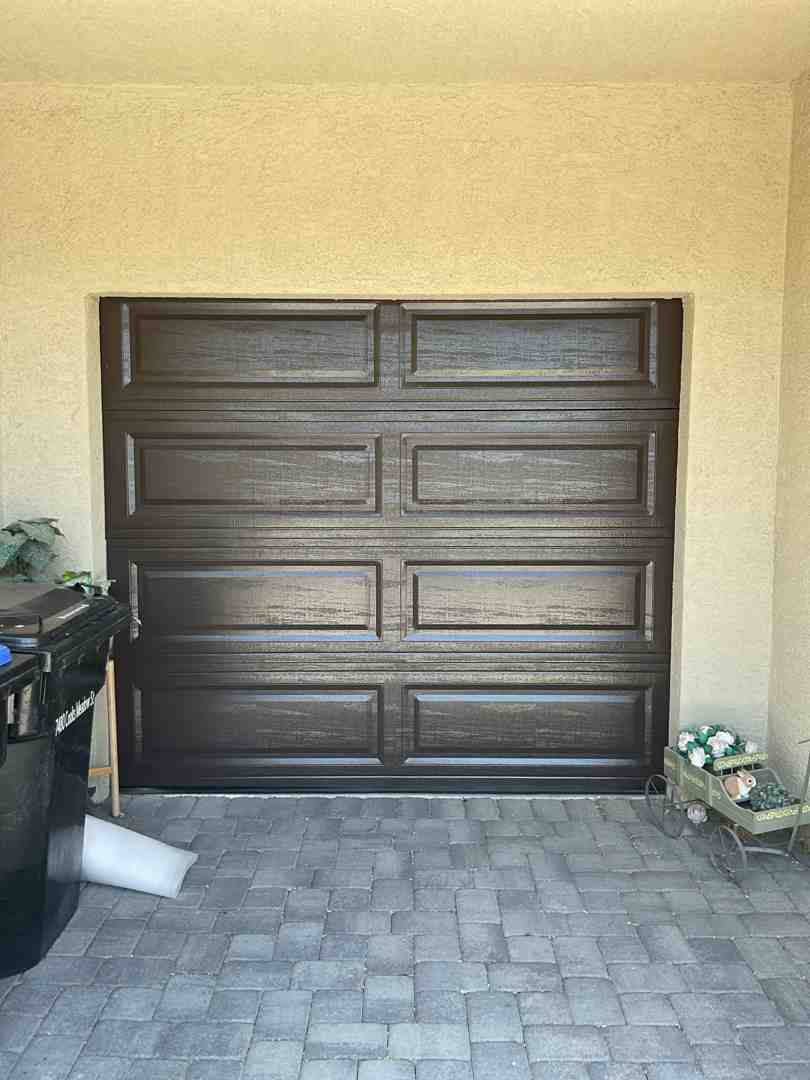
Homeowners who love the warm, rich character of natural timber without the punishing upkeep can opt for composite overlays. These doors combine a heavy-duty, insulated triple-layer steel core with exterior cladding made of high-density fiberglass or polymer composites molded from real wood boards.
These advanced composite overlays capture realistic woodgrain textures while incorporating specialized UV inhibitors. They do not rot, swell, shrink, or split in dry desert air, offering complete dimensional stability and long-lasting curb appeal.
Critical Engineering: Insulation Ratings, Thermal Breaks, and Reflective Finishes
A garage door’s exterior skin is only half the battle; internal engineering determines how much heat enters your home. Reviewing an insulated vs non-insulated garage door comparison demonstrates that an uninsulated steel door acts like a giant radiator, heating your garage to over 130°F on a standard summer afternoon.
To prevent this extreme heat gain, high-performance desert doors rely on three essential engineering features:
- Injected Polyurethane Cores: High-density insulation that fills every internal cavity without leaving air gaps.
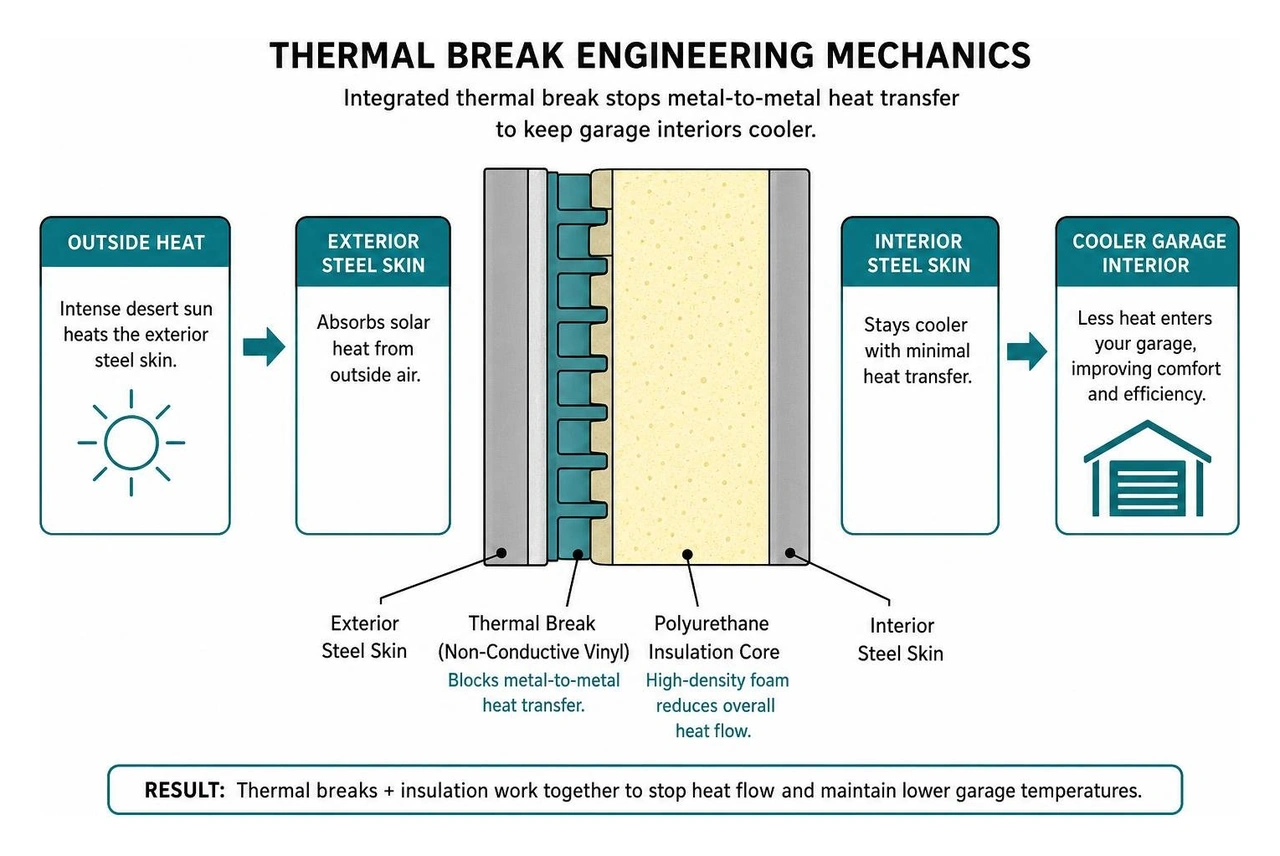
- Integrated Thermal Breaks: Non-conductive vinyl or rubber barriers placed between the interior and exterior steel skins to halt metal-to-metal heat transfer.
- Advanced Solar Reflective Coatings: Industrial factory-baked finishes formulated with heat-reflective pigments that bounce away infrared wavelengths.
Polyurethane vs. Polystyrene and Recommended Desert R-Values
When selecting insulation, homeowners typically choose between two types:
- Expanded Polystyrene (EPS): Rigid foam panels inserted between the steel layers. While budget-friendly, polystyrene leaves microscopic air pockets along the panel edges, yielding a lower thermal resistance (typically R-6 to R-9).
- Injected Polyurethane: A high-density foam that expands and chemically bonds to the steel skins, eliminating all internal air gaps. This produces a low U-factor of roughly 0.26 (demonstrating minimal heat transfer) and superior thermal ratings ranging from R-12 to R-18+.
For attached garages in Southern Nevada—where shared walls connect directly to kitchens, living rooms, or bedrooms—we strongly recommend a minimum rating of R-16. A quality R-16 door keeps garage interior temperatures roughly 20°F to 25°F cooler during peak afternoon heat, reducing the workload on your home’s air conditioning system and protecting sensitive items stored inside.
Solar Reflective Coatings and Color Selection
The color and chemistry of your door’s finish significantly impact heat absorption:
- Dark Colors (Black, Dark Walnut, Deep Bronze): Dark finishes can absorb up to 70% of solar radiation, pushing exterior panel surface temperatures between 160°F and 180°F under direct midday sun. This intense heat degrades insulation adhesives and stresses counterbalance springs.
- Light and Neutral Tones (White, Almond, Sandtone, Taupe): Lighter colors reflect up to 90% of solar radiation, keeping surface temperatures far closer to ambient air temperatures.
If your home’s architectural design demands a rich, darker finish, always ensure the door uses advanced heat-resistant paint technology. These coatings utilize specialized ceramic pigments that reflect invisible infrared solar rays while maintaining deep, saturated visible color.
Frequently Asked Questions About Desert Garage Doors
Exactly What Garage Door Materials Hold Up Best in the Las Vegas Desert Climate?
Triple-layer insulated steel built with 24- or 25-gauge exterior panels and an injected polyurethane core holds up best in the Las Vegas desert. It provides the ideal balance of structural strength, dent resistance, wind load tolerance, and thermal efficiency while remaining virtually impervious to dry rot and UV cracking. If you need assistance selecting the right model, explore our professional garage door installation in Las Vegas, NV to see modern, heat-resistant options built for Southern Nevada homes.
What R-value is recommended for an attached garage in Las Vegas?
For an attached residential garage in the Las Vegas Valley, we recommend a minimum rating of R-16. Because attached garages share insulated partition walls with air-conditioned living spaces, a high R-value door keeps garage temperatures 20°F to 25°F cooler in the summer. This prevents heat buildup from radiating through interior walls and keeps energy bills lower.
Do dark garage door colors cause panel damage in extreme heat?
Yes, standard dark-colored garage doors can absorb up to 70% of incoming solar radiation, driving surface temperatures above 160°F to 180°F under direct Mojave sun. This excessive thermal stress can cause panel bowing, compromise internal foam bonding, and accelerate the drying of perimeter weather seals. We recommend lighter neutral finishes (such as almond, sandtone, or white) or premium factory finishes formulated with solar-reflective pigments.
Conclusion
Choosing the right garage door material for your Southern Nevada home is essential for durability, curb appeal, and energy efficiency. By opting for a heavy-gauge, triple-layer steel door featuring foamed-in-place polyurethane insulation, a true thermal break, and a UV-resistant finish, you protect your home against the Mojave Desert’s harshest weather conditions for decades to come.
As a licensed, family-owned local business, Good Golly Garage Doors is dedicated to providing dependable, customer-first service across Las Vegas, Summerlin, Henderson, North Las Vegas, Sun City, and Boulder City. Our skilled technicians offer quick response times and 24/7 emergency service to keep your overhead doors operating safely and smoothly in any season.
Ready to upgrade your home with a high-performance desert door? Schedule garage door installation in Las Vegas today to request more information!
Need Garage Door Help ASAP?
We answer the phone 24/7 for emergency spring, track, panel, and opener repairs, so you can reach a real person any time. Our technicians arrive in clearly marked service vehicles carrying common replacement parts, and most jobs can be completed the same day. If the door appears unstable or unsafe, keep people and pets clear and let our team handle the repair.