
A Quick Start Guide to Torsion Spring vs Extension Spring Differences
Understanding the torsion spring vs extension spring difference is one of the most important things you can do as a homeowner when your garage door stops…
What’s the Difference Between Torsion Springs and Extension Springs on Your Garage Door?
Understanding the torsion spring vs extension spring difference is one of the most important things you can do as a homeowner when your garage door stops working. Here’s the short answer:
| Feature | Torsion Spring | Extension Spring |
|---|---|---|
| How it works | Twists/rotates to store energy | Stretches to store energy |
| Location | Mounted on a shaft above the door | Runs along the horizontal side tracks |
| Lifespan | 15,000–20,000 cycles (~10+ years) | 7,000–10,000 cycles (~6–7 years) |
| Safety when broken | Stays contained on the shaft | Can snap back violently without safety cables |
| Operation | Smooth, consistent, quiet | Can be jerky; more noise |
| Best for | Most residential and heavy doors | Lighter doors or low-headroom garages |
Both spring types do the same job — they counterbalance the weight of your garage door so it opens and closes smoothly. But they do it in very different ways, and choosing the wrong type (or ignoring a failing one) can mean an imbalanced door, premature wear, or a real safety hazard.
When one of these springs snaps — and it happens more often than most homeowners expect — you’ll likely hear a loud bang and find your door won’t budge. At that point, knowing which system you have and how it works puts you in a much better position to get it fixed fast and safely.
I’m Jason Henderson, founder and CEO of Good Golly Garage Doors, and through years of leading service teams across Austin and Central Texas, I’ve seen how often homeowners are surprised by the torsion spring vs extension spring difference — especially when a spring fails unexpectedly and disrupts their entire day. Let’s break down everything you need to know so you can make a confident, informed decision.
Torsion spring vs extension spring difference basics:
- garage door spring repair what homeowners should know
- how garage door springs work and why they break
Understanding the Torsion Spring vs Extension Spring Difference
To truly grasp how your garage door functions, we have to look at the physics of helical coil springs. Standard residential garage doors can weigh anywhere from 100 to over 300 pounds. Lifting that kind of deadweight manually would be a back-breaking chore, and even the strongest automatic garage door openers aren’t designed to lift that load alone.
That is where counterbalance systems come into play. Your garage door springs act as the “muscles” of the entire operation. They store mechanical energy when the door is closed and release it to help lift the door when it opens.
However, the way these helical coil springs manage energy storage and force application is where the two types diverge. A torsion spring works through twisting and rotational torque, while an extension spring relies on physical stretching and linear tension.
How you care for these springs also changes as the seasons shift. For example, during seasonal transitions in Central Texas, temperature drops and spikes can cause the steel to contract and expand, making proper maintenance essential. You can learn more about managing these changes in our Garage Door Spring Guide Warmer Weather.
How Torsion Springs Store and Release Energy
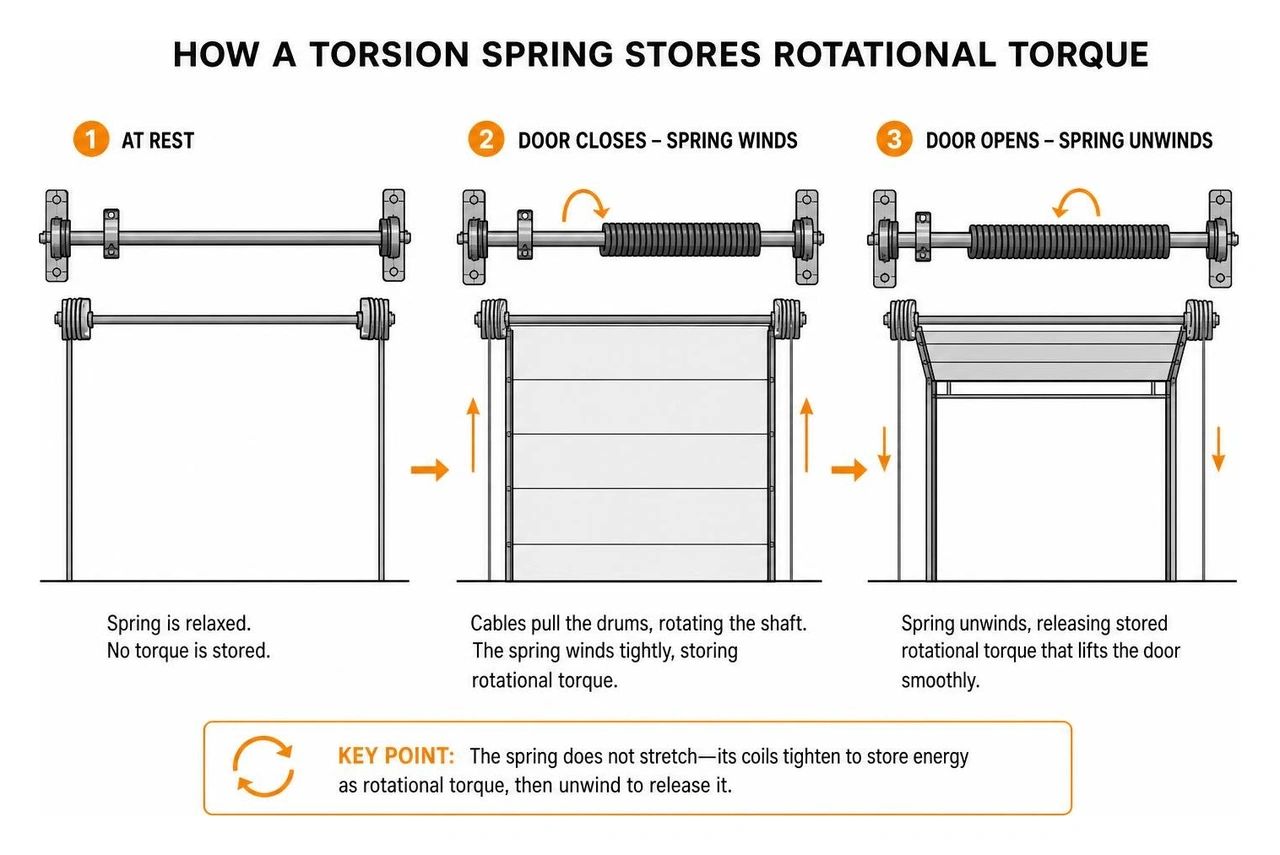
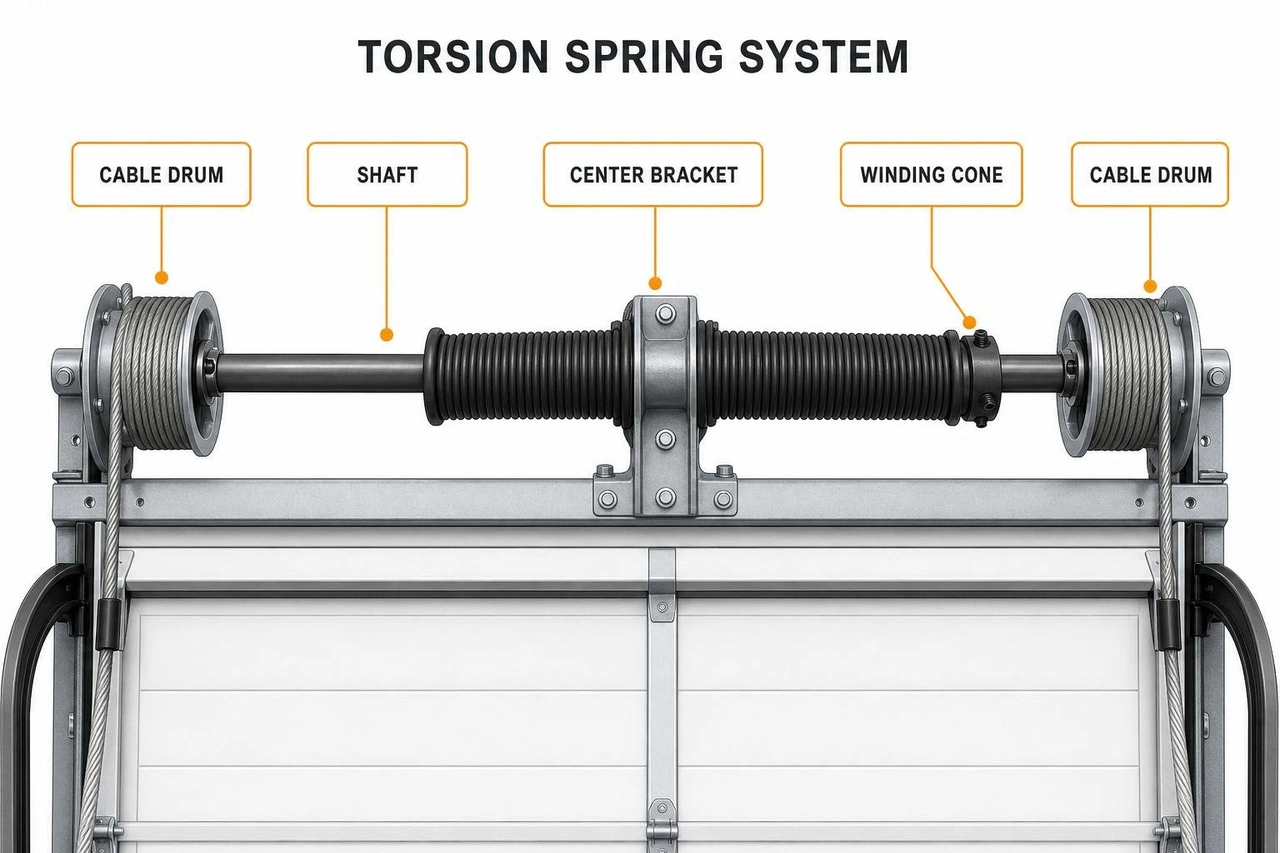
Torsion springs are mounted horizontally on a solid steel shaft directly above the garage door opening. When you close your garage door, cables attached to the bottom corners of the door pull on drums at the ends of the metal shaft. This action rotates the shaft, which winds the torsion coils tightly around it.
This winding process stores energy in the form of rotational torque. The spring doesn’t get longer; instead, it tightens its coils. When the door is activated to open, the coiled spring unwinds, releasing that stored rotational torque back into the shaft and cable drums. This pulls the cables upward and lifts the door with minimal effort.
Because the energy is released through a controlled rotation, torsion springs deliver smooth, consistent force throughout the door’s entire arc of travel. This steady application of power means less shaking, fewer sudden movements, and a much quieter operation overall. If you are experiencing grinding noises or shaky movement in your overhead system, our team at Garage Door Spring Repair Austin TX can inspect your torsion assembly to ensure it is winding and unwinding correctly.
How Extension Springs Store and Release Energy
Extension springs operate on a completely different mechanical principle: linear tension. Instead of twisting, these springs stretch out physically to store their energy.
You will find extension springs mounted horizontally on both sides of the garage door, running parallel to the horizontal tracks overhead. When the garage door closes, the cables pull on the springs, stretching them along the tracks. This stretching stores elastic potential energy within the steel coils.
When the door opens, the extension springs naturally want to contract back to their original, tightly closed length. This pulling force lifts the door. However, because extension springs exert force proportional to how far they are stretched, the counterbalancing force is often uneven. When the door is fully closed and the springs are stretched to their limit, they pull with maximum force. As the door rises and the springs contract, that lifting force decreases, which can sometimes lead to a slightly jerky or uneven movement.
Because extension springs are under massive linear tension, they require safety containment cables running through the center of each coil. Without these cables, a snapping extension spring turns into a dangerous, high-velocity projectile. For a deeper look into how these forces can impact your home’s daily safety, read our guide for Pflugerville Homeowners Understanding Your Broken Garage Door Spring.
Safety, Lifespan, and Performance Comparison
When choosing between these two spring systems, or when deciding whether to upgrade your existing setup, you have to weigh three critical factors: safety, longevity, and operational balance.
Garage door springs undergo intense wear and tear every single day. Over time, the constant cycle of stretching or twisting leads to material fatigue. Eventually, every spring will reach its breaking point. How they behave when they fail, and how long they take to get there, depends entirely on their design. For homeowners in our northern service areas, we have put together An Essential Guide to Garage Door Spring Replacement Round Rock to help navigate these performance differences.
Torsion Spring vs Extension Spring Difference in Safety and Failure Modes
The safety profiles of these two systems when they fail are night and day.
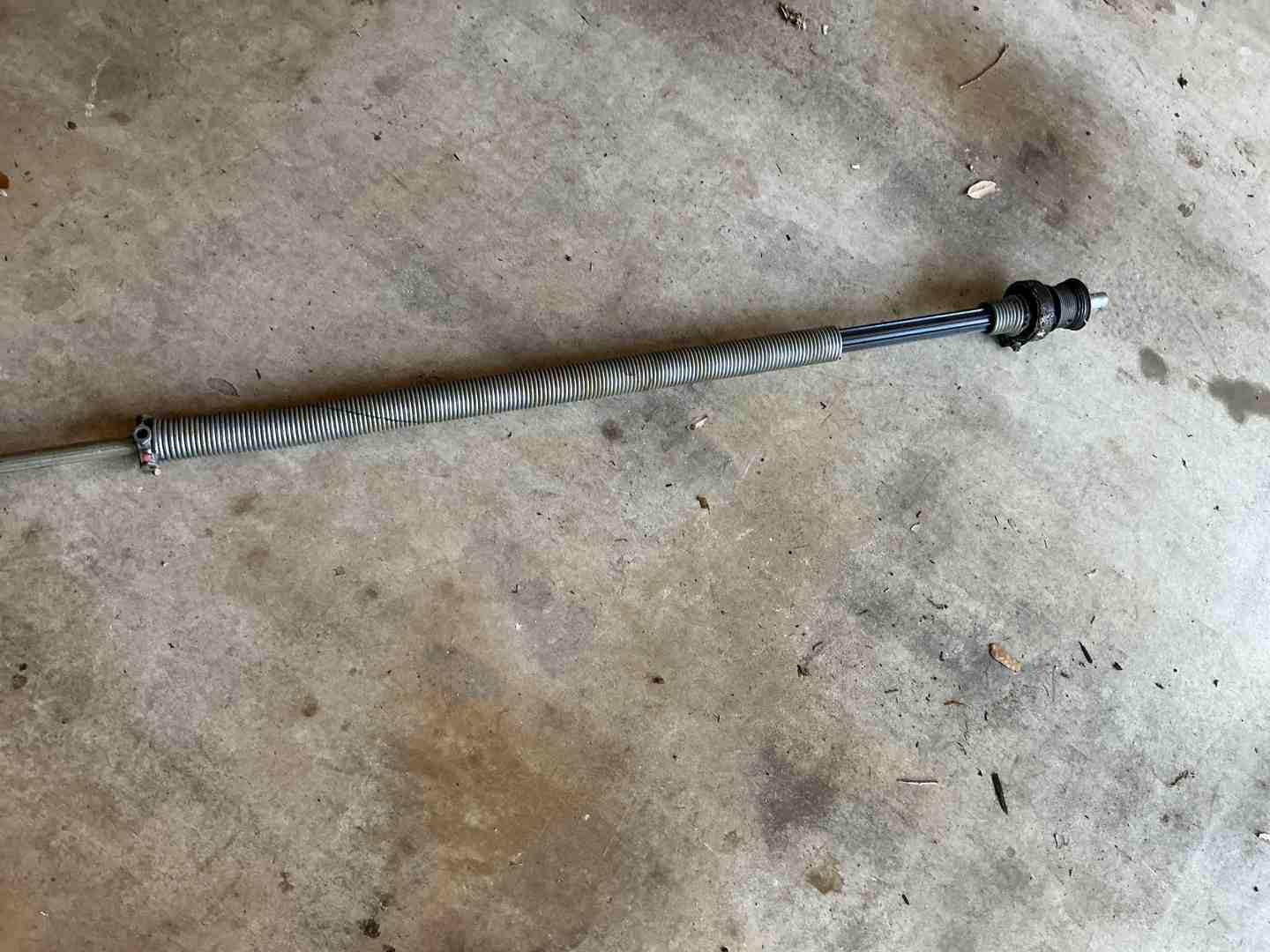
When a torsion spring breaks, it does so with a very loud, sudden bang — often described by homeowners as sounding like a gunshot or a heavy object falling in the garage. However, despite the frightening noise, the physical hazard is largely contained. Because the torsion spring is wound tightly around a solid steel horizontal shaft, the broken pieces of the spring remain safely held on the shaft. They cannot fly off, strike your vehicle, or cause bodily injury to anyone standing nearby.
Extension springs present a much higher safety risk when they fail. Because they store energy by stretching out to great lengths, a snapped extension spring releases all of that linear tension instantly. If the spring does not have a safety containment cable running through its center, the broken spring can fly off its hangers with enough velocity to shatter car windows, dent walls, or cause severe injuries.
Even if you have safety cables installed, the violent snap of an extension spring can still damage the surrounding tracks, pulleys, and horizontal side runners. If you live in the western Austin area and want to make sure your system is safely configured, our specialists at Garage Door Spring Repair Lakeway TX can evaluate your current setup and ensure all safety mechanisms are fully functional.
Torsion Spring vs Extension Spring Difference in Lifespan and Cycle Counts
The lifespan of a garage door spring is measured in “cycles.” One cycle represents the garage door opening and closing exactly once.
- Torsion Springs: Typically rated for 15,000 to 20,000 cycles.
- Extension Springs: Typically rated for 7,000 to 10,000 cycles.
To put those numbers into perspective, let’s look at how that translates into real-world years of service for a typical household using the garage door four times a day:
- A torsion spring rated for 15,000 cycles will last approximately 10 to 13 years before metal fatigue sets in.
- An extension spring rated for 10,000 cycles will last roughly 6 to 7 years under the exact same usage.
Torsion springs last significantly longer because they distribute the mechanical stress of operation evenly across the entire body of the coiled steel as it rotates. Extension springs, on the other hand, experience intense localized stress, particularly at the hooks or loops at the ends where they connect to the pulley system. These connection points are almost always where extension springs fail first.
If you are looking to maximize the years of service you get out of your garage doors, upgrading to a higher-cycle torsion system is often the most cost-effective long-term choice. Our team at Garage Door Spring Repair Bee Cave TX can help you calculate the best cycle rating for your home’s daily traffic.
Converting Extension Springs to Torsion Springs
If your garage is currently equipped with an older extension spring system, you don’t have to stick with it when it comes time for a replacement. Many homeowners choose to perform a system upgrade, converting their garage door from extension springs to a modern torsion spring system.
This conversion involves removing the old side springs, pulleys, and safety cables, and installing a brand-new torsion shaft, cable drums, high-tensile cables, and center support brackets directly above the door header.
What a Professional Conversion Involves
A professional conversion requires meticulous physical adjustments and precise calculations. First, our technicians must assess your garage’s headroom requirements. Standard torsion spring assemblies require between 2 and 10 inches of clear space above the door header to accommodate the horizontal shaft, brackets, and winding coils. If your garage has a very low ceiling, we may need to utilize specialized low-headroom track configurations or early-set torsion systems.
Once headroom is verified, the door’s exact weight must be measured. Because torsion springs must be perfectly calibrated to match the weight of your specific door, our technicians use precise engineering formulas to select the correct wire diameter, coil length, and spring size.
The installation process itself carries high safety risks. Winding a torsion spring requires specialized steel winding bars and a deep understanding of the high-tension forces involved. Attempting to wind these springs with makeshift tools like screwdrivers or pliers can lead to severe injury.
For homeowners in the master-planned communities of West Austin, our experienced technicians at Garage Door Spring Repair Spanish Oaks TX have the specialized tools and training to execute these conversions safely and efficiently.
Signs Your Garage Door Springs Need Immediate Attention
How do you know when your springs are reaching the end of their lifespan? Here are the most common warning signs that your garage door needs professional inspection:
- An Unbalanced Door: If you pull the emergency release cord and try to lift the door manually, it should stay in place when you let go at waist height. If it crashes down or feels incredibly heavy, the springs have lost their tension.
- A Loud Snapping Noise: If you are home and hear a sudden, explosive bang coming from the garage, check your springs immediately.
- Gaps in the Spring Coils: When a torsion spring breaks, the coils separate, leaving a highly visible 1- to 2-inch gap in the middle of the spring.
- Jerky Door Movement: If your door squeaks, shakes, or rises in a jerky, uneven motion, your springs are no longer counterbalancing the weight evenly.
- The Opener Struggles: If your automatic opener starts to lift the door a few inches and then reverses, it is likely detecting that the door is too heavy because a spring has broken.
If you notice any of these red flags, it is important to address them before the system fails completely. If you are in the northern suburbs, we recommend reading 5 Questions to Ask Before Hiring a Garage Door Spring Repair Service in Pflugerville TX to ensure you get qualified, safe assistance.
Frequently Asked Questions About Garage Door Springs
To help you quickly compare your options, here is a breakdown of how torsion and extension spring specifications stack up:
| Mechanical Specification | Torsion Springs | Extension Springs |
|---|---|---|
| Primary Force Type | Rotational Torque (Inch-Pounds) | Linear Tension (Pounds of Pull) |
| Mounting Location | Header wall above the door opening | Alongside the horizontal overhead tracks |
| Space Required | 2 to 10 inches of clear headroom | Clearance along the horizontal side tracks |
| Failure Behavior | Contained safely on the mounting shaft | Can fly off violently (requires safety cables) |
| Operational Noise | Quiet and highly controlled | Louder squeaks and stretching noises |
| Symmetrical Balance | Excellent (distributes weight evenly) | Fair (can pull unevenly over time) |
Can I Replace Extension Springs with Torsion Springs?
Yes, absolutely! Converting from extension to torsion springs is one of the most common and beneficial upgrades you can make to your garage door system.
The conversion process requires replacing almost all of the moving hardware on your door — including the springs, cables, drums, and brackets. Because this process alters how the door’s weight is distributed and requires working with high-tension components, it must be performed by professional garage door technicians who can accurately calculate the required spring rate and safely wind the new coils.
Do I Need to Replace Both Springs at the Same Time?
Yes, we always recommend replacing both springs simultaneously, even if only one of them has broken.
Your garage door springs were installed at the exact same time, meaning they have gone through the exact same number of opening and closing cycles. If one spring has reached its fatigue limit and snapped, the remaining spring has experienced the identical amount of wear and tear and is highly likely to fail shortly after.
Furthermore, installing a brand-new, strong spring next to an old, worn-out spring creates an imbalanced system. The new spring will have to work harder to compensate for the weaker one, leading to uneven door travel, extra strain on your automatic opener, and premature wear on your newly installed spring.
Why Did My Garage Door Spring Break?
The most common cause of spring failure is simple metal fatigue from normal, everyday use. Every time your door opens and closes, the steel coils bend and flex. Over the years, this constant movement creates microscopic fractures in the steel until the metal finally snaps.
However, environmental factors can accelerate this process. Here in Central Texas, our high humidity and intense summer heat can cause moisture to settle on the spring coils, leading to rust and corrosion. Rust acts like sandpaper on the steel, increasing friction between the coils as they move and creating weak spots that speed up failure.
To prevent this, we recommend lubricating your garage door springs every six months. Always avoid using WD-40, as it is a solvent that will actually strip away existing grease and accelerate wear. Instead, use a high-quality, silicone-based or lithium-grease spray designed specifically for garage doors.
Conclusion
At the end of the day, understanding the torsion spring vs extension spring difference helps you make the best, safest choices for your home’s overhead door system. While extension springs are still found on many older or lighter doors, torsion springs offer unmatched safety, double the lifespan, and a much smoother, quieter operation that stands up to our unique Central Texas climate.
Because garage door springs operate under extreme tension, keeping them properly maintained and calling in professionals when they break is the best way to keep your home running safely and smoothly.
If you are located in Austin, Round Rock, Pflugerville, Cedar Park, Georgetown, Lakeway, Bee Cave, Leander, Liberty Hill, Spanish Oaks, or West Lake, and need fast, transparent, and reliable support, our family-owned team at Good Golly Garage Doors is here to help. Contact us today to schedule your professional Good Golly Garage Doors Spring Repair and experience our signature “human touch” service firsthand!
Need Garage Door Help ASAP?
We answer the phone 24/7 for emergency spring, track, panel, and opener repairs, so you can reach a real person any time. Our technicians arrive in clearly marked service vehicles carrying common replacement parts, and most jobs can be completed the same day. If the door appears unstable or unsafe, keep people and pets clear and let our team handle the repair.