
How Often Should Garage Door Safety Features Be Tested in Las Vegas?
Las Vegas homeowners should test garage door safety features once each month , plus after a dust storm, a hard impact, or an opener change.
Essential Garage Door Safety Features in Nevada Homes
#
Las Vegas homeowners should test garage door safety features once each month, plus after a dust storm, a hard impact, or an opener change. Garage Door Safety Testing in Las Vegas, NV, should confirm that photo-eye sensors stop and reverse the door and that the contact auto-reverse feature responds when the door meets an obstruction. The Consumer Product Safety Commission recommends a monthly auto-reverse check. This schedule is especially important in the valley, where heat, dust, and intense sunlight can affect sensors and moving hardware. Stop using the automatic opener and arrange service if a safety test fails.
Learn About Garage Door Maintenance in Las Vegas, NV | Schedule Garage Door Service
I am Jason Henderson, founder and CEO of Good Golly Garage Doors, and I lead a experienced, family-owned team focused on reliable garage door service across Las Vegas and nearby communities. I help homeowners understand how often should garage door safety features be tested in the las vegas valley so they can spot problems early and protect the people and property in their homes.
Need help with a failed safety test? Contact Good Golly Garage Doors for service.
Every modern overhead garage door system relies on an interconnected network of mechanical components, electrical circuits, and optical sensors designed to prevent property damage and severe physical injury. Under national safety mandates, specifically the federal Underwriters Laboratories (UL) 325 standard enacted in 1993, all automated residential garage door openers manufactured and installed in Nevada must feature redundant secondary entrapment protection devices.

In the Las Vegas Valley, where attached garages frequently double as main entryways, home workshops, and storage zones, these safety mechanisms work around the clock. The primary entrapment protection system consists of both non-contact optical sensors and physical mechanical contact reverse systems. Additional integral hardware includes manual disconnect assemblies and spring containment cables that keep moving assemblies secured. Understanding how these features interact is essential for maintaining household safety year-round.
Photoelectric Eye Sensors and Auto-Reverse Mechanisms
Photoelectric eye sensors are mounted on opposing sides of the vertical garage door tracks, positioned no higher than six inches above the finished garage floor line. One unit acts as a sending sensor, casting an invisible infrared light beam across the threshold to the receiving sensor on the opposite track. As long as this optical beam remains unbroken, the opener operates smoothly to close the heavy door. If a child, pet, vehicle bumper, or stray object interrupts this path, the electrical circuit breaks instantly. This prompts the motor logic board to halt downward travel and reverse the door back into a fully open position within a fraction of a second.
Working hand-in-hand with optical detection is the internal mechanical auto-reverse system. Built directly into the motor housing, this feature relies on internal force settings and rotational monitoring. If an obstruction sits below the sensor line or if an object is struck by the downward-moving bottom seal, the motor detects sudden resistance and upward pressure. Once that threshold is crossed, the mechanical auto-reverse triggers an immediate stop and reversal, preventing the full deadweight of the door panels from crushing whatever lies underneath.
Manual Emergency Release Cords and Safety Containment Cables
Beyond automated electronics, mechanical failsafes protect users during system breakdowns and severe utility interruptions. The manual emergency release cord—easily recognized by its bright red handle dangling from the overhead trolley carriage—allows homeowners to disconnect the door panel assembly from the motorized drive track. When pulled downward and back toward the motor, it disengages the opener arm, allowing the door to be raised or lowered manually during power outages or unexpected electrical failures.
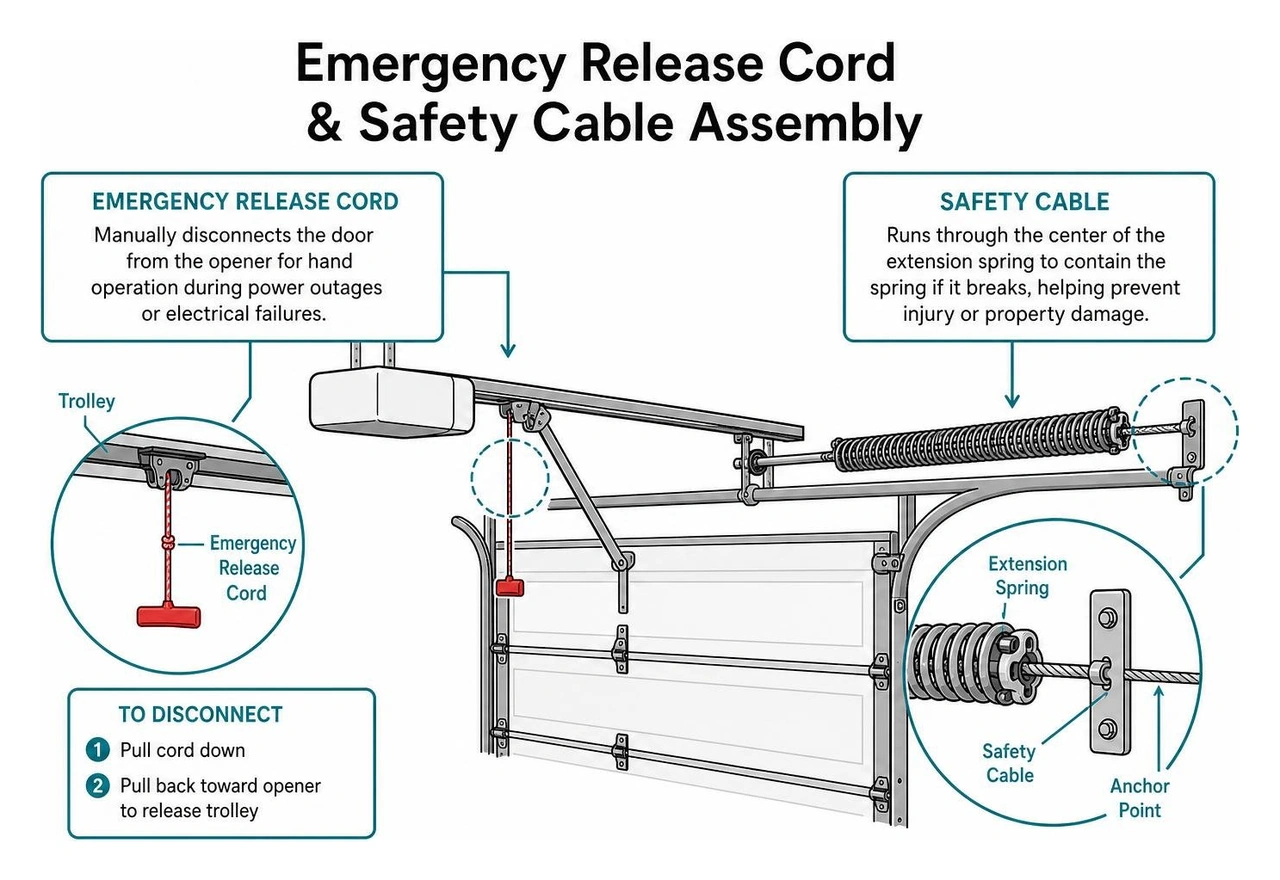
In systems equipped with extension springs running parallel above the horizontal tracks, safety containment cables serve an equally vital protective role. These heavy-gauge steel cables run straight through the center of the coiled springs and anchor firmly to the structural framework. Because garage door springs endure thousands of pounds of cyclic tension, an uncontained snapped spring can become a dangerous projectile. The safety cable secures the broken coil in place, protecting surrounding vehicles and nearby family members from sudden impact.
How Often Should Garage Door Safety Features Be Tested in the Las Vegas Valley?
A complete functional test of all automated garage door safety features should occur once every month. Because overhead garage systems are the largest, heaviest moving mechanical structures in any home, routine testing is essential to confirm that automatic safety reversals react properly under real-world conditions. Components can drift out of calibration subtly over time without exhibiting obvious visual warning signs until an obstruction is encountered.
Monthly testing ensures that optical sensors, mechanical torque limits, and manual release mechanisms remain fully operational throughout the year. Homeowners across the Las Vegas Valley should also conduct immediate safety tests following severe regional weather events, high-impact collisions with the door panels, or whenever any adjustments are made to the opener assembly. Regular evaluation aligns with comprehensive preventive maintenance practices.
CPSC Guidelines on Safety Testing
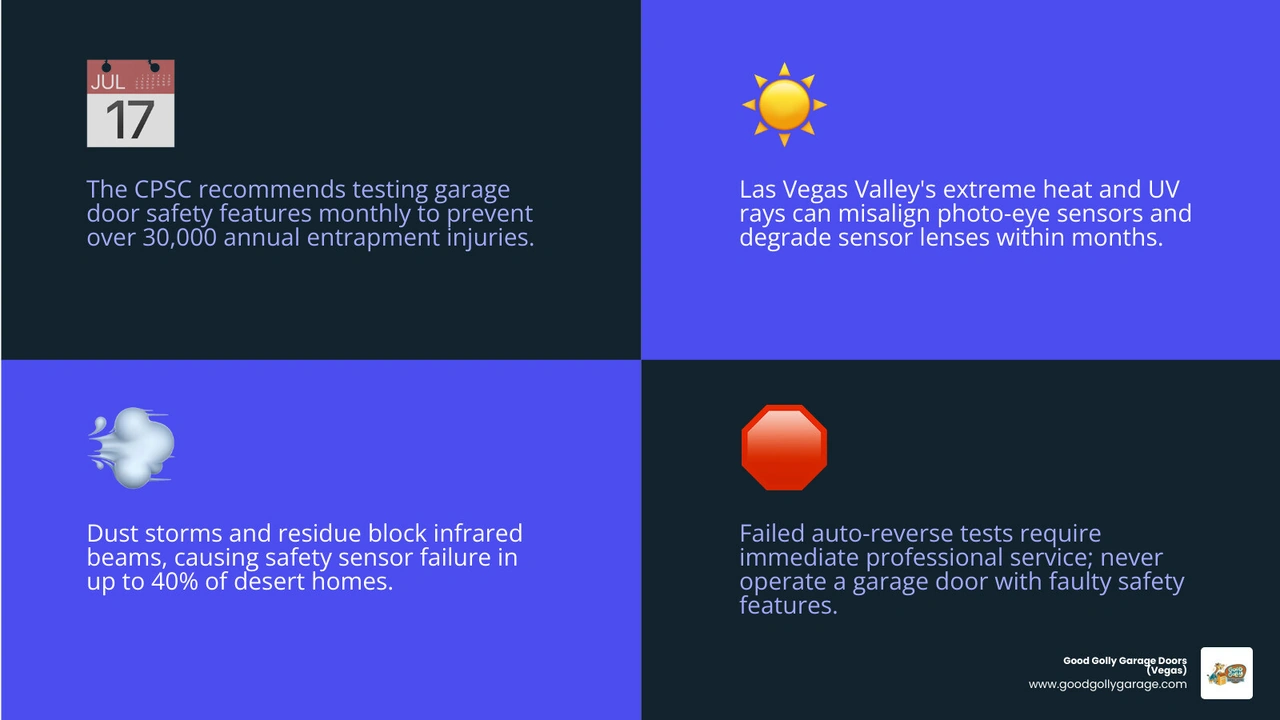
The U.S. Consumer Product Safety Commission (CPSC) urges all homeowners nationwide to adhere to a strict monthly testing schedule for both non-contact optical sensors and mechanical auto-reverse mechanisms. National statistics show that approximately 30,000 garage door-related injuries occur annually across the United States. Many of these injuries involve crushing trauma, severe lacerations, or entrapment that could have been prevented through routine monthly testing.
The CPSC established that motorized doors must reverse automatically within two seconds of making contact with an obstruction. By testing your system monthly, you confirm that your motor’s internal force sensors have not become desensitized due to gear wear or mechanical binding. Regular testing maintains compliance with established safety benchmarks, giving households dependable peace of mind throughout every season.
Desert Climate Factors: Environmental Impact in the Mojave
The extreme environment of the Mojave Desert introduces distinct physical stresses that make monthly safety evaluations especially vital throughout Las Vegas, Henderson, and North Las Vegas:
- Extreme Thermal Expansion: Summer surface temperatures inside uninsulated garages frequently exceed 130°F. This intense heat causes steel mounting brackets and metal vertical tracks to expand and shift, throwing delicate optical sensors out of alignment.
- Dust and Caliche Particle Accumulation: Desert dust storms and afternoon winds blow fine sand, grit, and caliche dust into garage openings. This debris coats photo-eye lenses and settles into track channels, weakening infrared signal reception.
- High-Intensity Sunlight Glare: The low-angle morning and late-afternoon sun in Southern Nevada can blind optical receiving sensors with intense ambient infrared light, tricking the system into sensing a blocked pathway.
- UV Degradation and Dry Rot: Relentless desert UV exposure quickly degrades rubber bottom weather seals and dries out internal wiring insulation, creating electrical resistance issues and unexpected safety stops.
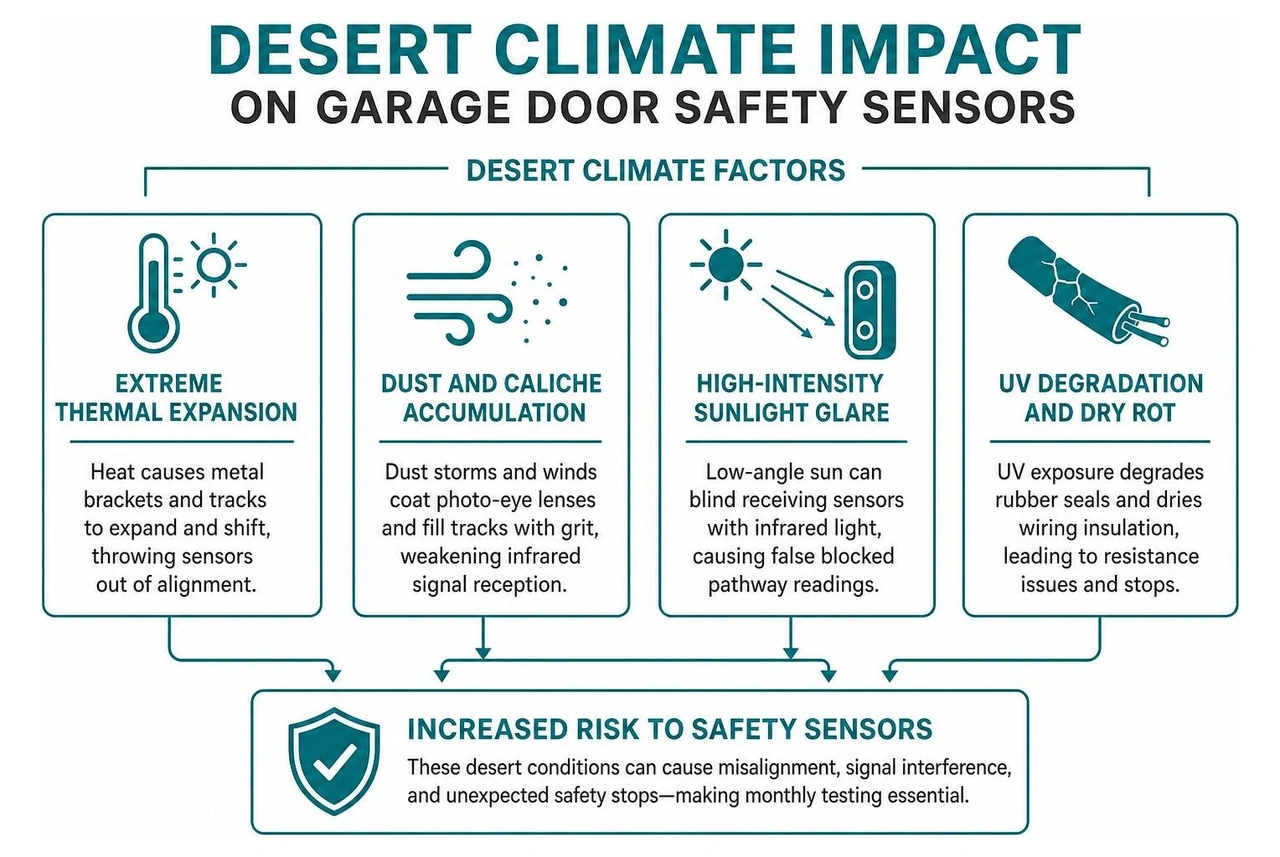
Understanding these unique desert conditions helps homeowners catch environmental wear early and maintain optimal system performance.
Step-by-Step Guide to Testing Garage Door Safety Features
Performing a monthly safety inspection requires no specialized mechanical tools and takes only a few minutes to complete. Follow this step-by-step process to verify your garage door’s automated optical and physical entrapment systems.
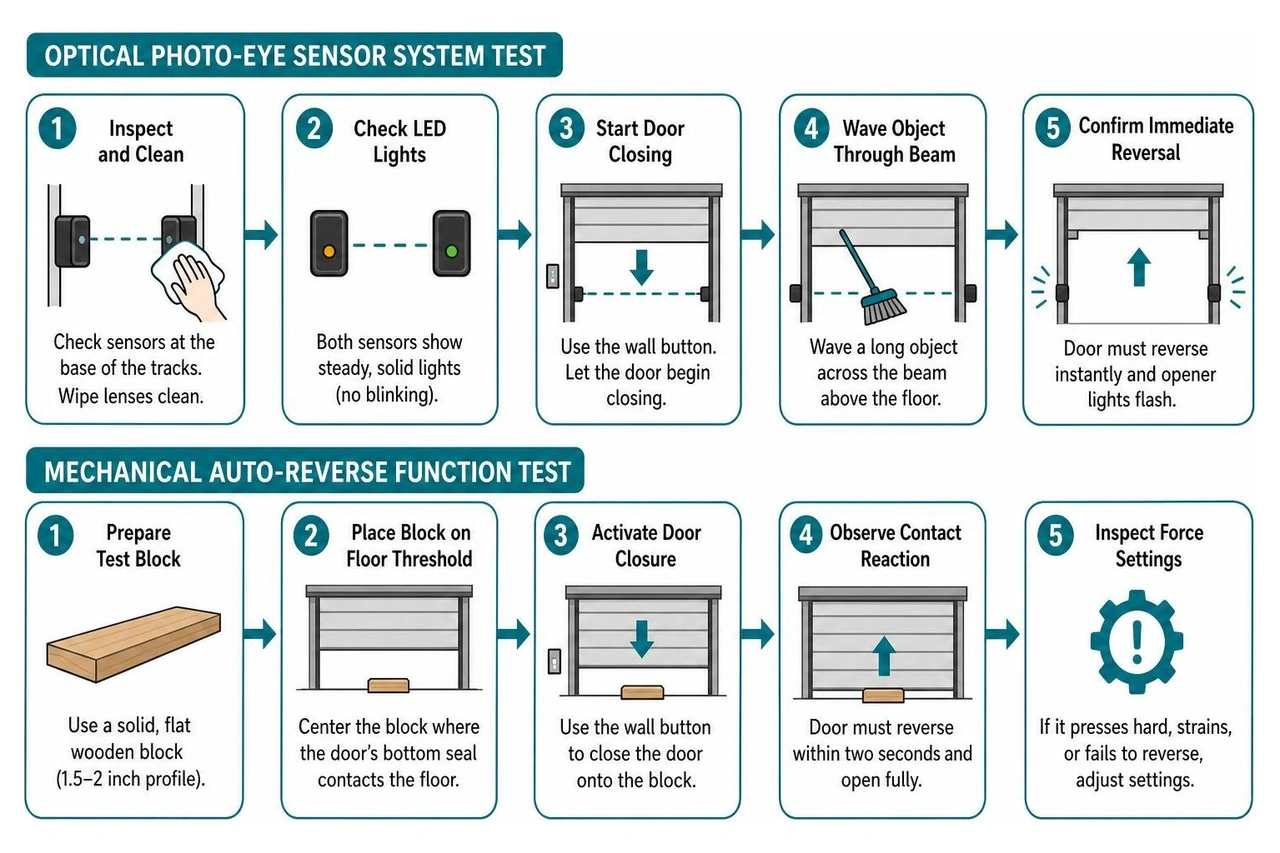
Testing the Optical Photo-Eye Sensor System
The non-contact photo-eye sensor system must halt and immediately reverse a closing garage door before the bottom panel touches an obstruction.
- Perform a Visual and Cleanliness Inspection: Examine the small sensor units mounted at the base of the left and right tracks. Wipe the optical glass lenses clean using a soft, dry microfiber cloth to remove dust, cobwebs, and grit.
- Verify the Solid LED Indicator Lights: Look closely at the small indicator lights on each sensor unit. The sending sensor should show a steady, solid light (often amber or green), and the receiving sensor should display a steady light without blinking or flickering.
- Initiate the Downward Door Cycle: Stand safely clear of the door’s travel path inside the garage, press the wall-mounted push button, and let the door begin closing toward the floor.
- Conduct the Object Interruption Wave Test: While the door descends, carefully wave a long-handled household broom or similar long object across the infrared beam between the two sensors, several inches above the floor.
- Confirm Immediate Reversal and Motor Flashing: The descending door must instantly stop its downward motion and reverse smoothly back to the fully open position. Most modern openers will also flash their overhead courtesy light bulbs to signal an optical beam interruption.
If your sensors show intermittent flickering lights or fail to trigger an automatic reverse, inspect the beam path for obstructions or schedule a professional service evaluation.
Testing the Mechanical Auto-Reverse Function
The physical auto-reverse system ensures that if an obstruction is missed by the optical beams, the door’s motorized closing force will stop downward travel upon contact.
- Prepare the Test Obstruction: Obtain a solid, flat wooden block (such as a 2×4 board laid flat, providing a 1.5-inch to 2-inch profile) or a solid, sturdy block.
- Position the Block on the Floor Threshold: Lay the block flat directly in the center of the garage door opening on the concrete floor, right where the bottom rubber seal makes contact.
- Activate the Door Closure: Step back into a safe operating position and activate the wall console button to close the garage door down onto the wood block.
- Observe the Contact Reaction: When the bottom edge strikes the wooden block, the door must automatically reverse direction within two seconds and travel back up to its open position without straining or hesitating.
- Inspect the Physical Force Settings: If the door presses down hard against the block, begins groaning, slips its drive belt or chain, or fails to reverse, the opener’s mechanical sensitivity settings require immediate professional adjustment.
Common Safety Feature Failures in the Mojave Desert Climate
The persistent desert heat, shifting winds, and intense sunshine across the valley create recurring safety component issues that every homeowner should recognize:
- Sunlight Interference and Sensor Blindness: When bright morning or evening sunlight shines directly into the lens of the receiving photo-eye, it can overpower the sending unit’s infrared signal. This optical blindness often causes the door to refuse to close, repeatedly reversing back up while flashing the overhead opener lights.
- Dust and Sand Buildup on Lenses: Fine Mojave caliche dust settles quickly over optical glass. This layer scatters the focused infrared beam, leading to false trips and intermittent operational failures.
- Vibration-Induced Bracket Shifting: Continuous thermal expansion combined with the daily vibration of opening and closing loosens mounting screws along the vertical tracks. This allows brackets to tilt out of level, breaking sensor alignment.
- Worn or Frayed Manual Release Cords: Desert heat dries out synthetic pull cords over time, causing them to fray and snap when pulled during a power outage.
- Bottom Seal Hardening: Intense ground heat bakes the rubber bottom astragal seal, turning it brittle. A stiff, hardened seal cannot cushion floor impacts, which can throw off down-force safety calibration.
Routine inspection of these critical components ensures that common climate-related issues are identified and resolved promptly.
Homeowner, Landlord, and Professional Safety Responsibilities
Ensuring consistent garage door safety requires clear coordination among homeowners, rental property managers, and experienced service technicians.
Under Nevada premises liability and residential rental habitability standards, landlords and property managers must provide and maintain safe living conditions. This includes ensuring all automated overhead garage doors have fully compliant, working entrapment protection systems installed. Landlords should schedule safety assessments between tenant occupancies and arrange prompt repairs whenever an operational fault is reported.
Homeowners and tenants are responsible for day-to-day visual monitoring, keeping safety eye paths clear of stored household items, and testing safety reversals monthly. Whenever tests show sluggish performance, misaligned sensors, or unresponsive mechanical reversal, turn off the opener and schedule a service visit. A professional inspection should be conducted annually by our local team through our dedicated Garage Door Maintenance Las Vegas NV program. Professional inspections ensure all mechanical and optical components meet strict safety standards across every neighborhood in the valley.
Frequently Asked Questions About Garage Door Safety Testing
What happens if a garage door fails an auto-reverse safety test?
If your garage door fails either the optical photo-eye wave test or the physical wooden block auto-reverse test, stop using the automatic opener right away. Continued use creates an entrapment hazard for young children, family pets, and vehicles. Disconnect the opener by pulling the red emergency release cord to operate the door by hand if necessary, and schedule an inspection with a qualified technician to recalibrate the internal motor limits, inspect electrical wiring, and align optical brackets safely.
Can high Las Vegas summer temperatures misalign safety sensors?
Yes. Extreme summer temperatures in the Las Vegas Valley regularly cause metal garage door framing, vertical tracks, and mounting hardware to expand. This thermal movement can shift the photo-eye brackets just enough to break the fine infrared line of sight between the two units. In addition, intense ambient heat can increase electrical resistance within aging sensor wiring, causing intermittent signal dropouts and unexpected door reversals during the hottest parts of the day.
Who is legally responsible for garage door safety in rental properties?
In Nevada residential rental properties, property owners and designated property management companies hold primary legal responsibility for providing doors that meet UL 325 entrapment safety standards. Landlords must ensure safety reversal devices work properly before a tenant moves in and must hire qualified service professionals to resolve reported safety malfunctions promptly. Tenants are responsible for keeping the sensor path clean, using the equipment properly, and reporting any safety test failures or damage right away.
Conclusion
Keeping your overhead door system in top condition protects your family, vehicles, and home. Testing your safety features every month using the optical wave test and the wooden block physical contact test allows you to identify hardware wear, dust buildup, and alignment shifts before they develop into dangerous safety hazards.
At Good Golly Garage Doors, our family-owned team takes pride in providing fast, dependable garage door service across Las Vegas, Summerlin, Henderson, North Las Vegas, Sun City, and Boulder City. Whether you are dealing with misaligned photo-eye sensors, an opener that fails its auto-reverse check, or need an annual safety tune-up, our experienced technicians are here to help.
Keep your home safe and fully protected. Schedule professional garage door maintenance in Las Vegas today with our friendly team, or contact Good Golly Garage Doors online to set up your comprehensive multi-point safety inspection!

Need Garage Door Help ASAP?
We answer the phone 24/7 for emergency spring, track, panel, and opener repairs, so you can reach a real person any time. Our technicians arrive in clearly marked service vehicles carrying common replacement parts, and most jobs can be completed the same day. If the door appears unstable or unsafe, keep people and pets clear and let our team handle the repair.