

All About How Extreme Las Vegas Heat Affects Garage Door Performance
Extreme desert temperatures put massive mechanical strain on your home.
Understanding How Extreme Las Vegas Heat Affects Garage Door Performance
Extreme desert temperatures put massive mechanical strain on your home. Understanding How Extreme Las Vegas Heat Affects Garage Door Performance comes down to thermal expansion, metal fatigue, and dry heat degradation. When outdoor summer temperatures pass 110°F, garage interiors frequently climb past 130°F. This intense heat causes steel tracks to expand out of alignment, weakens spring steel tensile strength, triggers opener thermal overload switches, and rapidly dries out rubber weatherstripping. For homeowners needing dependable garage door service in Las Vegas, NV, recognizing these heat-related warning signs early prevents unexpected system breakdowns during the hottest months.
If high temperatures are causing your system to stick or struggle, explore our complete guide to garage door maintenance in Las Vegas, NV or reach out today to schedule service in Las Vegas, NV.
I’m Jason Henderson, founder and CEO of Good Golly Garage Doors, with years of leadership experience resolving How Extreme Las Vegas Heat Affects Garage Door Performance across our desert communities. Our experienced, family-owned team specializes in heat-hardened components to ensure your overhead doors stay secure, balanced, and fully operational through every summer heatwave.
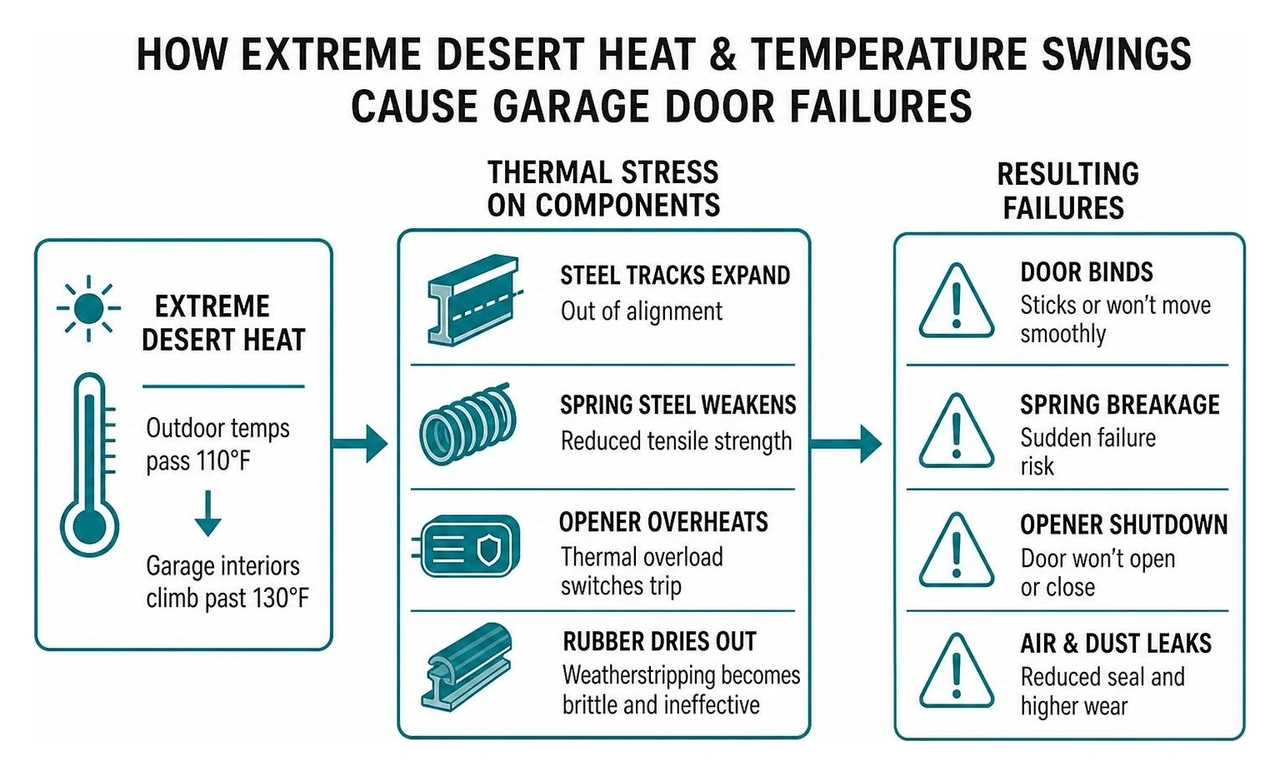
Mechanical Breakdown: How Extreme Las Vegas Heat Affects Garage Door Performance
When living in the Mojave Desert, our homes endure environmental extremes that standard mechanical systems simply were not built to handle without specialized care. A garage door is the largest moving mechanical system in any residence, consisting of hundreds of interconnected steel, aluminum, and electrical parts. Under normal conditions, these components balance precision counterweights with smooth track navigation.
When outdoor ambient air routinely surges past 110°F from June through August 2026, thermodynamic laws take over. Steel conducts and retains heat, structural frames swell, and precision clearances vanish. Understanding the physics behind this degradation helps explain why garage doors tend to malfunction on the hottest afternoons of the year.
Understanding How Extreme Las Vegas Heat Affects Garage Door Performance on Springs and Tracks
The core lifting power of your overhead system relies on heavy-gauge torsion springs mounted above the door opening. Under standard room-temperature conditions (around 70°F), high-carbon spring steel maintains a rated tensile strength between 250,000 and 300,000 psi. However, when an enclosed garage ceiling climbs to 130°F or higher, the tensile strength of the spring steel drops by approximately 6%.
This reduction in tensile resilience means the metal must work noticeably harder under continuous tension to lift the door panels. Standard torsion springs rated for 10,000 cycles—which normally last 9 to 10 years in milder climates—frequently fail in our desert climate after only 7,000 to 8,500 cycles, cutting their operational lifespan down to 5 or 6 years.
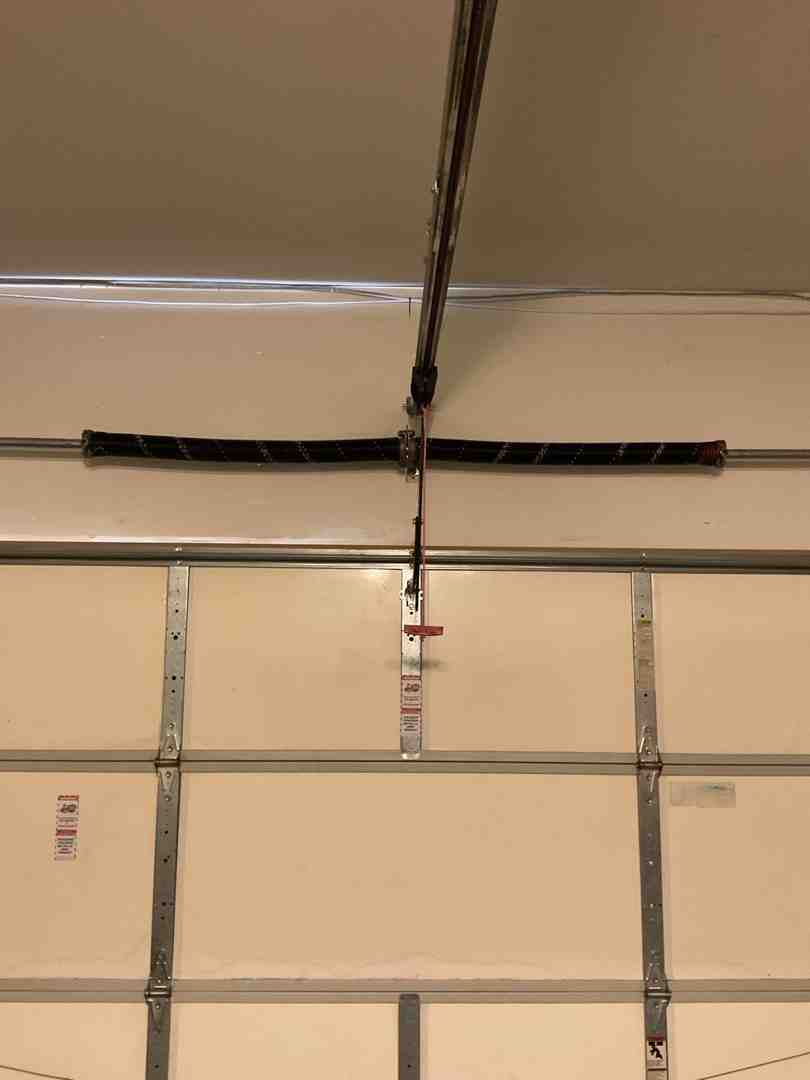
Thermal cycling is another destructive factor. In Las Vegas, day-to-night temperature swings (diurnal shifts) regularly fluctuate between 30°F and 50°F within a single 24-hour window. As the metal rapidly expands under intense midday heat and contracts during cooler desert nights, microscopic fissures begin forming along the crystalline structure of the spring wire. Over time, standard torsion springs in high desert conditions experience 20% to 30% faster metal fatigue compared to moderate coastal climates.
At the same time, the vertical and horizontal steel tracks experience significant thermal expansion. Steel tracks expand lengthwise and outward when superheated. If the tracks were installed with minimal clearance, this expansion causes track binding, warping, and bowing.
When panels expand faster than the surrounding framing, they can produce a loud, startling popping noise—commonly known in the industry as “oil-canning”—as the metal buckles inward and outward against the track jams. Enlisting preventive garage door maintenance in Las Vegas, NV ensures track spacing is calibrated specifically to accommodate high thermal expansion tolerances.
How Extreme Las Vegas Heat Affects Garage Door Performance in Openers and Electronics
The mechanical hardware is only half the battle; motor assemblies and logic boards are equally vulnerable to extreme desert conditions. Residential garage door openers are generally designed for ambient room operating temperatures between 40°F and 100°F. When ceiling temperatures hover above 130°F, openers operate well beyond their manufacturer-tested thermal thresholds.
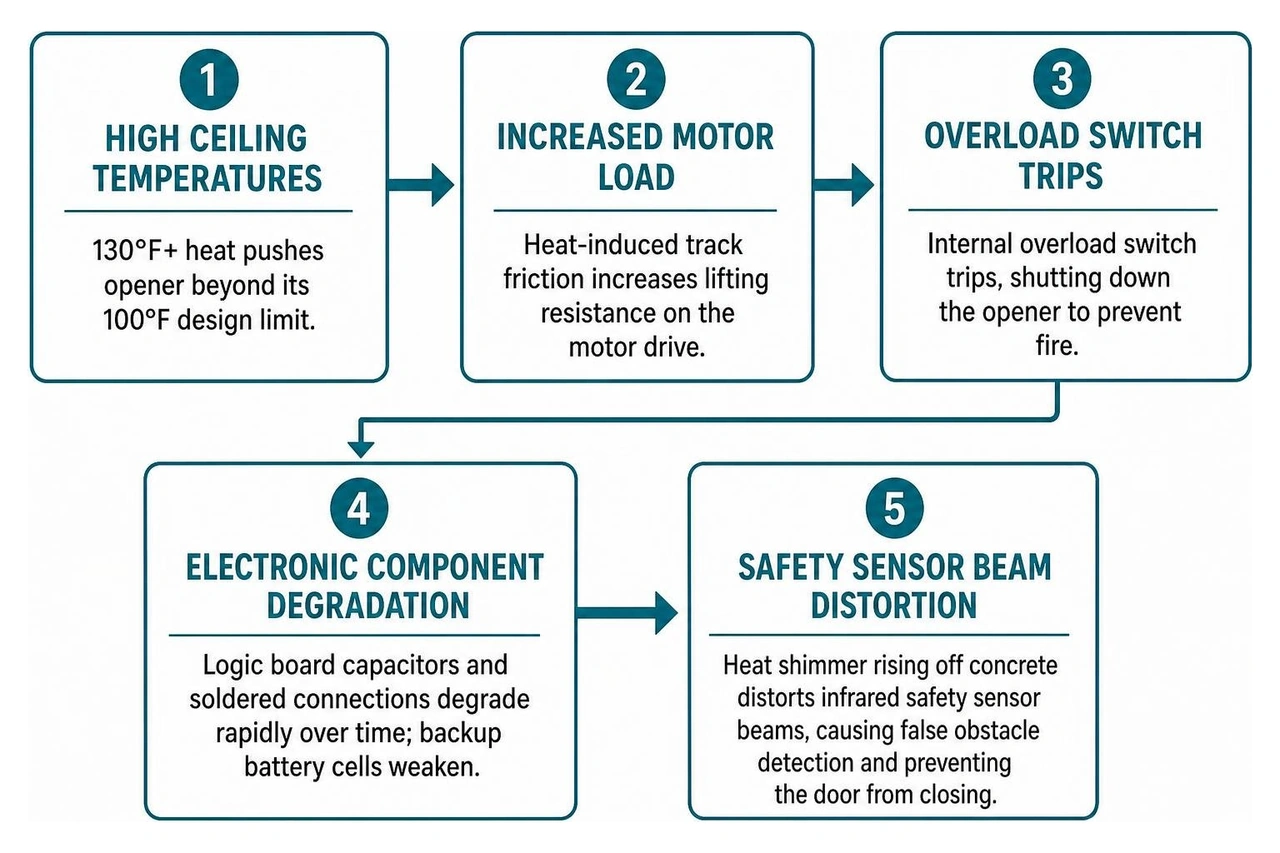
When an opener attempts to raise a door fighting thermal track friction, the electric motor draws increased amperage. This surge in electrical resistance quickly trips the internal thermal overload safety switch, causing the motor to hum softly, shut down mid-cycle, or refuse to respond until internal components cool down hours later. Over repeated summer seasons, sustained heat degrades delicate circuit board capacitors, softens solder points, and weakens internal backup battery cells.
Furthermore, infrared safety eyes near the garage floor are susceptible to optical interference caused by extreme heat. Blistering asphalt and concrete driveways release rising convective heat currents (“heat shimmer”). These intense thermal mirages refract and scatter the optical infrared light beam. When the receiving safety sensor fails to read a clean, unbroken beam due to thermal refraction, the opener assumes an obstacle is present, preventing the door from closing and flashing the overhead work lights. Upgrading your system through professional garage door opener installation in Las Vegas, NV equips your home with commercial-grade, thermally protected logic boards and high-lumen optical sensors.
Desert Environmental Hazards: Low Humidity, UV Exposure, and Abrasive Dust
Las Vegas garage doors face more than just elevated temperatures; they contend with a harsh combination of environmental stressors including single-digit relative humidity, intense ultraviolet (UV) radiation, and abrasive windstorms.
Polymer Breakdown and Weatherstrip Deterioration
While thermal expansion strains structural steel, solar radiation and low atmospheric moisture target non-metallic components. Las Vegas frequently experiences relative humidity levels below 15%. This arid environment rapidly extracts essential plasticizers and moisture from standard vinyl weatherstripping, perimeter trim seals, and bottom astragal gaskets.
Standard vinyl seals that typically last 8 to 10 years in mild regions become brittle, shrink, crack, and turn powdery within 3 to 5 years under the desert sun. Once this perimeter seal fails, superheated outdoor air and fine dust freely enter your garage, raising interior temperatures even further.
Ultraviolet rays also degrade exterior panel finishes. Dark-colored vinyl doors absorb 40% to 50% more thermal energy than lighter shades, driving surface temperatures up to an astonishing 165°F. At these extreme levels, uninsulated vinyl panels soften, bow out of their retainers, and permanently warp.
Wood doors dry out, check, splinter, and split as natural moisture evaporates. Routine garage door inspection in Las Vegas, NV identifies brittle seals, surface degradation, and structural warping before drafts and dust compromise your garage space.
Dust Infiltration and Lubricant Evaporation
The Las Vegas Valley is prone to severe dust storms and sudden gusty wind events throughout the year. High winds carry mineral-rich desert silt and caliche dust, driving particles directly into unprotected garage door hardware.
When homeowners apply standard thick grease or WD-40 to noisy hardware, it creates severe mechanical problems:
- Standard petroleum grease becomes tacky, trapping windblown dust, silica, and grit.
- Trapped grit mixes with oil to form an abrasive “grinding paste” that acts like liquid sandpaper inside roller bearings and hinge pivots.
- WD-40 acts as a solvent rather than a long-term lubricant, dissolving factory protective oils and evaporating rapidly in low humidity.
- Steel roller bearings seize up entirely, dragging along the track rather than rolling smoothly, resulting in flat spots and metal-on-metal gouging.
During high-wind seasons, the combination of elevated wind loads and abrasive track friction leads to a 300% to 400% surge in emergency mechanical failures. Eliminating this grit buildup and restoring operational smoothness requires precision garage door repair in Las Vegas, NV utilizing high-grade, non-tacky synthetic lubricants designed specifically for arid climates.
Desert-Rated Upgrades for High-Heat Resilience
Living in the desert requires hardware engineered to withstand severe thermal expansion, low humidity, and high winds. Investing in desert-rated components helps prevent midsummer breakdowns, improves energy efficiency, and keeps your system running reliably year-round.
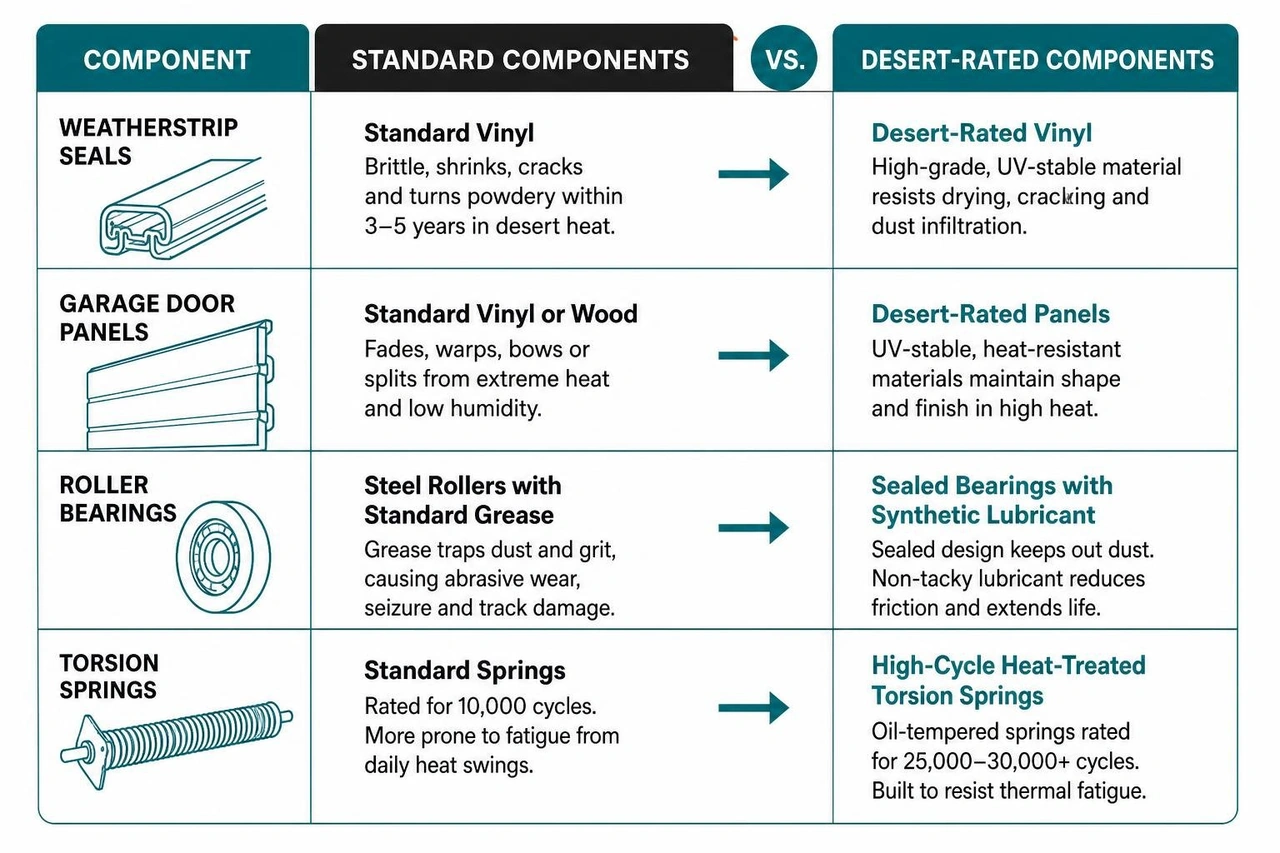
Essential Heat and Dust Hardening Solutions
Upgrading specific components provides lasting protection against extreme desert conditions:
- High-Cycle Heat-Treated Torsion Springs: Standard builder-grade springs are rated for 10,000 cycles, but upgrading to heavy-duty, oil-tempered springs rated for 25,000 to 30,000+ cycles provides the structural strength needed to withstand thermal fatigue and daily diurnal temperature swings.
- Sealed Precision Nylon Rollers: Unlike standard unshielded steel ball-bearing rollers, commercial nylon rollers equipped with sealed, rubber-gasket ball bearings keep out abrasive dust and silt while operating quietly. These components can last up to 150,000 cycles.
- Polyurethane Foam-Injected Sandwich Panels: Installing steel doors with dense polyurethane core insulation (delivering R-values from R-12 to R-18) creates an effective thermal barrier. Quality polyurethane insulation can lower interior garage temperatures by up to 30°F compared to uninsulated single-layer steel doors.
- EPDM Synthetic Rubber Bottom Astragals: Replacing standard vinyl seals with high-grade EPDM (Ethylene Propylene Diene Monomer) rubber provides long-term flexibility. EPDM withstands surface temperatures up to 250°F without cracking, melting, or losing elasticity.
- Solar-Reflective Exterior Coatings: Selecting light-colored finishes (such as bright white, almond, desert sand, or specialized heat-reflective coatings) reflects up to 70% of direct solar radiation, keeping panels substantially cooler than dark finishes.
| Component | Standard Builder Grade | Desert-Rated Upgrade | Desert Lifespan Difference |
|---|---|---|---|
| Torsion Springs | 10,000 Cycle / Uncoated Wire | 30,000+ Cycle / Heat-Treated High-Tensile | 5 Years vs. 12–15+ Years |
| Track Rollers | Open Steel Ball-Bearings | Sealed Bearing Nylon Rollers | 3–4 Years vs. 10–15 Years |
| Bottom Seal | Standard Vinyl Astragal | Heavy-Duty EPDM Rubber | 2–3 Years vs. 7–10 Years |
| Panel Core | Uninsulated Single-Skin Steel | Triple-Layer Foamed Polyurethane (R-16+) | Prevents Sagging; Drops Heat up to 30°F |
| Opener Drive | AC Motor / Standard Logic Board | DC Belt Drive / Thermally Protected Board | High Overheat Risk vs. Continuous Duty |
Keeping these components in peak working order starts with dedicated garage door maintenance in Las Vegas, NV tailored specifically for our Mojave climate.
When to Repair vs. Replace Heat-Damaged Systems
It can be difficult to decide whether to repair an aging door or replace the entire system. While simple issues like dry rollers or broken springs can be fixed with quality replacement parts, severe thermal damage often calls for a full system replacement.
Consider full replacement when your overhead door displays:
- Severe Panel Bowing or Sagging: If horizontal steel or vinyl door sections have bowed significantly under heat, they will bind against track vertical jambs, putting dangerous strain on your opener.
- Delamination and Insulation Breakdown: When aged single-pane doors allow interior garage temperatures to exceed 140°F, heat transfers directly into adjacent living spaces, increasing your home’s cooling costs.
- Repeated Track and Frame Misalignment: When structural framing around the opening shifts or horizontal tracks warp beyond safe tolerances, full track and panel replacement is the most reliable long-term solution.
When chronic mechanical issues arise from severe heat exposure, scheduling a garage door replacement in Las Vegas, NV or choosing complete garage door installation in Las Vegas, NV ensures your home is equipped with a modern, energy-efficient system designed for extreme desert weather.
Professional Maintenance Schedules for Las Vegas Homeowners
Due to high UV levels, blowing dust, and large temperature swings, garage doors in Las Vegas require a more frequent service schedule than systems in mild climates. Relying on an annual inspection often leaves vulnerable parts exposed to excessive wear during hot summer heatwaves.
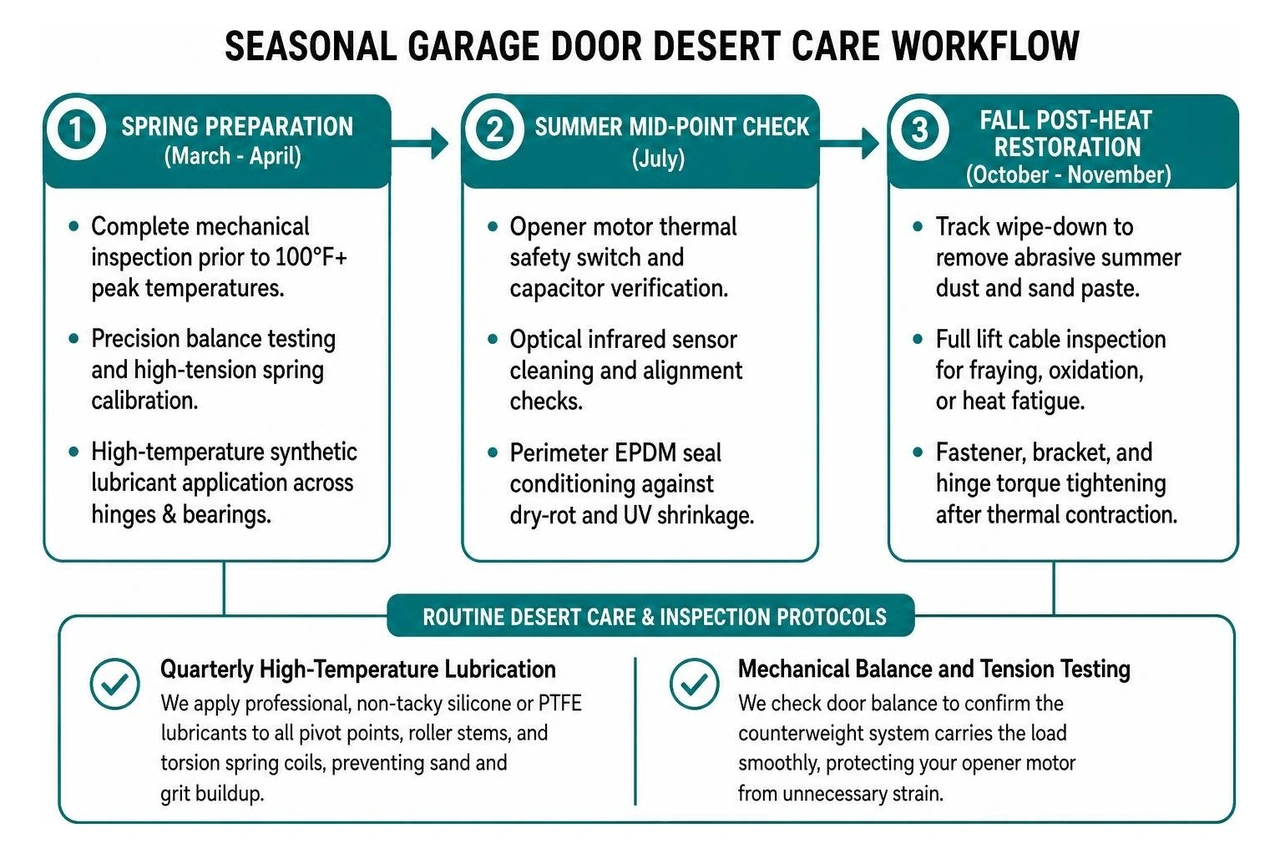
Routine Desert Care and Inspection Protocols
To keep your overhead system operating safely and efficiently, our technicians perform comprehensive seasonal evaluations:
- Quarterly High-Temperature Lubrication: We apply professional, non-tacky silicone or PTFE lubricants to all pivot points, roller stems, and torsion spring coils, preventing sand and grit buildup.
- Mechanical Balance and Tension Testing: We check door balance to confirm the counterweight system carries the load smoothly, protecting your opener motor from unnecessary strain.
- Precision Track Realignment: We verify track plumb and spacing to ensure proper expansion gaps during triple-digit summer weather.
- Safety Reversal and Optical Sensor Diagnostics: We clean, test, and calibrate your opener’s auto-reverse features and infrared sensors to maintain reliable safety operation.
- Cable and Fastener Inspection: We check high-tension aircraft cables for fraying, rust, or loose connections caused by seasonal thermal expansion and contraction.
If your door becomes jammed or suffers a sudden mechanical failure in the middle of a heatwave, our technicians provide fast emergency garage door repair in Las Vegas, NV to restore security and functionality to your home. Enrolling in specialized garage door maintenance services in Las Vegas, NV ensures seasonal maintenance tasks are completed safely and professionally by trained technicians.
Frequently Asked Questions About Desert Heat and Garage Doors
Why does my garage door opener struggle or shut down on hot summer afternoons?
Your garage door opener struggles on hot afternoons due to a combination of high ambient ceiling heat and increased mechanical friction. When interior garage temperatures rise above 130°F, the opener motor operates past its rated thermal range (typically 40°F to 100°F).
At the same time, expanding metal tracks create extra friction for the motor to overcome. This added strain causes the motor to draw higher electrical current, tripping its internal thermal overload switch. The opener shuts down to protect its internal motor and circuitry, remaining unresponsive until the system cools down. If your unit regularly overheats, prompt garage door opener repair in Las Vegas, NV can diagnose motor fatigue, replace worn logic boards, or adjust system sensitivity.
How often should garage door components be lubricated in Las Vegas?
In the desert, garage door components should be professionally lubricated every 3 to 4 months. Standard annual schedules are insufficient for Las Vegas because dry air and high temperatures cause lubricants to evaporate quickly, while windblown sand and dust settle into moving parts.
Always use high-grade, non-tacky silicone or Teflon-based spray lubricants. Avoid petroleum grease and WD-40, which attract dust and create an abrasive paste that damages bearings, rollers, and hinges.
How do daily temperature swings cause torsion springs to snap?
Torsion springs endure constant physical tension to balance the weight of your garage door. In Las Vegas, daily temperatures can fluctuate by 30°F to 50°F between cool nights and superheated afternoons.
This continuous thermal cycling causes the high-carbon steel spring wire to expand and contract repeatedly. Over time, this movement creates microscopic stress fractures along the steel coil, accelerating metal fatigue. Combined with the natural 6% drop in tensile strength at peak garage temperatures, these micro-fractures weaken the steel until the spring suddenly snaps during a standard open or close cycle.
Conclusion
The extreme heat, intense UV rays, and blowing dust of the Mojave Desert create demanding operating conditions for any residential garage door. From micro-fractures in heat-stressed torsion springs to thermal overload shutdowns in opener motors, extreme temperatures can take a heavy toll on your entire overhead system.
Protecting your investment, lowering interior garage temperatures, and preventing midsummer breakdowns comes down to regular care: using heat-rated synthetic lubricants, scheduling quarterly balance checks, and upgrading to durable desert-rated components like high-cycle springs, sealed nylon rollers, and insulated sandwich panels.
Good Golly Garage Doors is a licensed, family-owned garage door company serving Las Vegas, NV (including Summerlin, Henderson, North Las Vegas, Sun City, and Boulder City), offering repair, installation, replacement, opener upgrades, maintenance, and 24/7 emergency service. Our experienced local technicians understand the unique challenges desert heat poses to your garage door. We take pride in delivering fast response times, dependable workmanship, and honest recommendations to keep your garage door running safely and smoothly through every season.
Don’t wait for summer temperatures to leave your car trapped in a hot garage. Contact Good Golly Garage Doors today to learn more about our complete lineup of desert-hardened garage door services, or click below to schedule service in Las Vegas, NV with our trusted local team!

Need Garage Door Help ASAP?
We answer the phone 24/7 for emergency spring, track, panel, and opener repairs, so you can reach a real person any time. Our technicians arrive in clearly marked service vehicles carrying common replacement parts, and most jobs can be completed the same day. If the door appears unstable or unsafe, keep people and pets clear and let our team handle the repair.