

Garage Door Track Repair in Lake Arrowhead, CA
Is your garage door jammed in Lake Arrowhead? Contact us for immediate track repair services, ensuring your home’s safety with expert, same-day solutions. Don't wait, call now!
Is Your Garage Door Jammed or Off the Rails?
You hit the remote button hoping to pull into your garage, but instead, the door grinds to a halt, hangs unevenly, or completely dislodges from the vertical rails. A garage door that has come off its tracks creates a safety hazard, potentially locking your vehicle inside or leaving your home exposed to the elements in Lake Arrowhead. Contact us to schedule an inspection or call to discuss available financing options for repairs.
When the heavy steel rollers slip out of the guide tracks, the immense tension in the torsion spring system becomes unstable, making DIY attempts dangerous. Restoring the door to safe operation requires precise alignment and heavy-duty hardware adjustments. Expert technicians utilize commercial-grade components to prevent future misalignment.
Diagnosing the Root Cause of Track Misalignment
A garage door coming off its track is rarely a random event; it is usually a symptom of a mechanical failure within the lift system or the result of physical impact. When the tracks loosen from the wall jambs, the distance between the rails widens, allowing the rollers to slip out.
Good Golly Garage Doors approaches every track repair by first identifying why the failure occurred. Simply popping the rollers back in without correcting the underlying geometry will result in the door falling again, likely causing more damage to the panels or the opener. Common culprits include a vehicle bumping the vertical track, a cable that has jumped the drum, or a track that is no longer plumb.
The repair process must address the specific type of track system installed in your home. Whether you have a standard radius track, a vertical lift track for high ceilings, or a low-headroom track for tight spaces, the alignment tolerances are measured in fractions of an inch. A misalignment of even a quarter-inch can cause increased friction, causing the opener to reverse automatically or the motor to burn out prematurely.
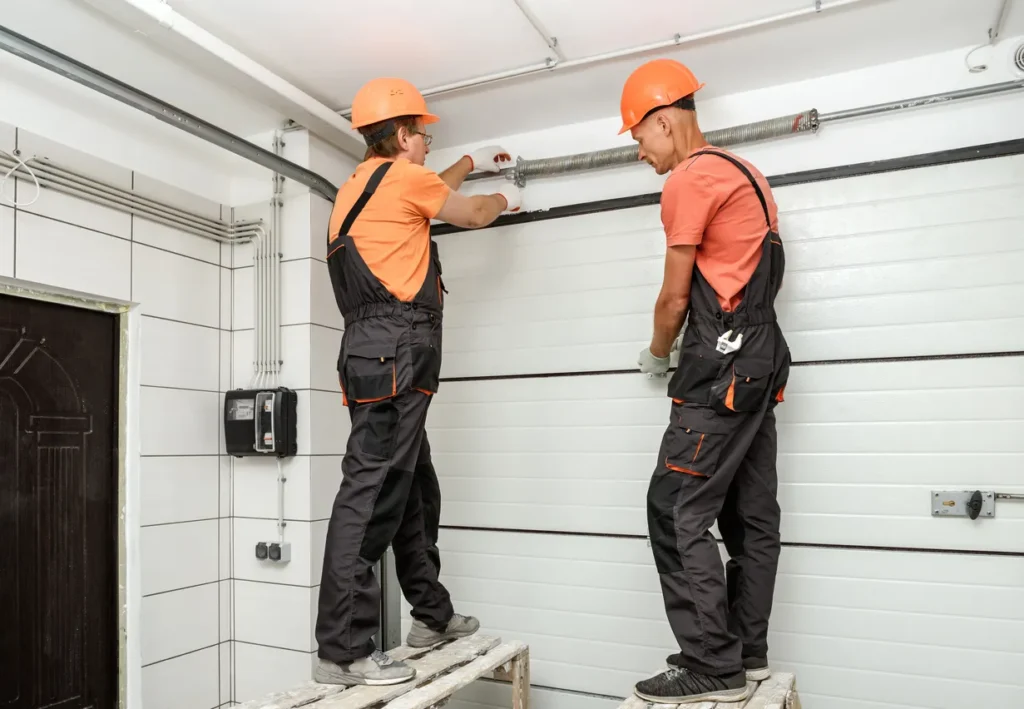
Service Installation: What’s Included
When a technician arrives to address a track issue, the goal is not just to make the door move again, but to restore the system to factory specifications. The service visit is comprehensive, covering the entire perimeter of the door opening to ensure stability:
- Site Safety Inspection: The first step involves securing the door in a stationary position. If the door is hanging precariously, clamps and locking pliers are used to prevent it from falling further while the tension is managed.
- Track Realignment and Securing: Technicians loosen the track brackets attached to the door jambs. Using levels and measuring tape, the vertical and horizontal tracks are adjusted so they are perfectly parallel to the door and equidistant from each other.
- Hardware Examination: Every bolt and nut securing the track to the wall is tightened. If the lag screws have stripped out the wood due to age or dry rot, longer or wider fasteners are installed to bite into fresh framing.
- Roller Re-insertion and lubrication: The rollers are carefully guided back into the track. If the stem of a roller is bent or the wheel is chipped, it is replaced to ensure it does not snag inside the rail.
- Sensor Alignment: Once the physical track is fixed, the safety eye sensors are realigned to ensure the beam is unbroken and the door will reverse correctly if an object is in the path.
Our Process: From Evaluation to Perfect Tracks
The repair process follows a strict protocol to ensure safety and longevity. This is not a matter of bending metal back into place with a hammer; it involves calibrating the entire lift system:
- Tension Release: Before touching the tracks, the immense tension on the torsion springs often needs to be mitigated or monitored. If the door is wedged, the potential energy in the springs can release violently.
- Gap Adjustment: The spacing between the track and the door is critical. If the track is too close, the door binds against the weather stripping. If it is too far, the rollers fall out. Technicians adjust this spacing to the manufacturer’s recommended gap.
- Checking for “Out of Square”: Tracks must be perfectly vertical. If a track leans even slightly, the door will bind as it travels upward. Laser levels are often employed to verify that the vertical rise is true.
- Horizontal Angle Correction: The horizontal tracks hanging from the ceiling must be square to the front wall. If they are not hung straight, the door will rack (twist) as it opens, leading to structural damage to the panels.
- Final Torque Check: Once alignment is confirmed, every fastener is torqued down. This prevents the vibration of the door from loosening the tracks in the future.
Deciding Between Repair or Complete Replacement
Homeowners often face the decision of whether to repair existing tracks or invest in a full replacement. This decision depends on the extent of the damage and the age of the system. While metal tracks are durable, they are not indestructible.
When to Repair
Repair is the viable option when the structural integrity of the steel is intact. This is typically the case when the issue is caused by loose fasteners or a minor impact that bent the lip of the track slightly:
- Minor Bends: Small dings in the vertical track can often be straightened using a track anvil and specialized dollies.
- Loose Brackets: If the track is straight but simply moving against the wall, tightening or adding bracing resolves the issue.
- Single Section Damage: If only the vertical section is damaged but the horizontal curve is fine, a partial repair is cost-effective.
When to Replace
Replacement becomes necessary when the damage compromises the smooth travel of the rollers or when the metal has fatigued.
- Severe Impact: If a car has backed into the vertical track, crimping the metal so that the roller cannot pass, the section must be replaced. Bending it back will leave weak spots and rough surfaces that create noise and resistance.
- Rust and Corrosion: In environments where moisture is present, galvanized coating can wear off. Once deep rust sets in, the friction increases significantly. Rusted tracks cannot be sanded smooth effectively; they should be replaced.
- Fatigue Cracks: Older tracks may develop stress cracks around the bolt holes. This indicates the metal is failing and could snap under load.
- Upgrading Systems: If you are upgrading to a heavier, insulated door, the old tracks may be too light-gauge (thin) to support the new weight. Upgrading to heavy-duty 14-gauge or 12-gauge industrial tracks ensures better durability.
Local Expertise: Adapting to Lake Arrowhead’s Rules
Operating a garage door in the mountains presents challenges that are not present in milder regions:
- Foundation Settling: Mountain homes often experience slight shifting or settling of the foundation. Even a minor shift in the garage floor or walls can throw the tracks out of plumb. Adjustable track brackets are essential in this region to allow for periodic recalibration.
- Power Outage Operation: Power outages can occur during winter storms. A perfectly aligned track system allows you to manually lift the door with one hand. If the tracks are binding, manually lifting a heavy door becomes difficult or impossible, potentially trapping you.
Good Golly Garage Doors technicians are familiar with these local variables and adjust the track spacing and lubrication choices accordingly, opting for silicone-based lubricants that do not gum up in freezing temperatures.
The Hidden Dangers of DIY Track Repair
Many homeowners attempt to fix a dislodged door by forcing the rollers back into the track or loosening bolts to shift the rail. This is extremely hazardous. The garage door acts as a single moving wall, and the tracks act as the guide. The weight of the door is held by the cables and springs, but the tracks dictate the path:
- Sudden Drop Risk: If you loosen the track brackets while the door is in the up position, the tracks can spread, causing the door to crash to the floor.
- Spring Tension Release: Often, the bottom bracket serves as the anchor for the high-tension lift cables. Mistaking this bracket for a track adjustment point can release the cable, causing the bracket to become a projectile.
- Further Damage: Forcing a door down when it is wedged in the tracks can buckle the door panels. Once a panel is kinked, it cannot be repaired and requires replacement.
Ensuring Long-Term Performance Through Maintenance
Once the tracks are repaired or replaced, keeping them in optimal condition requires minimal but consistent attention. The goal is to reduce friction, which reduces the workload on the automatic opener:
- Debris Removal: The inside of the tracks collects dust, spiderwebs, and old grease. Wiping them out with a clean rag ensures the rollers make full contact with the metal.
- Lubrication: Contrary to popular belief, heavy grease should never be applied to the inside of the tracks. Grease traps grit and turns into an abrasive paste. Only the roller bearings and hinges should be lubricated.
- Fastener Tightening: The vibration of the door moving up and down can loosen nuts over time. Checking the track bolts annually keeps the system rigid.
Why Professional Alignment Matters
The difference between a functioning door and a high-performance door lies in the alignment. A professionally aligned track system allows the door to “float” in the opening. When the tracks are perfectly parallel and leveled, the door requires very little force to move. This extends the life of your automatic opener, reduces noise transfer into the home, and ensures the safety reverse mechanisms work as intended.
Professional technicians carry specialized winding bars, impact drivers, and laser levels that allow for calibration within millimeters. They also carry a variety of track sizes and gauges in their service vehicles, ensuring that whether you need a standard radius or a low-headroom solution, the parts are available. This capability transforms a potentially week-long ordeal into a same-day resolution.
Choose Us: Proven Reliability & Local Praise
Your garage door is the largest moving object in your home and a primary entry point. When the tracks fail, security and convenience are compromised. We prioritize rapid response times for residents in Lake Arrowhead to ensure that your day is not derailed by a mechanical failure. Our approach combines technical precision with high-quality materials to deliver repairs that withstand the rigors of daily use and mountain weather conditions.
From the initial safety inspection to the final torque check, every step is executed with the intent of preventing future failures. We do not just put the door back on the tracks; we correct the geometry that caused it to fall in the first place.
Good Golly Garage Doors is ready to restore the safety and functionality of your home today. Don’t let a broken garage door trap you at home. Call our team now for expert track repair services.
Proudly Serving Victorville and Surrounding Areas
We provide the best garage door services you can find across Victorville, CA. Wherever you are, Good Golly Garage Doors is ready to deliver. Let’s get your garage door in Victorville, CA or beyond back in top shape with service that’s fast, friendly, and built to last.
Call (760) 979-0605 All Service Areas