

Garage Door Spring Repair in Wrightwood, CA
Struggling with a faulty garage door in Wrightwood? Schedule fast, professional spring repair with Good Golly Garage Doors to secure and restore access efficiently.
Stuck with a Broken Garage Door Spring?
If you are struggling with a garage door that won’t open or close, it is likely due to a faulty spring, a common and frustrating issue that renders your vehicle trapped or your home exposed. Don’t let a snapped component disrupt your entire schedule or compromise the security of your property in Wrightwood.
We provide the response required to restore access to your garage. When a spring snaps, the door becomes dead weight, often too heavy to lift manually and dangerous to attempt fixing without proper tools. Our team specializes in safely replacing high-tension springs, ensuring your system is balanced and operational before we leave the premises.
- Rapid, on-site spring repair to get your door functioning today.
- Expert technicians with over 30 years of regional experience handling torsion and extension systems.
What You Get With Professional Spring Repair Services
When you schedule a service for a broken spring, the objective is to restore the mechanical balance of your garage door system. A broken spring is not merely a cosmetic issue; it is a mechanical failure that places the full weight of the door, often several hundred pounds, onto the opener and cables. Continued use of the opener with a broken spring will likely result in motor failure, turning a standard repair into a complete system overhaul.
Our service focuses on comprehensive diagnosis and replacement using high-cycle components. Standard builder-grade springs are typically rated for 10,000 cycles (one cycle being a full open and close sequence). For many households, this equates to roughly 3-5 years of usage. We prioritize the installation of high-cycle springs rated for 20,000 cycles or more, effectively doubling the lifespan of the repair.
Upon arrival, the technician assesses the specific configuration of your door. Garage doors generally utilize one of two spring types: torsion springs or extension springs. Torsion springs are mounted horizontally above the door opening and use torque to lift the weight. Extension springs run parallel to the track and stretch to provide lift assistance. The repair process includes identifying the correct wire size, inside diameter, and length required to lift your specific door weight. Installing a spring that is too strong or too weak will cause the door to drift or crash, creating safety hazards.
Service includes a full safety inspection of the surrounding hardware. When a spring snaps, the sudden release of tension can damage cables, pulleys, and brackets. We inspect these components for fraying or stress fractures to ensure the new springs operate smoothly without putting strain on compromised parts. The goal is a door that can be lifted with one hand when disconnected from the opener, indicating perfect balance.
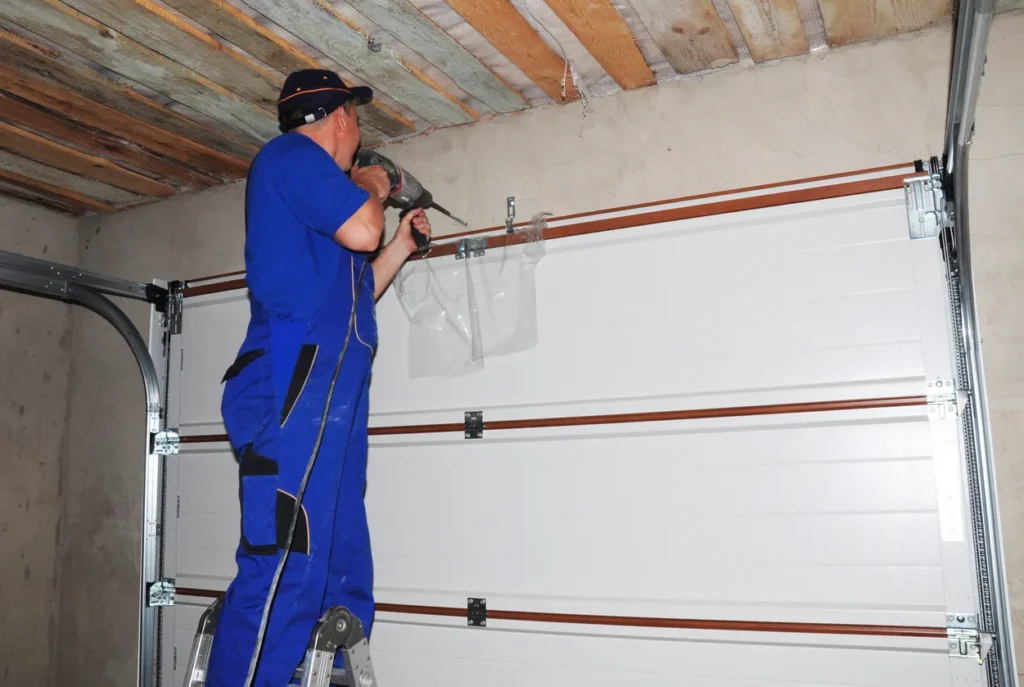
How the Spring Replacement Process Works
Replacing a garage door spring is widely considered the most dangerous aspect of garage door maintenance due to the extreme tension involved. Professional replacement follows a strict safety protocol to protect both the technician and your property. We utilize specialized winding bars and containment procedures that are not available in standard DIY toolkits.
The process begins with securing the door. If the door is stuck open or partially open, it must be clamped or blocked to prevent it from crashing down when the remaining tension is released. For torsion systems, the tension on the unbroken spring (if applicable) must be carefully released before the shaft can be manipulated.
- System De-tensioning and Removal: The technician manually unwinds the tension from the unbroken spring using winding bars. This is a critical step, as the stored energy in even an old spring is sufficient to cause severe injury. Once the tension is zeroed out, the center bearing plate and drums are loosened to slide the old springs off the torsion tube.
- Hardware Inspection and Preparation: Before the new springs are installed, the tube is checked for straightness and the bearings are inspected for wear. In Wrightwood, where temperature fluctuations can cause metal fatigue, checking the center and end bearings is vital to ensure smooth rotation.
- Installation of New Components: The new springs are slid onto the shaft. The winding cones and stationary cones are bolted to the center bracket and the shaft, respectively. The color-coding on the springs is verified to ensure the “right-hand” and “left-hand” winds are placed on the correct sides of the center bracket.
- Winding and Tensioning: This is the precision phase. The technician calculates the exact number of turns required based on the door height and spring capacity. The springs are wound manually, adding tension in quarter-turn increments.
- Balancing and Testing: Once wound, the door is manually tested. The technician disengages the electric opener and lifts the door by hand. A properly balanced door should stay in place when lifted halfway, it should not shoot up (springs too tight) or fall down (springs too loose). Adjustments are made to the winding until neutral buoyancy is achieved.
- Lubrication and Final Check: The coils of the new springs are lubricated to reduce friction and noise. This lubrication also acts as a barrier against rust, which is particularly important in mountain climates where moisture is prevalent.
When Replacement Beats Repair
Homeowners often ask if a spring can be repaired rather than replaced. The industry standard answer is definitive: springs cannot be repaired; they must be replaced. A spring creates lift through the structural integrity of the steel coil. Once that steel snaps, the integrity is gone. Welding or clamping a spring is unsafe and ineffective.
The real decision lies in whether to replace just the broken spring or both springs (if your door has a two-spring system). It is almost always more cost-effective and logical to replace both springs simultaneously.
- Cycle Life Synchronization: Garage door springs are installed in pairs and undergo the same workload every time the door opens and closes. If the right spring breaks today, the left spring is likely at the end of its cycle life as well. It may last another week or another month, but failure is imminent. Replacing both eliminates the need for a second service call and a second repair fee in the near future.
- Imbalanced Lift: Even if the old spring hasn’t snapped yet, it has suffered “relaxation,” meaning it has lost some of its tensile strength over time. Pairing a brand-new, tight spring with an old, stretched spring creates an imbalance. The door will pull unevenly, causing the rollers to grind against the tracks and potentially warping the door panels.
- Opener Preservation: An imbalanced door forces your electric opener to work harder to compensate for the weak side. This excess strain can strip the gears in the opener’s motor. Good Golly Garage Doors recommends dual replacement to protect your investment in the opener system.
Signs that indicate you need replacement include a loud “gunshot” noise in the garage (the sound of the coil snapping), a door that opens a few inches and stops, or cables that appear loose and disconnected. If you notice a gap of two to three inches in the coil of the spring, the component has failed.
Local Factors Affecting Springs in Wrightwood
Operating a garage door in Wrightwood presents unique challenges compared to lowland areas. Understanding these local factors explains why specific maintenance protocols are necessary for this region.
- Cold Weather Brittleness: Steel contracts in cold temperatures. During Wrightwood’s winters, where temperatures drop significantly, the steel coils of the springs become more brittle. This increases the likelihood of snapping, especially during the first operation of the morning when the metal is coldest. We use high-grade steel springs designed to withstand thermal contraction without compromising structural integrity.
- Snow Load and Moisture: While springs lift the door, the external environment affects the door’s weight. Ice accumulation on the exterior of the door adds weight that the springs must counter. If the springs are already weak, this added winter weight can cause the door to fail to open. Furthermore, the wet winters introduce moisture that accelerates rust. Rust puts pits in the spring coils, creating weak points where fractures begin.
- Permits and Safety Codes: While simple repairs typically do not require municipal permits, all work must adhere to safety standards regarding containment cables (for extension springs) and entrapment protection. We ensure that every installation meets current safety criteria to prevent liability issues for the homeowner.
- Seasonality of Failures: We observe a spike in spring failures during the transition from autumn to winter. As the metal goes through freeze-thaw cycles, micro-fractures in the steel expand. Proactive inspection in the fall can often catch weary springs before they snap during a snowstorm.
Why Professional Execution Matters
The difference between a functional door and a hazardous situation often comes down to the quality of the parts and the precision of the installation. Big-box stores sell “one-size-fits-all” springs that rarely match the specific weight requirements of custom or insulated garage doors found in Wrightwood homes. Using an incorrect spring forces the installer to over-wind or under-wind the coil to make the door move, which drastically reduces the safety factor of the system.
We utilize calibrated scales to weigh the door prior to spring selection. This ensures that the spring installed is mathematically matched to the door’s requirements.
Beyond the spring itself, we address the integration of the spring with the rest of the lift system. This includes verifying the condition of the center bearing plate. A seized bearing will prevent the torsion tube from spinning freely, causing the new spring to bind and potentially snap prematurely. We also ensure that safety cables are installed on all extension spring systems. These cables act as a containment net; if an extension spring snaps, the safety cable prevents it from whipping around the garage and causing injury or damage to parked vehicles.
Good Golly Garage Doors prioritizes the longevity of the repair. We do not use “service grade” springs that are designed to fail in a few years. By installing high-cycle components and balancing the door to neutral buoyancy, we ensure that your manual use of the door is effortless and your electric opener is subjected to minimal strain. This holistic approach to repair extends the life of your entire garage door system, not just the springs.
Secure Your Garage Door Today
A broken spring is an urgent mechanical failure that compromises the security and functionality of your home. Waiting to address the issue increases the risk of damaging your opener or experiencing a dangerous cable failure. The tension involved in these systems requires professional handling to ensure the repair is safe, effective, and durable.
Do not attempt to lift a dead door manually or manipulate high-tension components without training. Restore your home’s access and safety with a properly balanced, high-cycle spring replacement.
For professional garage door spring repair and replacement, contact us today to ensure your system is safe and efficient.
Proudly Serving Victorville and Surrounding Areas
We provide the best garage door services you can find across Victorville, CA. Wherever you are, Good Golly Garage Doors is ready to deliver. Let’s get your garage door in Victorville, CA or beyond back in top shape with service that’s fast, friendly, and built to last.
Call (760) 979-0605 All Service Areas