

Garage Door Spring Repair in Surprise, AZ
Immediate garage door spring repair in Surprise, AZ. Same-day service by certified technicians. Contact us now for a fast and reliable solution!
Broken Garage Door Spring? Professional Repair Services Available
Discover a loud snap from your garage? A broken spring can disrupt your routine, and our technicians provide professional repair services in Surprise, AZ. If your car is trapped or your door refuses to lift, contact us to schedule service and restore access to your home.
- Promptly scheduled repair service to restore proper garage door operation.
- All repairs done by certified technicians with high-quality springs.
- Clear explanations of recommended work and associated costs provided before repairs begin.
Services from Good Golly Garage Doors include manufacturer-backed warranties, which typically apply for about one year.
Immediate Relief for Trapped Vehicles and Heavy Doors
When a garage door spring snaps, the most immediate consequence is often a vehicle trapped inside the garage. The springs are the muscles of your garage door system. Without them, the heavy lifting falls entirely on the opener, which is not designed to lift the dead weight of a 200 to 400-pound door. Attempting to force the door open with the automatic opener can strip gears, burn out the motor, or cause the door to crash down, leading to further damage or injury. Good Golly Garage Doors treats these service requests as high priority because a broken spring is more than a maintenance issue. It can interrupt daily routines and limit access to your garage.
Our technicians arrive prepared with appropriate tools and a selection of commonly used spring sizes to match the specific weight and dimensions of your door. There is no “one size fits all” in spring replacement. Using the wrong size spring will result in an unbalanced door that is difficult to operate and unsafe to use. We focus on identifying the exact counterbalance requirements of your specific door setup. Whether you have a standard steel door or a heavy custom wood carriage house door, the goal is to restore the counterbalance so the door feels nearly weightless when operated manually.
We provide a solution that addresses the root cause of the failure. Most builder-grade springs are rated for a specific number of cycles, usually around 10,000 opens and closes. Once that limit is reached, metal fatigue sets in and the steel fractures. We offer high-cycle options that can last significantly longer, helping reduce the likelihood of repeated spring failures over a short period of time.
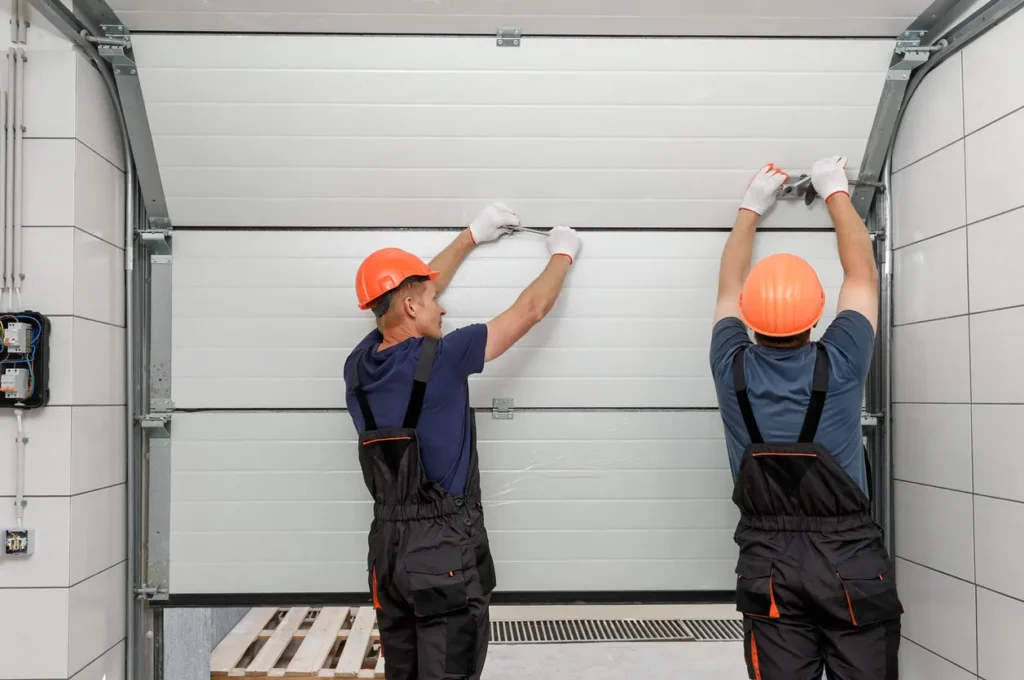
The Spring Replacement Process: Safety and Precision
Replacing a garage door spring is a technical process that involves handling high-tension steel components. It is widely considered the most dangerous aspect of garage door maintenance and requires specific tools and training to execute safely. The process begins with a complete safety inspection of the entire garage door system to ensure that the failure of the spring has not damaged other components, such as the cables, drums, or hinges.
- The first step involves securing the garage door in the down position to prevent movement during the repair. If the door is stuck open or halfway, it must be carefully lowered and clamped. This ensures that the potential energy in the system is controlled before any disassembly begins.
- Next, the tension is released from the unbroken spring, if you have a two-spring system, using winding bars. This is a critical step. Even an unbroken spring holds enough tension to cause serious injury if unbolted without unwinding. The cables are then disconnected from the bottom brackets.
- The technician then removes the fractured spring from the center shaft. This often requires loosening the set screws on the winding cones and sliding the spring off the torsion tube. If the bearings or the tube itself show signs of wear, this is the stage where those components are inspected and prepared for the new installation.
- New springs are slid onto the torsion tube. The stationary cones are bolted to the center bracket, and the winding cones are positioned for tensioning. The technician ensures the springs are installed on the correct side of the center bracket, as springs are wound specifically for left or right-side mounting.
- Tensioning is the most precise part of the job. The technician uses winding bars to add the exact amount of torque required to lift the specific weight of your door. This is calculated based on the door’s height and mass.
- Finally, the door is balanced and tested. A properly balanced door should stay in place when lifted halfway manually. It should not rise on its own or fall closed. The technician makes fine-tune adjustments to the tension to achieve proper balance before reconnecting the automatic opener.
Diagnosing the Damage: Repair or Full Replacement?
Homeowners often ask if a spring can be repaired rather than replaced. The answer is no. A garage door spring breaks because the metal has reached the end of its fatigue life. Welding or reconnecting a snapped spring is not a safe or reliable option because the structural integrity of the steel is compromised throughout the entire coil, not just at the break point. Replacement is the only appropriate solution.
A common decision point arises when only one spring breaks on a two-spring system. It is generally recommended to replace both springs at the same time. Garage door springs are installed in pairs and cycle together. If one has reached its cycle limit and broken, the second spring is likely near the end of its service life as well. Replacing both springs during one visit can help reduce the likelihood of another failure in the near future.
- Check for a visible gap in the coil. For torsion springs, which are located above the door, a clean two-inch gap in the metal coil is the most obvious sign of failure.
- Listen for the noise. A spring break often sounds like a loud bang or a heavy object hitting the ground. If you heard a sharp noise from the garage but see nothing on the floor, inspect the header above the door.
- Inspect the cables. When a spring snaps, the sudden loss of tension can cause the lift cables to loosen or come off the cable drums. If your cables appear loose or tangled, do not attempt to adjust them yourself.
- Test the door weight. If you pull the emergency release cord and attempt to lift the door by hand, it should move with minimal effort. If it feels unusually heavy or difficult to lift, the spring may be broken. Do not attempt to force it.
Why Professional Calibration is Critical
The risks associated with garage door spring replacement are significant. Torsion springs are under substantial tension. The energy stored in a wound spring is capable of lifting several hundred pounds. If that energy is released unexpectedly due to improper handling or tools, serious injury or property damage can occur. This type of repair is not suitable for a do-it-yourself approach.
Professional calibration involves more than winding a spring. It includes verifying that the door travels evenly, that cables remain properly seated on both sides, and that the automatic opener applies the correct amount of force to operate safely. An unbalanced door can place unnecessary strain on the opener and reduce its service life.
Good Golly Garage Doors uses winding bars designed specifically for winding cones to reduce the risk of slippage. Our technicians are trained to apply the correct torque based on door weight and configuration, and they follow established safety procedures throughout the process.
- Correct winding helps ensure the door stays in position when partially opened. A door that drifts downward can pose a risk to people and property, while a door that rises on its own can damage the opener or mounting hardware.
- Professional assessment also includes confirming that the spring size and cycle rating match the actual weight of the door. In some cases, original installations include springs that are undersized, which can lead to premature failure. We address this by installing springs that are properly matched to the door.
- We also inspect shaft bearings and the center bearing. A spring failure can sometimes damage these components. Replacing a spring without addressing worn or damaged bearings can result in excessive noise or uneven operation.
Restore Your Garage Door Functionality
A broken spring prevents your garage door from operating correctly and can affect home security and convenience. You need a solution that is safe, reliable, and designed for long-term performance. We focus on properly matched spring replacements that support smooth operation and help extend the life of the entire garage door system.
Do not attempt to operate the door or replace the spring yourself. The potential risks outweigh the benefits. Our team is equipped to handle the controlled release of tension, accurate installation, and precise balancing required for proper operation. We remove and dispose of the old broken spring and leave your garage in working order. Get your garage door back on track with professional spring replacement. Contact us to schedule service and discuss your repair options.
Proudly Serving Phoenix, AZ, and Surrounding Areas
We provide the best garage door services you can find across Phoenix, AZ. Whether it’s the impact of Phoenix’s heat and sudden storms on garage door components, we ensure our solutions are tailored to your needs. Wherever you are, Good Golly Garage Doors is ready to deliver.
Call (602) 399-7054 All Service Areas