

Garage Door Spring Repair in Running Springs, CA
Struggling with a broken garage door spring in Running Springs? Contact Good Golly Garage Doors for fast, reliable repair and peace of mind. Schedule now!
Broken Garage Door Spring? Get It Fixed Fast!
Struggling with a garage door that won’t open? You might be dealing with a broken spring – a common issue for many homeowners in Running Springs. A snapped spring can trap your vehicle inside the garage, disrupt your daily schedule, and turn a heavy door into a significant safety hazard.
Contact us to schedule your repair or inquire about financing options for your new spring system.
When you choose Good Golly Garage Doors for your repair, you receive:
- Prompt service that ensures your garage is secure and fully functional within hours.
- A durable fix that withstands the extremes of Running Springs climates.
Backed by local permitting know-how for peace of mind.
Expert Restoration of Garage Door Functionality
When a garage door spring breaks, the entire counterbalance system fails. The spring is the muscle behind the operation, lifting the heavy weight of the door panels so the opener doesn’t have to. Without a functioning spring, the door becomes “dead weight,” often weighing several hundred pounds. Attempting to lift it manually is dangerous, and running the automatic opener can strip gears or burn out the motor.
Our service focuses on restoring the equilibrium of your door system. We arrive with a fully stocked truck carrying various spring sizes and gauges to match the specific weight and height of your door. The goal is to get your door moving smoothly again in a single visit.
What is included in a standard spring repair visit:
- System Diagnostics: We assess the condition of both springs (if a dual system), cables, drums, and bearings to determine the root cause of the failure.
- Precision Spring Matching: We measure the existing wire gauge, inside diameter, and length to fabricate or select the exact replacement spring needed for your specific door weight.
- Tension Calibration: Technicians wind the new springs to the precise tension required to balance the door, ensuring it stays halfway open when released manually.
- Safety Inspection: A full review of the safety reverse mechanisms and sensors to ensure the door is safe for family use.
- Lubrication and Tune-up: We apply cold-weather-rated lubricants to the springs, rollers, and hinges to reduce friction and noise, read expert tips on maintenance.
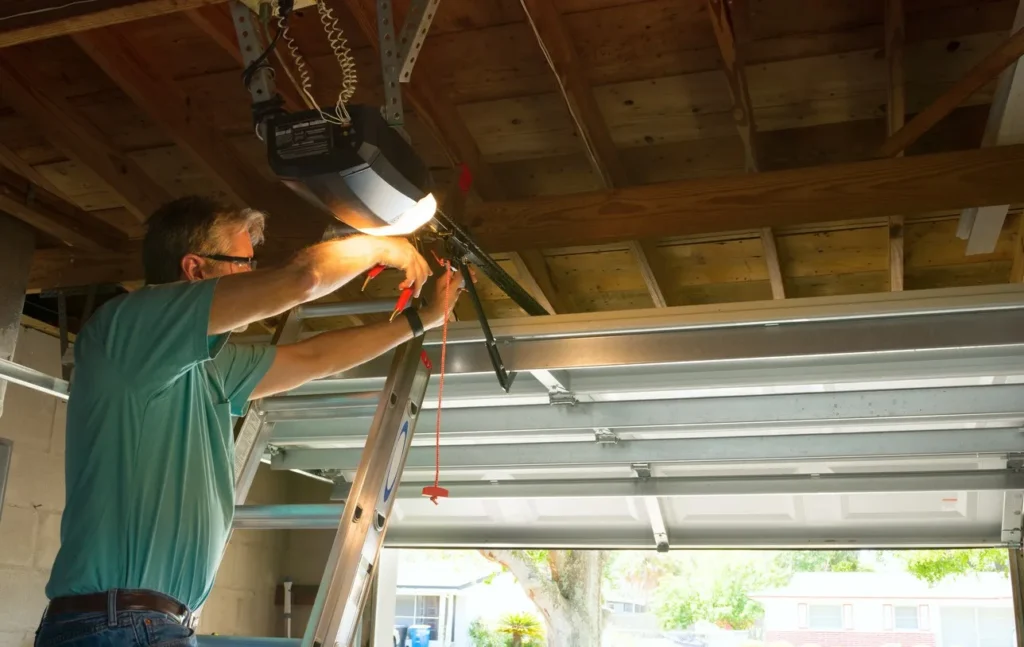
The Spring Replacement Process: From Tension to Balance
Replacing a garage door spring is a highly technical process that involves managing extreme tension. Torsion springs, located above the door opening, store mechanical energy that is released to lift the door. Extension springs, located along the side tracks, stretch and contract to provide lift. The repair process differs slightly depending on which system your home utilizes, but the standard of care remains high.
The Torsion Spring Replacement Workflow:
- Securing the Door: The door is clamped in the closed position to prevent accidental movement during the repair.
- Unwinding the Intact Spring: If one spring is broken but the other remains under tension, the intact spring must be carefully unwound using winding bars to release stored energy.
- Disassembly: The torsion tube is manipulated to slide off the broken spring coils and remove the center bearing plate if necessary.
- Installation: The new spring is slid onto the torsion tube. We ensure the stationary cone is secured to the center bracket and the winding cone is accessible.
- Winding and Tensioning: Using solid steel winding bars, the technician winds the spring a calculated number of quarter-turns based on the door’s height and drum radius.
- Securing the Set Screws: Once tension is achieved, the set screws on the winding cone are tightened against the torsion shaft.
The Extension Spring Replacement Workflow:
- relieving Tension: The door is opened fully to relieve tension on the extension springs, then clamped in place.
- Disconnecting Safety Cables: Safety containment cables (which prevent a snapping spring from flying across the room) are disconnected.
- Pulley and Cable Inspection: We inspect the pulleys and lift cables for fraying or wear, as these work in tandem with extension springs.
- Installation: The old springs are unhooked, and new springs are installed on the horizontal track hangers and the pulley fork.
- Re-cabling: Safety cables are threaded through the new springs and secured.
- Balancing: The door is lowered, and the cable length is adjusted to ensure the door lifts evenly on both sides.
Making the Decision: Repair vs. Full Replacement
Homeowners often ask if they can repair a single broken coil or if they need to replace the entire spring system. In the garage door industry, “repair” almost always refers to the replacement of the spring system itself. Springs are rated for a specific number of cycles (one cycle equals opening and closing the door once). Metal fatigue is cumulative; you cannot weld or patch a broken spring wire because the structural integrity is compromised throughout the entire coil.
Signs that indicate a full replacement is necessary:
- Visible Separation: A clear gap of two to three inches in the coil indicates a clean break.
- Elongation: On extension springs, if the coils look stretched out or have lost their tight shape, they can no longer provide adequate lift.
- Loud Bang: A noise resembling a gunshot or a firecracker usually signals the exact moment a spring snaps.
- Door Falls Heavily: If the door slams down when you try to close it, or feels incredibly heavy to lift, the spring is no longer assisting the lift.
Why we recommend replacing both springs simultaneously:
Most double-car garage doors utilize a two-spring torsion system. If one spring breaks, the second spring is likely nearing the end of its lifecycle as well. They were installed at the same time and have endured the same number of cycles.
- Cost Efficiency: Replacing both springs in one service call saves the cost of a second trip fee when the second spring inevitably breaks shortly after the first.
- Balanced Operation: A new spring is strong and tight, while an old spring is weaker and fatigued. Mixing old and new springs causes the door to lift unevenly, putting strain on the opener and the door tracks.
- Predictable Performance: Installing two new springs resets the cycle count for the entire system, providing years of worry-free operation.
High-Elevation Considerations for Running Springs
Operating a garage door in Running Springs presents unique challenges due to the local geography and climate. Located at an elevation of approximately 6,000 feet, the region experiences weather patterns that differ significantly from the valleys below. The significant annual snowfall, ranging from 70 to 120 inches, and the sharp temperature drops affect the metallurgy and mechanics of your garage door system.
Impact of Cold Weather on Springs:
- Metal Brittleness: Steel contracts in cold temperatures. When the thermometer drops, the metal in your springs becomes more brittle. The sudden shock of engaging the opener to lift the door can cause a cold spring to snap unexpectedly.
- High-Cycle Requirements: During winter, cars are moved in and out more frequently to avoid snow accumulation, increasing the cycle count usage during the most vulnerable weather periods.
- Viscosity of Lubricants: Standard grease can thicken and harden in freezing temperatures, causing springs to bind rather than glide. We utilize synthetic, low-temp lubricants specifically designed for high-altitude environments to ensure smooth operation.
Snow Load and Structural Strain:
- Ice Damming: Ice can form at the bottom seal of the door, freezing it to the concrete. If the springs attempt to lift a frozen door, the immense resistance can snap the steel coils or strip the opener gear.
- Additional Weight: Snow accumulation on the exterior of the door panels adds dead weight. While springs are calculated to lift the door, adding wet, heavy snow pushes the springs beyond their rated capacity, accelerating wear and tear.
At Good Golly Garage Doors, we account for these factors by recommending high-cycle, oil-tempered springs or galvanized options that resist corrosion from snowmelt and road salts. We ensure the tension is set to account for the drag caused by cold tracks and rollers, ensuring reliable operation even during the peak of winter.
Ensuring Safety and Long-Term Reliability
The counterbalance system is the most dangerous component of a garage door. The energy stored in a fully wound spring is sufficient to cause severe injury or property damage if mishandled. Professional repair mitigates these risks through specialized tools and training. We do not recommend DIY spring replacement due to the high risk involved with winding bars and high-tension cables.
The Professional Difference:
- Correct Sizing: A spring that is too strong will make the door difficult to close and can damage the opener. A spring that is too weak will not lift the door, causing the cables to jump off the drums. We use precision weighing scales to determine the exact inch-pounds of torque required.
- Cycle Rating upgrades: For homes with high traffic, we offer high-cycle springs rated for 20,000 to 50,000 cycles, compared to the standard builder-grade 10,000 cycles. This effectively doubles or triples the lifespan of the repair.
Safety Containment:
For homes with extension springs, safety cables are a non-negotiable requirement. These steel cables run through the center of the spring and are secured to the wall and track. In the event of a break, the safety cable keeps the spring on the rod, preventing it from becoming a dangerous projectile. If your current system lacks these, we install them as part of the repair process.
Final System Balance Test:
Before completing the job, we perform a balance test. The technician disconnects the electric opener and lifts the door by hand. A properly balanced door should be easy to lift with one hand and should stay stationary when left roughly three to four feet off the ground. If the door slides down, the springs are too weak. If it flies up, they are too strong. Achieving this “neutral buoyancy” is the hallmark of a successful spring repair, ensuring your electric opener works effortlessly and lasts longer.
Good Golly Garage Doors ensures that every repair ends with a safe, balanced, and quiet door, ready to handle the demands of your daily life.
Don’t let a broken spring trap you at home, contact us now for expert repair service.
Safe Garage Door Spring Repair in Running Springs, CA
Broken springs can stop your door cold and put your safety at risk. Good Golly Garage Doors provides expert garage door spring repair in Running Springs, CA, restoring balance and function with professional-grade parts and trained technicians. Avoid injury and restore access, schedule today.
Fix Your Garage Springs Safely and Quickly
Proudly Serving Victorville and Surrounding Areas
We provide the best garage door services you can find across Victorville, CA. Wherever you are, Good Golly Garage Doors is ready to deliver. Let’s get your garage door in Victorville, CA or beyond back in top shape with service that’s fast, friendly, and built to last.
Call (760) 979-0605 All Service Areas