

Garage Door Spring Repair In Lakeway, TX
Battling a snapped garage door spring in Lakeway? Contact us for immediate repair and ensure your garage door's functionality and safety with our expert service.
Caught off-guard by a broken garage door spring in Lakeway? Don’t let a trapped vehicle disrupt your day; contact us immediately for emergency repair or to discuss financing options. A snapped spring renders your heavy door immovable and dangerous, requiring immediate, professional attention to restore function and safety to your home:
- Get rapid repair with our certified technicians, ready to serve 24/7.
- Experience a safe, secure fix, ensuring long-lasting performance.
- Enjoy peace of mind with same-day service and guaranteed satisfaction.
Fully licensed and insured, with comprehensive warranties to back every repair.
Immediate Spring Replacement and System Restoration
When you request service from Good Golly Garage Doors, you are not just buying a replacement part; you are purchasing a complete restoration of your garage door’s counterbalance system. The spring is the engine of your garage door, bearing the immense weight of the panels to simulate a neutral weight for the opener. When this component fails, the entire system is compromised.
Our service visit focuses on immediate functionality and long-term reliability. We arrive with fully stocked trucks containing a variety of spring sizes and types to match the specific weight and height of your door. This ensures we can complete the repair in a single visit without waiting for parts orders.
The scope of our spring repair service includes:
- Precision Spring Matching: We measure the existing wire size, inside diameter, and length to calculate the exact lift required (IPPT or Inch Pounds Per Turn) for your specific door.
- Dual Spring Replacement: If your door utilizes a two-spring system and one breaks, we replace both. This prevents a secondary service call when the second spring, which has endured the same cycle count, inevitably fails shortly after the first.
- Safety Cable Installation: For extension spring systems, we install or replace safety containment cables to prevent injury should a spring snap in the future.
- Balance and Alignment: After installation, we reset the drum timing and level the door to ensure it sits flush with the floor and operates smoothly without binding in the tracks.
- Opener Recalibration: Once the door is balanced, we recalibrate your electric opener’s force and limit settings to ensure it works in harmony with the new springs.
We understand that homeowners in Lakeway need their garage doors to operate quietly and reliably. Therefore, our standard service often includes upgrading to high-cycle springs. While standard builder-grade springs are rated for approximately 10,000 cycles (about 3-5 years of usage), high-cycle springs can last 20,000 to 50,000 cycles, significantly extending the time between necessary repairs.
The Process: How We Restore Your Door’s Lift
Replacing a garage door spring is a high-stakes mechanical procedure that involves managing extreme tension. This is not a simple part swap; it requires specific tools and strict adherence to safety protocols to manage the potential energy stored in the winding mechanism.
Our technicians follow a rigorous, step-by-step protocol to ensure the repair is performed safely and correctly:
- Site Assessment and Securement: First, we inspect the entire door system to identify the type of spring system (torsion or extension) and assess the condition of adjacent hardware like cables, drums, and bearings. We secure the door in the closed position to prevent accidental movement during the repair.
- Tension Release: Next, for torsion systems, we use winding bars to slowly and carefully release any remaining tension on the unbroken spring. This is a critical safety step, as the unbroken spring still holds enough force to cause severe injury.
- Disassembly and Removal: We loosen the set screws on the winding cones and cable drums. The torsion tube is slid aside to allow for the removal of the old springs and the installation of the new units. For extension springs, we detach the safety cables and pulleys to remove the stretched coils.
- Installation of New Hardware: We slide the new, calibrated springs onto the torsion shaft. We also inspect the center bearing plate—a component often overlooked—and replace it if the bearing is worn or seized, as a bad bearing can shorten the life of the new spring.
- Winding and Tensioning: Using solid steel winding bars, we apply the precise number of turns to the new springs based on the door’s height. A seven-foot door typically requires a different winding count than an eight-foot door. Incorrect winding leads to a door that is “hot” (flies up) or “heavy” (crashes down).
- Testing and Balancing: We manually lift the door to waist height to check the balance. A properly balanced door should float in place, neither falling nor rising. This confirms that the springs are doing the work, not the electric opener.
- Lubrication and Final Check: Finally, we lubricate the coils to reduce friction and noise. We run the door through several automatic cycles to verify smooth operation and confirm that all safety sensors are functioning correctly.
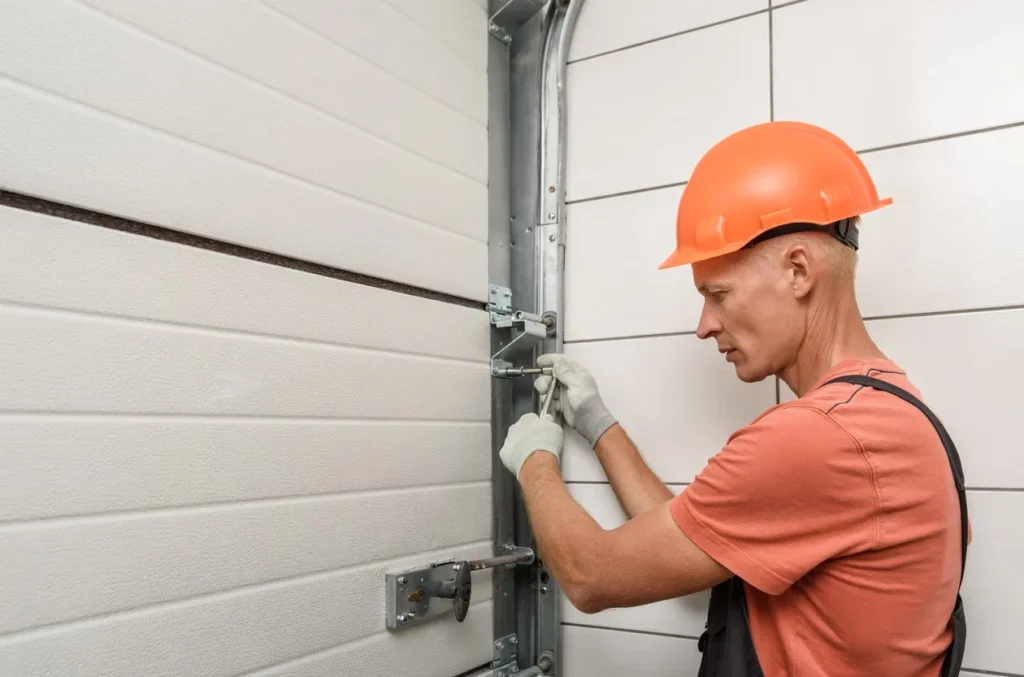
Critical Decision: Replace vs. Repair
Homeowners often ask if a spring can be repaired rather than replaced. The answer is definitive: garage door springs cannot be repaired. Once the metal coil has snapped due to fatigue, it must be replaced. However, there are decisions to be made regarding the scope of the replacement.
You need to evaluate the condition of your system to decide between a simple spring swap or a system overhaul:
- Single vs. Pair Replacement: If you have a two-spring system, replace both. Springs are installed in matched pairs and undergo the same tension every time the door opens. If the right spring breaks today, the left spring is likely at 99% of its life cycle and will break very soon. Replacing both saves you the cost of a second service call and emergency trip fee.
- Tube and Shaft Condition: If the torsion tube is bent or grooved, new springs will not rotate smoothly. In this case, replacing the tube alongside the springs is necessary to prevent noise and uneven lifting.
- Cable Condition: Inspect your lift cables. If they are frayed, rusted, or kinked, they should be replaced during the spring job. The cables work in tandem with the springs; if a cable snaps, the door can fall crookedly and jam in the tracks.
- Cycle Rating Upgrade: If your household uses the garage door as the main entry point (opening it 4-6 times a day or more), opt for high-cycle oil-tempered springs. The upfront cost is marginally higher, but the lifespan is doubled or tripled compared to standard galvanized springs.
Local Considerations for Garage Door Hardware
Operating a garage door in Central Texas presents specific challenges that impact the longevity of your hardware. The local climate and housing styles in the area play a significant role in how frequently your springs may need attention:
- Extreme Heat and Metal Fatigue: The intense heat of Texas summers affects the metallurgy of your garage door springs. Metal expands in heat, and the garage environment can become an oven. This thermal cycling can accelerate metal fatigue, causing springs to lose tension faster or become brittle over time.
- Temperature Fluctuations: While winters are generally mild, cold snaps can cause the metal to contract. It is common for springs to snap during the first significant freeze of the year or during drastic temperature shifts, as the hardened steel becomes less pliable under tension.
- Heavier Custom Doors: Many homes in this region feature custom wood overlay doors or carriage-house style doors to match architectural aesthetics. These doors are significantly heavier than standard steel doors. If the previous installer used standard springs for a heavy custom door, the springs were likely overwound to compensate, leading to premature failure. We ensure your heavy aesthetic doors are supported by springs specifically calibrated for their substantial weight.
- Humidity and Rust: Although not coastal, the humidity can lead to surface rust on galvanized springs. We often recommend oil-tempered springs for their superior durability and resistance to binding, provided they are lubricated regularly.
Why Professional Installation is Essential
Attempting to replace garage door springs yourself is the most dangerous DIY project a homeowner can undertake. The torsion spring system is under extreme pressure, holding enough potential energy to lift a 300-pound object effortlessly. If a winding bar slips or a casting fails during installation, the energy release can cause severe impact injuries, broken bones, or worse.
Beyond the immediate physical danger, correct spring installation is a matter of mathematics and physics:
- The Wrong Spring Damages the Opener: If you install a spring that is slightly too strong, your electric opener will struggle to push the door down, stripping the gears. If the spring is too weak, the opener will strain to pull the heavy dead weight, burning out the motor. Professional installation protects your expensive opener unit.
- Proper winding is skill-based: Knowing exactly how much tension to apply requires experience. Over-tensioning causes the door to bounce off the floor, compromising security. Under-tensioning leaves the door heavy and difficult to lift manually in an emergency.
- Tooling requirements: We utilize solid steel winding bars designed specifically for this task. Makeshift tools like screwdrivers can snap or bend under the torque required to wind a spring, leading to catastrophic slips.
Good Golly Garage Doors employs technicians who are specifically trained to handle these high-tension environments safely. We verify that every component, from the center bearing to the end drums, is aligned to within a fraction of an inch. This precision prevents the door from shifting sideways, which can grind down your rollers and damage the tracks over time.
We also focus on the entire counterbalance ecosystem. When a spring breaks, the cables often go slack and jump off the drums. Re-spooling these cables correctly is essential to ensure the door lifts evenly. If one cable is tighter than the other, the door will rack (hang crooked), which can jam the door in the opening and potentially bend the door panels. Our service ensures that when we leave, your door is level, balanced, and operating within manufacturer specifications.
Don’t gamble with high-tension steel or leave your home vulnerable with a door that won’t close. A broken spring is a mechanical failure that requires immediate, expert intervention to resolve safely.
Secure your home and restore your mobility today. Contact us now to schedule your spring repair service.
Fast, Safe, and Professional Spring Repair You Can Rely On
A broken garage door spring instantly disrupts your day, compromises your home’s security, and creates a serious safety hazard—this is not a repair that can wait. We understand how urgent and stressful a snapped spring can be for Lakeway homeowners. That’s why we’re committed to connecting you with rapid, professional spring replacement services that restore both safety and functionality to your home as quickly as possible.
Don’t put your safety at risk or leave your garage door inoperable any longer. Contact us today to schedule your immediate spring repair or discuss convenient financing options. Your home’s security, reliability, and peace of mind always come first.
 All Service Areas