

Garage Door Spring Repair In Glendale, AZ
Dealing with a broken garage door spring in Glendale? Ensure your home's security with our immediate, professional spring replacement services. Contact us now!
A Snapped Spring Has Your Vehicle Trapped Inside
You hit the wall button to leave for work, hear a loud bang like a gunshot, and now your heavy garage door refuses to lift more than a few inches off the ground. If you are dealing with a broken garage door spring in Glendale, you need professional intervention to restore access to your vehicle and secure your home. Contact us now to schedule spring replacement or discuss financing options.
A broken spring renders your automatic opener useless and turns your garage door into a dangerously heavy wall. Trying to force the door open can burn out your opener motor or cause the door to crash down, risking significant injury or property damage. Our team specializes in high-tension spring diagnostics and replacement, ensuring your door is balanced and safe to operate within hours of your call.
- Same-day service ensures your door is back in action quickly so you can continue your day.
- Transparent pricing with no hidden fees allows you to make informed decisions.
- High-quality, high-cycle parts are used for every repair for your peace of mind and long-term reliability.
Prompt Response and Scope of Spring Repair
When a spring snaps, the counterbalance system fails, placing the full weight of the door, often between 150 and 400 pounds; entirely on cables and the opener arm. This is not a malfunction that resolves itself. Professional repair involves a complete assessment of the counterbalance assembly, removal of the fractured components, and the installation of new, properly rated steel springs.
Homeowners in Glendale require a response that prioritizes safety and speed. Upon arrival, a technician evaluates the type of spring system currently installed. Most modern homes utilize torsion spring systems mounted above the door header, while some older installations or specific architectural designs use extension springs running parallel to the overhead tracks. Identifying the correct system is the first step in the scope of work.
The service appointment focuses on restoring the door’s “neutral buoyancy.” A properly sprung door should sit halfway open without drifting up or down when disconnected from the opener. Achieving this requires precise calculation of the spring’s IPPT (Inch Pounds Per Turn) to match the door’s weight and height. Installing a generic spring found at a big-box store often leads to an unbalanced door, which puts excessive strain on the electric opener and shortens the lifespan of the entire system.
The Technical Process of Restoring Your Counterbalance System
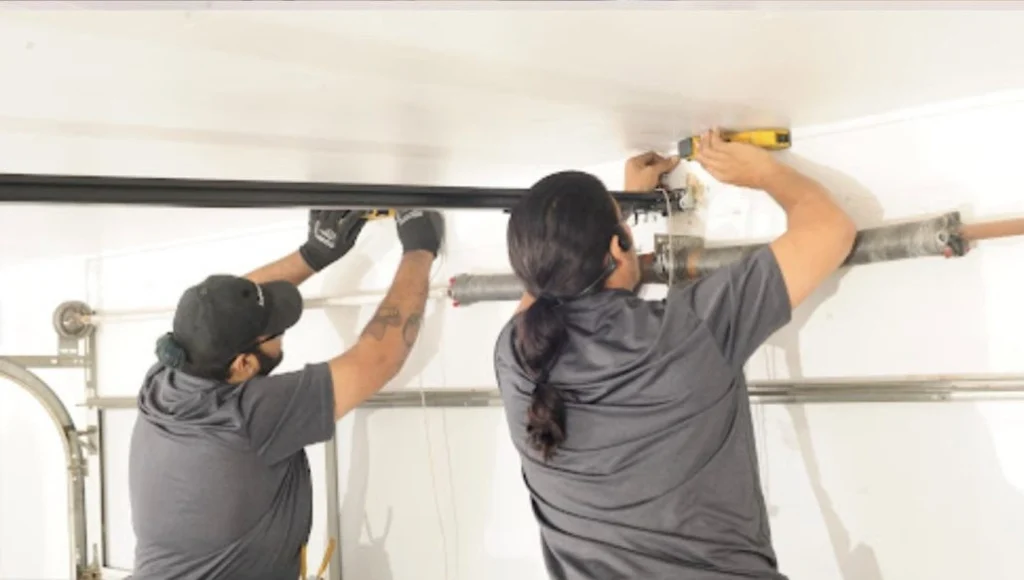
Repairing a garage door spring is a dangerous procedure involving high torque and kinetic energy. It is not a DIY project. The process follows a strict safety protocol to ensure the stored energy is managed correctly and the door operates smoothly for years to come.
- Site Safety and Stabilization: The first step involves securing the work area. The technician disconnects the electric opener to prevent accidental activation. If the door is stuck in a partially open position, it is clamped or blocked to prevent it from crashing down while tension is released from the remaining cables or unbroken springs.
- Unwinding and Removal: Even if one spring has snapped, the remaining spring (in a dual-spring system) often holds significant tension. The technician uses winding bars to carefully unwind the intact spring, releasing the torque. Once the tension is zeroed out, the center mounting plate, cable drums, and spring shaft are loosened. The snapped spring coils and the old intact spring are removed from the torsion tube.
- Installation of New Hardware: New, high-cycle springs specifically matched to your door’s weight are slid onto the torsion tube. Good Golly Garage Doors technicians ensure the winding cones and stationary cones are oriented correctly. The tube is re-centered, and the cable drums are reset to ensure the lift cables have equal tension on both sides.
- Winding and Balancing: This is the most critical phase. The new springs are wound to a specific number of turns based on the height of the door. A standard seven-foot door typically requires roughly 30 quarter-turns. The technician then tests the balance by lifting the door manually. If the door is too heavy, more tension is added; if it flies up, tension is released. This fine-tuning continues until the door can be lifted with one hand.
- Lubrication and Safety Check: Once balanced, the coils are lubricated to reduce friction and noise. The opener is reconnected, and a full safety cycle is run to verify that the auto-reverse sensors function correctly and the opener force settings are optimized for the new springs.
When to Replace vs. Repair: Making the Right Decision
In the context of garage door springs, “repair” almost always means “replacement.” You cannot weld or rejoin a snapped spring coil, as the metal has suffered fatigue failure. However, the decision often lies in whether to replace just the broken spring or the entire spring setup.
If your garage door utilizes a two-spring system and only one has broken, it is imperative to replace both simultaneously. Springs are installed in pairs and undergo the same number of tension cycles. If the right spring breaks today, the left spring is likely near the end of its lifespan and will break in the near future. Replacing both saves you the cost of a second service call and ensures the door remains perfectly balanced.
Homeowners must also decide between standard-cycle springs and high-cycle springs.
- Standard-Cycle Springs: typically rated for 10,000 cycles (one open and one close equals a cycle). For a home where the garage is used as the main entry point, this might last 5-7 years.
- High-Cycle Springs: rated for 25,000 to 50,000 cycles. These use a thicker wire gauge and larger diameter coil. While the upfront cost is marginally higher, the longevity is significantly increased, making this the smarter financial choice for long-term homeowners.
Signs that indicate you need a full overhaul of the counterbalance system (springs, cables, and bearings) include:
- Visible rust or corrosion on the spring coils.
- Frayed or kinking lift cables.
- A “grinding” noise from the bearing plates at the end of the torsion bar.
- Gaps visible in the coil winding when the door is closed.
Local Factors Affecting Garage Door Hardware in Glendale
Operating a garage door in Arizona presents unique challenges that differ from other regions. The intense climate directly impacts the metallurgy and longevity of your garage door components.
- Monsoon Moisture and Oxidation: While the climate is generally dry, the monsoon season from late June through September brings humidity and blowing dust. If the springs are not properly lubricated, this moisture can cause surface rust. Rust creates friction points on the coils, creating “hot spots” where the metal weakens and eventually snaps. A preventative maintenance schedule that includes seasonal lubrication is vital for local homeowners.
- Construction Variations: Homes in Glendale range from older ranch-style properties to modern custom builds with heavy, insulated doors. The weight difference between a non-insulated single-layer steel door and a wood-overlay carriage house door is substantial. Correct spring sizing is not universal; it is specific to the weight of the door found in your specific neighborhood. Using an undersized spring on a heavy, heat-insulated door will result in rapid failure.
- Permitting and HOA Regulations: Generally, replacing a garage door spring does not require a city permit as it is considered a repair of an existing mechanical system. However, if you are upgrading the entire door to a different style or weight class alongside the spring repair, checks with local HOA guidelines regarding exterior aesthetics may be necessary. Our team handles the technical compliance, ensuring the mechanical safety meets all industry standards.
Why Professional Calibration is Non-Negotiable
The primary reason to avoid DIY attempts is safety, but the secondary reason is the operational health of your automatic opener. A garage door opener is designed to push and pull a door that is already effectively weightless due to the springs. It is not designed to deadlift 300 pounds of steel.
If a spring is installed incorrectly too tight or too loose, the opener gear assembly takes the abuse. You might save a small amount on labor by attempting a fix yourself, only to strip the main drive gear of your expensive opener a month later.
Professional calibration involves:
- Torque Accuracy: Ensuring the winding cones are set to the exact manufacturer specifications.
- Leveling: Ensuring the door lifts evenly and does not bind in the tracks.
- Bearing Inspection: Checking the center and end bearings for wear, which is often overlooked by amateurs but crucial for silent operation.
- Cable Drum Timing: Ensuring the cables wrap cleanly around the drums without overlapping, which prevents the door from becoming crooked.
We provide documentation of the specific spring size (wire gauge, inner diameter, and length) installed on your door. This transparency ensures you know exactly what hardware is securing your home. We do not use “one-size-fits-all” springs; we cut and wind springs that are mathematically correct for your specific door application.
Why Choose Us
When a garage door spring snaps, you need more than a quick fix; you need a team that understands safety, precision, and the unique demands of Glendale homes. Our technicians specialize exclusively in high-tension spring systems, allowing us to diagnose failures quickly and restore full functionality without guesswork. We respond fast because we know a trapped vehicle and unsecured garage disrupt your entire day. Every repair is completed using properly rated, high-cycle springs calibrated specifically to your door’s weight, height, and usage patterns, never generic parts. With transparent pricing, same-day service, and strict safety protocols, we deliver repairs that protect your opener, extend the life of your entire door system, and give you lasting peace of mind.
Secure Your Garage and Vehicle Now
A broken spring is more than an inconvenience; it is a security risk and a safety hazard. Your car is trapped, your home is accessible if the door is partially open, and the heavy door is unstable. Do not attempt to lift the door manually or disconnect the emergency release cord while the door is open, as it could slam down with lethal force.
Restoring the safety and function of your overhead door requires specialized tools and training. We deliver precise, high-cycle spring replacement. Get your door balanced, quiet, and reliable today.
Contact us now to dispatch a technician for spring repair.
Proudly Serving Phoenix, AZ, and Surrounding Areas
We provide the best garage door services you can find across Phoenix, AZ. Whether it’s the impact of Phoenix’s heat and sudden storms on garage door components, we ensure our solutions are tailored to your needs. Wherever you are, Good Golly Garage Doors is ready to deliver.
Call (602) 399-7054 All Service Areas