

Garage Door Spring Repair in Big Bear, CA
Struggling with a broken garage door in Big Bear? Our expert team swiftly handles spring repairs with same-day service to ensure your garage is safe and operational. Contact us today!
Is a Broken Torsion or Extension Spring Keeping Your Garage Door Shut?
Dealing with a garage door that won’t open due to a snapped spring can be frustrating and disrupt your daily routine, especially when you need to get your vehicle out into the elements in Big Bear. Our team provides quick and effective solutions to get your garage door back in working order; contact us to schedule a safety inspection or repair.
When a spring breaks, the heavy lifting mechanism fails, effectively trapping your vehicle inside or locking you out of your garage. This is not merely an inconvenience; it is a mechanical failure that renders the heaviest moving object in your home dangerous or inoperable. We address this urgency with a streamlined approach designed to restore functionality:
- Comprehensive service covering tension adjustment, spring replacement, and full system balancing.
- Professional insights to extend the life of your garage door hardware and reduce future disruptions.
Performed by licensed professionals, our services ensure peace of mind regarding the safety and longevity of your repair.
Assessment and Safety Protocols
When you request service for a spring failure, the process begins with a distinct focus on safety and damage mitigation. A garage door spring holds an immense amount of potential energy. When it snaps, that energy is released, but the remaining tension in the cables or the secondary spring (in a dual-spring system) can still pose significant risks. The first step involves securing the door in the down position to prevent accidental crashing, which could injure people or damage property.
Technicians arrive equipped to identify the specific type of spring system utilized by your door. Most residential homes utilize either torsion springs, mounted horizontally above the door opening, or extension springs, which run parallel to the ceiling tracks. Identifying the correct system is vital because the repair methodologies differ drastically. For torsion systems, the measurement of the wire gauge, inner diameter, and length of the remaining spring coils is calculated to ensure the replacement matches the door’s weight requirements perfectly.
Using a “one-size-fits-all” spring on a heavy, insulated mountain home door will result in rapid failure or damage to the electric opener. The assessment phase ensures that the hardware selected for installation is rated specifically for the mass and trajectory of your specific door panels.
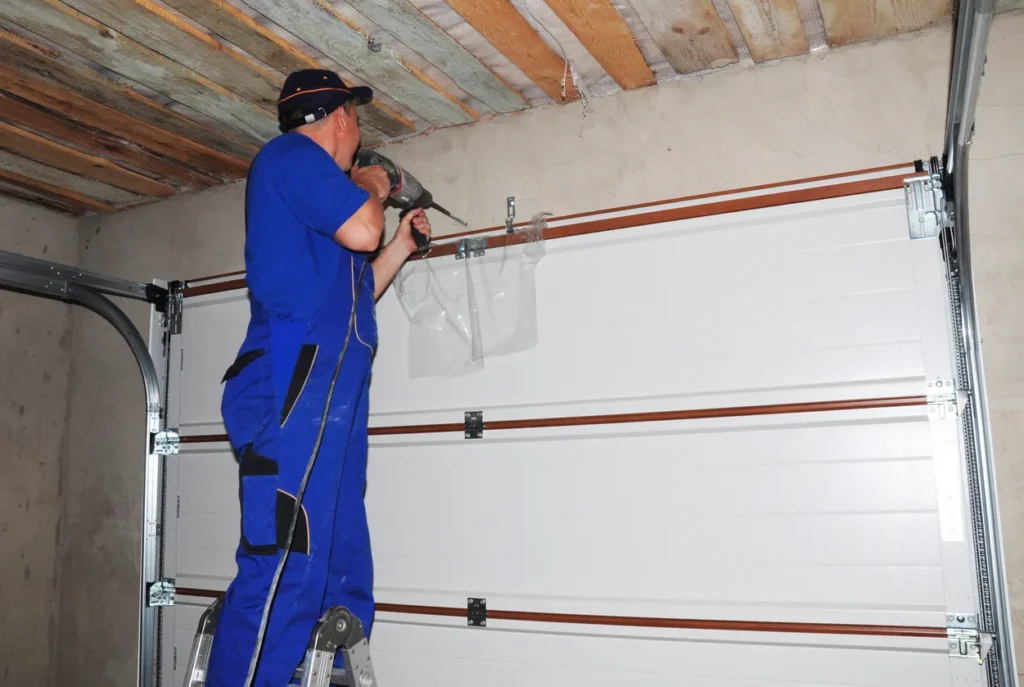
The Spring Replacement Process
Restoring a garage door to full operation involves a precise sequence of mechanical steps. This process is handled by experienced technicians who understand the physics of counterbalance systems. The goal is not just to replace the metal coil, but to reset the equilibrium of the entire door system so that it can be lifted manually with one hand or by the electric opener with minimal strain.
Securing the Workspace:
- The garage door is clamped to the track to prevent movement.
- Power to the automatic opener is disconnected to prevent accidental engagement during the repair.
- Ladder placement is adjusted for stability, particularly in garages with high ceilings or uneven floors.
Unwinding and Removal:
- For torsion systems, any remaining tension on the unbroken spring (if applicable) is carefully released using winding bars. This is the most critical safety step.
- The set screws on the winding cones are loosened, and the old springs are slid off the torsion tube.
- For extension systems, safety cables are disconnected, and the pulleys are inspected for wear before the spring is unhooked.
Installation of New Hardware:
- New springs are slid onto the torsion tube or attached to the pulley system.
- Center bearings and end bearing plates are checked for fluidity; if they are seized, they are replaced to prevent friction.
- The springs are anchored to the center bracket and the winding cones are positioned.
Winding and Balancing:
- Tension is added to the new springs by winding them to a specific count calculated based on the door height.
- The door is tested manually. A properly balanced door should stay halfway open without falling or shooting up.
- If the balance is off, tension is micro-adjusted until neutral buoyancy is achieved.
Final System Check:
- All fasteners are tightened.
- The automatic opener is re-engaged and the force settings are recalibrated to match the new spring tension.
- Lubricant is applied to the coils to reduce friction and noise.
Deciding Between Repair and System Upgrades
A common question during a service call is whether to simply replace the broken spring or to look at the broader health of the garage door system. While a broken spring is a singular point of failure, it is often a symptom of age or cycle exhaustion. Garage door springs are rated by “cycles”, one cycle being a full open and close operation. Standard builder-grade springs are typically rated for 10,000 cycles. If you use your door as the main entry point to your home, you may burn through these cycles in just a few years.
Replacing the broken spring is the baseline requirement to get the door moving again. However, if your system utilizes a two-spring setup and only one has snapped, it is standard industry practice to replace both simultaneously. Since both springs were installed at the same time and have lifted the same weight for the same number of cycles, the second spring is likely near the end of its fatigue life. Replacing both prevents a second service call in the near future and ensures the door lifts evenly.
Situations often arise where the failure of the spring has caused collateral damage. When a spring snaps, the sudden loss of lift support can cause cables to jump off their drums or pulleys to shear. If the door slammed shut, panels might be misaligned. In these scenarios, the repair scope expands to include resetting the cables and realigning the track. If the door is older and the panels are taking on water weight or showing signs of structural fatigue, a technician might discuss whether the cost of high-cycle springs is justified or if a full door replacement is a more economic long-term strategy. Good Golly Garage Doors focuses on providing the data you need to make this financial decision based on the remaining lifespan of your current equipment.
Critical Considerations for Mountain Climates
Operating a garage door in a high-altitude environment like Big Bear presents unique challenges that standard suburban repairs do not address. The climate here is characterized by heavy snowfall, fluctuating temperatures, and freezing conditions, all of which impact the metallurgy and performance of garage door springs.
Metal Brittleness and Cold:
- The sudden shock of engaging a frozen door can cause an older, brittle spring to snap instantly.
- High-quality, oil-tempered springs are generally recommended for these environments as they offer better resilience against temperature-induced stress.
Snow Loads and Ice Accumulation:
- Snow and ice accumulation at the bottom of the door adds unexpected weight.
- Even a few pounds of ice can throw off the precise balance of the spring tension.
- If the springs are not calibrated to account for the heavier, insulated doors typically found in mountain homes, the opener gear will strip trying to lift the dead weight.
Corrosion and Rust:
- Road salts and moisture brought into the garage on vehicle tires create a corrosive environment.
- Rust on a spring increases coil-to-coil friction, which slows down the door and increases the rate of metal fatigue.
- In this region, galvanized springs or a rigorous lubrication schedule are necessary to prevent premature rusting that leads to snapping.
The Importance of High-Cycle Springs
For homeowners who utilize their garage heavily, moving beyond standard springs to high-cycle options is a strategic upgrade. A standard spring may last 5 to 7 years depending on usage. High-cycle springs, which are larger and utilize a heavier wire gauge, can be rated for 25,000 to 50,000 cycles. This effectively doubles or triples the lifespan of the hardware.
In a mountain environment where service availability can be impacted by road conditions during storms, reliability is paramount. Installing high-cycle springs reduces the frequency of failure. This upgrade changes the geometry of the spring coils; they are often longer and wider, which distributes the stress of the lift more evenly across the metal. This distribution means less heat buildup and less fatigue per cycle.
When selecting replacement parts, the focus is on matching the “IPPT” (Inch Pounds Per Turn) to the door weight while increasing the cycle rating. This is a mathematical calculation performed by the technician. It allows the door to feel weightless to the opener while utilizing hardware that will not require attention for a decade or more.
Why Professional Calibration is Mandatory
Garage door spring repair is strictly a professional service due to the extreme danger involved. The springs act as the “muscle” of the door, while the opener is merely the “brain.” When the muscle is broken, the door is effectively a dead weight of several hundred pounds. Attempting to lift it manually can result in back injury or crushing hazards. Attempting to repair the spring without the proper winding bars and training can result in severe impact injuries or lacerations.
Beyond safety, professional calibration ensures the longevity of your automatic opener. If a spring is replaced but wound too tight (hot), the door will fly up, potentially damaging the radius tracks and the top section. If it is wound too loose (cold), the opener has to drag the door up, which will eventually strip the plastic gears inside the motor unit or burn out the capacitor.
Sensor Alignment:
- Vibration from a snapping spring often misaligns safety sensors.
- Technicians verify that the beam is uninterrupted and the reverse mechanism functions correctly.
Cable Inspection:
- Springs and cables work in tandem. Fraying cables are often discovered during spring replacement.
- Replacing cables during the spring service prevents a secondary failure where the door could fall unevenly.
Lubrication and Maintenance:
- Proper lubrication of the new springs is essential to ensure smooth operation.
- Silicone-based sprays are used to prevent the collection of dust and grit, which is common with grease-based lubricants.
Hardware Standards and Specifications
The quality of the steel used in the manufacture of the spring dictates its performance. We utilize springs manufactured to meet strict industry standards for tensile strength and ductility. The differentiation in hardware often comes down to the manufacturing process, whether the wire is hot-rolled or cold-rolled and how it is treated for corrosion resistance.
Torsion springs usually come in pairs for double-wide doors. The “left-wound” and “right-wound” springs are not interchangeable. They are color-coded (usually black and red) to indicate winding direction. Installing a spring on the wrong side or winding it in the reverse direction will cause the cables to unspool and the door to jam.
Extension springs utilize a different rating system based on pull weight. These springs stretch and contract rather than wind. They require safety containment cables, a steel cable that runs through the center of the spring. If an extension spring snaps, the safety cable keeps the metal fragments from becoming dangerous projectiles. Verifying the presence and condition of these safety cables is a non-negotiable part of the service.
Establishing Long-Term Door Health
Once the crisis of the broken spring is resolved, the focus shifts to maintaining that state of repair. Regular visual inspections can catch issues before they result in another failure. Look for gaps in the coils of torsion springs or elongation in extension springs. Listen for squeaking or grinding noises, which often indicate that the springs are dry and rubbing against themselves.
By choosing the correct hardware specifications and ensuring precise installation, the garage door remains a convenience rather than a liability. The seamless operation of the door protects your vehicle and maintains the thermal efficiency of your garage. When you prioritize quality parts and expert installation, you minimize the risk of being stuck in the snow or locked out of your home. Good Golly Garage Doors is committed to delivering this level of mechanical precision and reliability for every service call.
Secure your garage and restore convenience today; contact us now to schedule your spring repair service.
Safe & Fast Garage Door Spring Repair in Big Bear, CA
Broken springs are dangerous and leave your garage inoperable. Trust Good Golly Garage Doors for professional garage door spring repair in Big Bear, CA. We handle the high-tension work safely, replacing springs with durable, long-lasting parts. Avoid injury and downtime; schedule expert repair today.
Get Your Garage Door Springs Repaired Safely Today
 All Service Areas