

Garage Door Spring Repair in Anthem, AZ
Struggling with a broken garage door spring in Anthem? Contact Good Golly Garage Doors for expert same-day spring repair services and secure your garage today.
Is Your Garage Door Heavy or Refusing to Lift?
You press the button, the motor hums, but the door remains on the floor or only lifts a few inches before dropping back down. This is often the result of a broken garage door spring, a high-tension component responsible for supporting the full weight of the door. Springs commonly fail due to age, usage cycles, and the extreme temperature changes common in Anthem. If your garage door is no longer lifting properly, professional spring replacement is necessary to restore safe operation. Homeowners can contact our team to schedule service and discuss repair options.
A broken spring makes a garage door unsafe and difficult to operate, often trapping vehicles inside the garage. This type of failure rarely happens at a convenient time and should not be ignored. Good Golly Garage Doors specializes in professional garage door spring repair in Anthem, AZ. Our approach focuses on accuracy, safety, and long-term performance rather than temporary fixes. Call us to get started!
What to Expect From Professional Spring Replacement
When a spring breaks, the counterbalance system of the garage door is no longer functional. Electric openers are not designed to lift the full weight of the door, which can range from 150 to more than 300 pounds. Proper spring replacement restores balance so the door can be lifted smoothly and safely. Service begins with a detailed assessment to identify the type of spring system in use and determine the correct wire gauge and length required for proper balance. Replacement springs are selected based on the actual weight and height of the door, not generic sizing.
Rather than patching a failed component, damaged springs are replaced with high-cycle steel springs designed to withstand regular use. Standard builder-grade springs are typically rated for approximately 10,000 cycles. Higher-cycle options are available to help extend the lifespan of the repair and reduce future wear.
Each service visit includes an inspection of surrounding components. When a spring fails, the sudden release of tension can affect cables, drums, bearings, and mounting brackets. Lift cables are checked for fraying, drums are inspected for cracking, bearings are tested for smooth movement, and hardware is tightened as needed. The system is lubricated using products suitable for high-temperature environments.
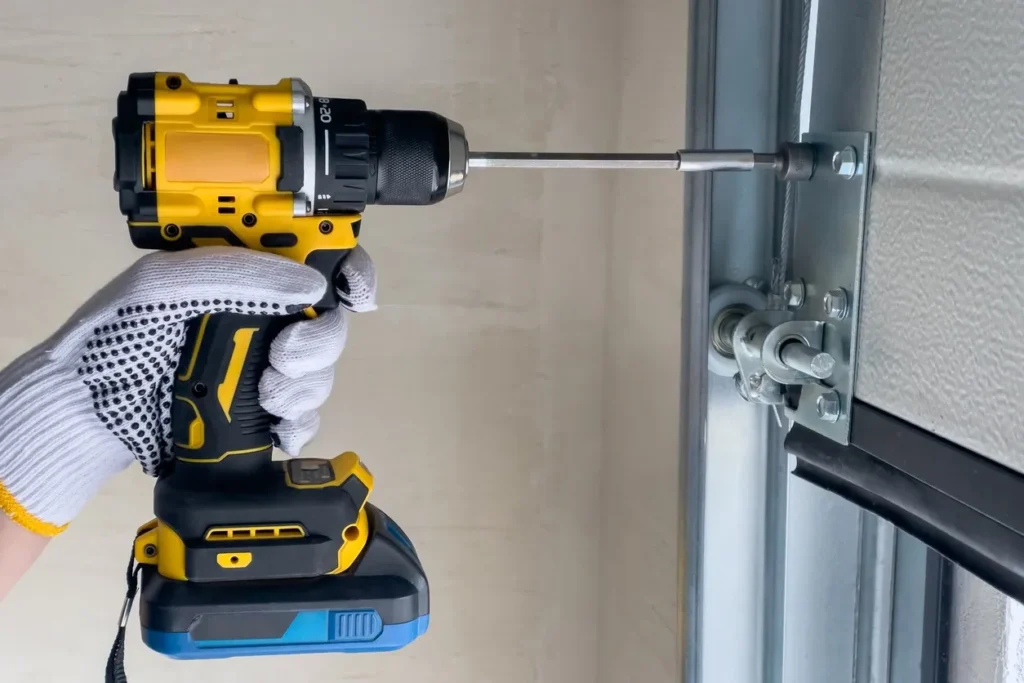
The Technical Process of Replacing Broken Springs
Replacing a garage door spring is widely considered the most dangerous aspect of garage door maintenance due to the extreme potential energy stored in the coils. We follow a strict, safety-first protocol to ensure the repair is performed without property damage or injury.
- Securing the Door: The process begins by clamping the door securely to the track to prevent it from moving unexpectedly. If the door is stuck halfway open, we carefully lower it to the closed position. This is critical because spring replacement must be done with the door completely closed to minimize tension on the cables during the initial setup.
- Releasing Residual Tension: If you have a torsion spring system (mounted on a bar above the door header), one spring may still be intact even if the other has broken. We insert winding bars into the cone of the unbroken spring to carefully unwind the tension. This step requires precise control, as a slipping bar can cause severe injury. For extension springs (located along the side tracks), we ensure the safety cables are detached and the springs are fully relaxed before removal.
- Disassembly and Removal: Once the tension is neutralized, we disconnect the springs from the center bracket and the end bearing plates. We slide the torsion tube over to remove the old spring coils. This is also the stage where we inspect the tube itself for bending or wear. If the bearings are seized, we remove them to prepare for new components.
- Installation of New Hardware: We slide the new springs onto the torsion tube. It is vital to install the correct wind direction (left-wound vs. right-wound) on the correct side of the center bracket. We bolt the springs to the center anchor bracket and re-engage the cable drums. The lift cables are checked to ensure they are seated perfectly in the drum grooves; a misaligned cable will cause the door to open crookedly.
- Winding and Balancing: Using winding bars, we wind the new springs to the specific tension required for the weight and height of your door. This is a mathematical calculation, not a guess. A standard 7-foot door usually requires a specific number of quarter-turns. After winding, we test the balance. We disconnect the opener and lift the door manually. A perfectly balanced door should stay suspended halfway open without drifting up or falling down.
- Final Calibration: Once balanced, we reconnect the electric opener and adjust the force and limit settings. We run the door through several cycles to ensure smooth operation and verify that the safety reversal system is functioning correctly.
Why We Always Replace Both Springs
Homeowners often ask if they can replace only the single spring that snapped to save on costs. While technically possible, this is strongly discouraged and is not a practice we stand by for long-term reliability. Garage door springs are installed in pairs (on most double-car doors) and are rated for the same cycle life. If one spring has broken due to metal fatigue and usage, the second spring is undoubtedly nearing the end of its lifespan as well.
Replacing only one spring creates an imbalance in the door. The new spring will have maximum tension and elasticity, while the old spring will be stretched and weaker. This forces the new spring to work harder, wearing it out prematurely. Furthermore, the imbalance can cause the door to rack or twist as it opens, putting unnecessary strain on the rollers and the electric opener’s gear system.
Servicing both springs simultaneously saves you money in the long run. It prevents the need for a second emergency service call when the second spring inevitably snaps a few weeks or months later. It ensures that the door lifts evenly, protecting your motor and tracks from damage.
Differentiators in Spring Repair Service
Choosing the right provider for high-tension repairs is a decision that impacts the safety of your home. We distinguish our service through technical accuracy and inventory readiness. Many general handymen or less specialized services may attempt to use a “one-size-fits-all” spring. However, springs are specific to the pound. Installing a spring meant for a 200lb door on a 180lb door will make the door “hot” (too fast to open, hard to close), while an undersized spring will destroy your opener gears.
We arrive with fully stocked trucks containing a wide variety of wire gauges and lengths. This allows us to cut and install the exact spring needed for your specific door weight, regardless of whether it is an insulated steelback door or a custom wood overlay door.
Our technicians are trained to diagnose the root cause of the failure. Sometimes a spring breaks early because the wrong size was installed previously. We measure the door weight directly rather than simply reading the color code on the old spring, ensuring that we correct any past errors. Good Golly Garage Doors prioritizes the longevity of your system over a quick fix.
Indicators That Your Spring Is About to Fail
Spring failure often happens suddenly and can be accompanied by a loud noise. However, there are warning signs that may appear beforehand. Recognizing these indicators can help homeowners plan for replacement before the door becomes inoperable.
- Visible Gaps in the Coil: If you look at the torsion spring above the door and see a visible two-inch gap in the coil, the spring has already snapped. This is the most obvious sign, but often homeowners don’t look up until the door fails to open.
- Elongation of Extension Springs: For doors with springs on the sides, look for elongation. If the coils look stretched out and do not return to a tight coil when the door is open (tension released), the metal has lost its elasticity and is liable to snap soon.
- Loud Squeaking or Groaning: While noise can indicate a need for lubrication, a loud groaning sound that persists despite lubrication suggests the metal is straining under the load.
- Door Falls When Released: If you pull the emergency release cord (with the door closed) and lift the door to waist height, it should stay there. If it feels incredibly heavy or immediately slams to the floor, the springs are worn out and are no longer providing sufficient lift assistance.
Regular inspection and timely repair are key to keeping your garage door safe and reliable. With the Good Golly Gold Plan, members receive routine maintenance, and exclusive discounts on services, helping prevent sudden failures and extend the life of your garage door system.
Secure Your Garage Today
A broken garage door spring is more than an inconvenience; it is a breach of your home’s security and a safety hazard. Attempting to lift a door with a broken spring manually can result in back injuries or crushed fingers, and DIY repair attempts on high-tension springs are statistically dangerous.
We provide the expertise and parts required to fix the issue correctly the first time. Don’t let a stuck door disrupt your schedule or leave your home vulnerable. Trust Good Golly Garage Doors to restore the balance and functionality of your garage door with professional precision. Contact us now to schedule your garage door spring repair in Anthem, AZ!
Proudly Serving Phoenix, AZ, and Surrounding Areas
We provide the best garage door services you can find across Phoenix, AZ. Whether it’s the impact of Phoenix’s heat and sudden storms on garage door components, we ensure our solutions are tailored to your needs. Wherever you are, Good Golly Garage Doors is ready to deliver.
Call (602) 399-7054 All Service Areas