

Garage Door Spring Repair in Adelanto, CA
Repair broken or worn springs with expert garage door spring repair in Adelanto, CA from Good Golly Garage Doors. Call now to schedule dependable service!
Trapped by a Heavy Garage Door That Won’t Budge?
Dealing with a garage door that won’t open can disrupt your entire day, leaving your vehicle trapped or your home vulnerable. When a spring snaps, the door becomes dead weight, making it dangerous or impossible to lift manually. For reliable resolution, schedule a professional spring repair
Residents in Adelanto often face this issue unexpectedly, but the solution is straightforward when handled by professionals. Our team specializes in diagnosing the failure points of your lift system and restoring functionality with high-quality components.
- Get your garage door fixed with professional service options.
- Receive clear, upfront pricing with no hidden fees discussed before work begins.
- Trust in professional service backed by manufacturer warranties, which typically apply for about one year on parts, along with workmanship coverage.
All services are performed by certified technicians with full adherence to local safety codes.
Spring Repair: What to Expect During Service
When a garage door spring breaks, it is rarely a subtle event. You likely heard a loud bang resembling a gunshot or a firecracker coming from the garage. This noise occurs because the potential energy stored in the tightly wound coils is suddenly released. Once this happens, the counterbalance system fails, and the door feels incredibly heavy, often weighing upwards of 200 to 300 pounds. Attempting to use the automatic opener in this state can strip its gears or burn out the motor, leading to more expensive repairs.
Good Golly Garage Doors provides a structured, responsive approach to getting your system back online. The focus is on safety and accuracy. Upon arrival, a technician performs a 25-point safety inspection. This is not just to look at the broken spring, but to determine if the sudden snap caused collateral damage to cables, drums, or rollers.
Here is what generally happens during a service visit:
- System Diagnosis: The technician identifies whether you have a torsion spring system (mounted above the door) or an extension spring system (mounted along the sides).
- Weight Assessment: We weigh the door to ensure the replacement springs match the specific lift requirements. Installing the wrong size can cause the door to bounce or crash.
- Inventory Availability: Technicians carry commonly used spring sizes and components, allowing many repairs to be completed during the visit when appropriate parts are available.
- Safety Containment: If the door is stuck in a partially open position, we secure it to prevent falling before any work begins.
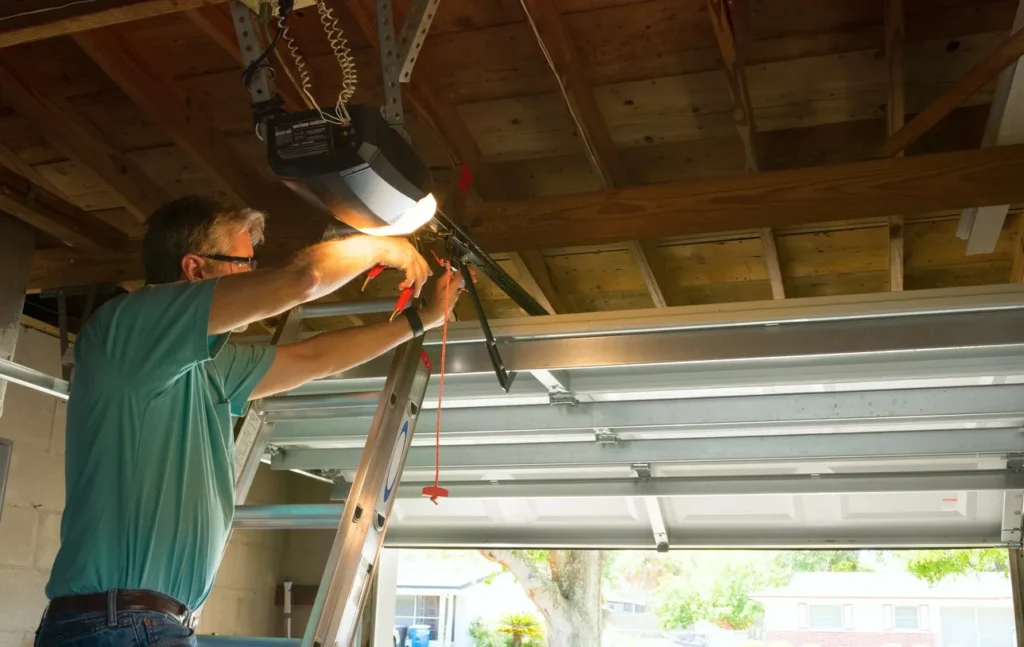
The Torsion and Extension Spring Replacement Process
Repairing a garage door spring is technically a replacement process. Springs cannot be welded or put back together once the metal has fatigued and separated. The replacement procedure is precise and involves handling high-tension components that can be dangerous if mishandled. Understanding the steps involved helps illustrate why this is a job for equipped professionals rather than a DIY project.
Preparing the Door and Workspace
The workspace must be cleared to allow for safe ladder placement and tool access. The process begins by disconnecting the electric garage door opener to prevent accidental activation. This ensures that the drive mechanism is disengaged, allowing the technician to manipulate the door manually. Clamps are applied to the track just above the rollers to lock the door in the down position. This is critical because the springs provide lift. If they are manipulated while the door is unsecured, the door could move unexpectedly.
Unwinding and Removal
For torsion spring systems, the intact spring (if there are two) must be carefully unwound. Even though one spring is broken, the other still holds significant tension.
- Technicians use hardened steel winding bars that fit precisely into the winding cone.
- The tension is released in quarter-turn increments.
- Great care is taken to keep the body positioned away from the cone of danger in case a winding bar slips.
- Once all tension is removed, the center bearing plate and cable drums are loosened, allowing the old springs to be slid off the torsion tube.
Installation of New Coils
The new springs are selected based on the door’s weight and track radius. We slide the new springs onto the torsion tube, replacing the center bearing if it shows signs of wear. The cable drums are re-secured, ensuring the lift cables have equal tension on both sides. Uneven cables can cause the door to rack or jam in the tracks.
Winding and Balancing
This is the most physically demanding part of the repair. The new springs must be wound to a specific number of turns calculated based on the height of the door.
- The technician uses winding bars to tighten the spring, adding tension.
- Once the calculated turns are achieved, the set screws are tightened to lock the spring to the shaft.
- The technician then tests the balance of the door. A properly balanced door should stay in place when lifted halfway up manually. It should not move rapidly upward or drift downward.
- Adjustments are made in small increments until the balance is correct.
Deciding Between Spring Repair and Complete Replacement
Homeowners often ask if they can just replace the one broken spring or if they need to overhaul the entire system. While the immediate goal is to address the break, looking at the broader health of the garage door system is financially prudent.
The Both Springs Rule
Most standard garage doors utilize two springs to share the weight. These springs are installed at the same time and undergo the same number of open and close cycles. If one spring breaks, the second spring is likely near the end of its lifespan as well. Replacing only one spring creates an imbalance because the new spring is tight and fresh, while the old one is stretched and fatigued.
- Replacing both springs ensures the door lifts evenly.
- It helps avoid an additional service visit if the second spring fails later.
- It provides a unified warranty start date for the hardware.
High-Cycle vs. Standard-Cycle Springs
When selecting a replacement, you have options regarding durability. Standard springs are typically rated for 10,000 cycles. For an active household using the door frequently, this may last only a few years.
- Standard Cycle: Best for homeowners planning to move soon or for garages that are used less frequently.
- High-Cycle Options: These springs are larger and engineered to last 25,000 to 50,000 cycles. They cost more upfront but can extend the time between replacements.
- Powder Coated vs. Oil Tempered: We help you decide between corrosion-resistant coated springs, which are cleaner and rust-resistant, and oil-tempered springs, which are durable and self-lubricating but may leave residue.
Assessing the Opener and Hardware
Sometimes a spring break is forceful enough to damage the electric opener. If the gear sprocket inside the opener is stripped, or if the trolley arm is bent, we may recommend addressing those components at the same time. If your door system is over 15 years old, uninsulated, and showing track or panel wear, it may be worth discussing long-term options rather than continuing to repair aging components.
Why Professional Spring Service Ensures Long-Term Safety
Garage door spring replacement is consistently ranked as one of the most dangerous home repairs for untrained individuals. The amount of torque required to lift a heavy garage door is stored entirely within the springs. Improper tools or techniques can lead to serious injury.
Beyond the immediate physical risk, improper installation can shorten the lifespan of other components.
- Opener Preservation: The electric opener is designed to move a balanced door. If the springs are not calibrated correctly, excessive strain can damage internal gears and motors.
- Structural Integrity: An unbalanced door places uneven pressure on tracks and rollers, which can lead to misalignment or component failure over time.
Good Golly Garage Doors utilizes certified technicians who understand the mechanics of the lift system. We measure door weight and select springs with the correct wire gauge and length for the specific garage door system.
Warranty and Peace of Mind
Opting for professional repair provides financial protection. DIY repairs do not include warranty coverage. Professional service includes manufacturer warranties on parts, typically around one year, along with labor coverage. If adjustments are needed as springs settle, those concerns can be addressed under the terms provided.
Professional technicians can also identify early signs of wear in cables, bearings, and rollers, helping prevent future breakdowns.
Restoring Convenience
The goal is to restore normal operation so your garage door opens and closes smoothly and securely. Professional service allows the system to be tested, balanced, and adjusted correctly so you can use your door with confidence.
Restore Safe, Reliable Operation with Professional Spring Repair
A broken garage door spring can disrupt daily routines and compromise safety. With careful diagnostics, properly calibrated replacement springs, and adherence to safety standards, Good Golly Garage Doors restores reliable operation to your garage door system. Ensure your repair is handled with precision, safety, and local expertise. Contact us to schedule service.
Proudly Serving Victorville and Surrounding Areas
We provide the best garage door services you can find across Victorville, CA. Wherever you are, Good Golly Garage Doors is ready to deliver. Let’s get your garage door in Victorville, CA or beyond back in top shape with service that’s fast, friendly, and built to last.
Call (760) 979-0605 All Service Areas