
Garage Door Service In Leander, TX
Caught with a non-functioning garage door when you least expect it? At Good Golly Garage Doors, we offer rapid, reliable repairs around the clock. Contact us immediately to schedule a diagnostic visit or emergency repair. Residents in Leander often face unexpected mechanical failures due to weather or wear, and a stuck door can trap your vehicle or leave your home vulnerable. We address these issues head-on with professional speed and precision.
- Same-day service ensures your garage door is fixed without delay.
- 24/7 availability means help is always just a phone call away.
- Trust in top-rated local technicians with decades of combined experience.
All services come with a solid warranty and no hidden fees—guaranteed.
Comprehensive Service Scope and Capabilities
When a garage door malfunctions, the root cause is often hidden within the complex interplay of tension and weight distribution. A service call involves a thorough inspection of the entire counterbalance system, the opener mechanism, and the structural integrity of the panels. Addressing the immediate symptom, such as a noisy door or a unit that refuses to close, requires examining every moving part to ensure long-term reliability.
Torsion and Extension Spring Management: The springs are the workhorses of your garage door system, bearing the heavy lifting every time you cycle the door. Over time, metal fatigue sets in, leading to snaps or loss of tension.
- Technicians safely unwind and remove damaged torsion springs located above the door header.
- Extension springs, found along the horizontal tracks, are inspected for fraying and proper safety cable installation.
- High-cycle springs are available for homeowners who use their garage as the primary entry point, offering greater longevity than standard builder-grade springs.
- Balancing the door is a critical step; a door must remain stationary when manually lifted halfway to ensure the opener is not being overworked.
Opener Diagnostics and Motor Repair: The operator unit is responsible for the automation of the door, but it relies on a well-balanced system to function correctly. Issues often manifest as grinding noises, intermittent operation, or failure to respond to remote commands.
- Gear and sprocket assemblies are checked for wear, particularly in chain-drive units where plastic gears can strip over time.
- Logic boards and capacitors are tested to ensure electrical signals are processing correctly, especially after local power surges or lightning storms common in the region.
- Limit switch adjustments ensure the door closes creates a tight seal against the concrete without reversing unexpectedly.
- Belt drive systems are inspected for tension and integrity to maintain quiet operation.
Cable and Drum Restoration: Cables work in tandem with springs to lift the door. When a cable frays or snaps, the door can become crooked, jamming in the tracks.
- Frayed aircraft-grade cables are replaced immediately to prevent catastrophic failure.
- Cable drums are inspected for cracks or damage that could cause the cable to slip off during operation.
- Technicians ensure that both cables have equal tension to prevent the door from racking or twisting during travel.
Track and Roller Alignment: The guide tracks dictate the path of the door. If these are bent, rusted, or misaligned, the door will bind or derail.
- Vertical and horizontal tracks are leveled and secured to the framing to prevent movement.
- Nylon or steel rollers are inspected; worn rollers with bad bearings cause excessive noise and vibration.
- Cleaning and lubricating the tracks removes debris that causes friction, ensuring smooth travel for the door sections.
The Service Process From Start to Finish
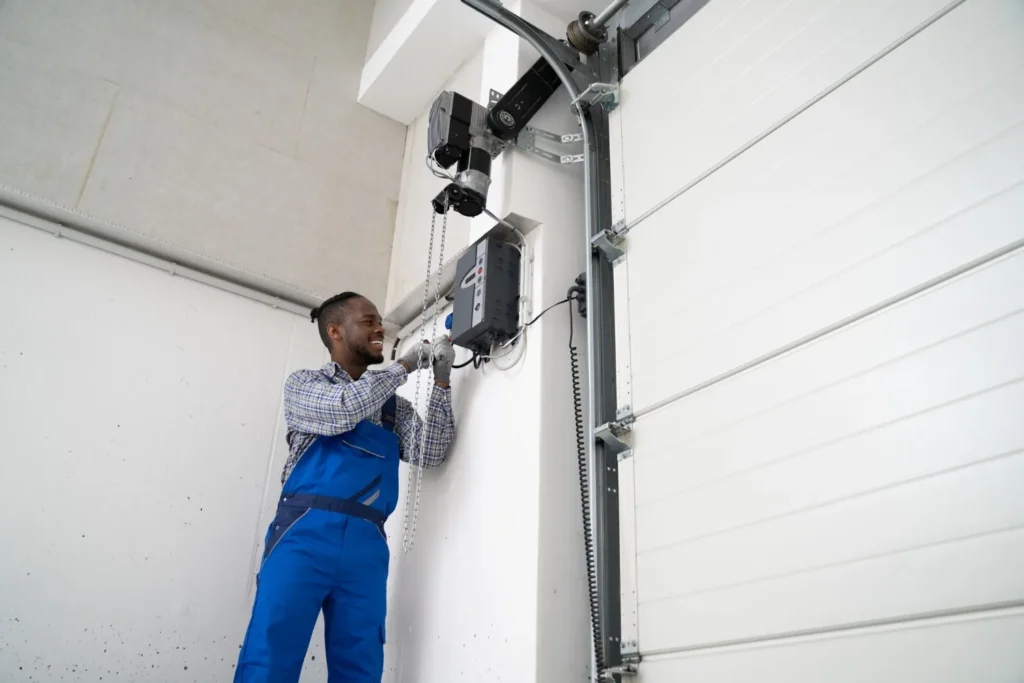
Understanding the workflow of a professional service visit helps homeowners prepare and ensures transparency. The goal is to move from a state of malfunction to full operation with minimal disruption to your day. This process is designed to be efficient, safety-focused, and thorough:
- Initial Safety Inspection and Diagnosis: The technician arrives and begins by securing the area. A 25-point safety inspection is conducted to identify not just the obvious breakage, but any underlying stress points. This involves manually testing the door’s balance, checking the safety reversal system (sensors), and visually inspecting hardware for signs of metal fatigue or rust.
- Clear Explanation and Estimate: Once the issue is isolated, the technician provides a detailed explanation of the problem. You receive options for repair, ranging from the bare minimum fix to a comprehensive overhaul that ensures longevity. A flat-rate quote is provided upfront, so there are no surprises regarding labor or parts costs once the work begins.
- Execution of Repairs: Upon approval, the technician proceeds with the repair using stocked inventory from the service truck. This typically involves isolating the energy in the springs, removing damaged components, and installing new, high-quality parts. The focus is on precision; bolts are tightened to spec, and cables are wound with exact tension.
- System Calibration and Testing: After the mechanical repairs are complete, the system undergoes rigorous testing. The opener force settings are calibrated to ensure the door reverses if it hits an object. The travel limits are set so the door seals tightly against the floor without buckling. The technician cycles the door multiple times to watch for smooth operation and listen for irregularities.
- Final Walkthrough: The service concludes with a demonstration. The technician shows you what was fixed, explains basic maintenance tasks you can perform (like lubrication), and verifies that all accessories, such as remotes and keypads, are functioning correctly.
Determining When to Repair or Replace Your Unit
Homeowners often struggle with the decision of whether to pour money into an existing system or invest in a full replacement. While repairs are often the most cost-effective route for isolated issues, there are specific thresholds where replacement becomes the smarter financial and functional choice:
- The 50% Rule: A general guideline in the industry suggests that if the cost of the repair approaches or exceeds 50% of the cost of a new garage door system, replacement is the better investment. This is particularly true if the current door is older and likely to experience other failures in the near future. Spending money on a new motor for a door with rotting panels and rusted tracks is rarely a wise long-term decision.
- Age and Safety Standards: Garage doors have changed significantly over the last two decades.
- If your opener was manufactured before 1993 and lacks photoelectric safety sensors (the “eyes” at the bottom of the tracks), it is non-compliant with modern safety codes and should be replaced.
- Wooden doors that have warped, cracked, or absorbed significant moisture often become too heavy for standard openers and springs. In these cases, upgrading to a lightweight, insulated steel door improves safety and reduces strain on the mechanism.
- Energy Efficiency and Insulation: Older, non-insulated doors act as a thermal bridge, allowing heat to escape in the winter and enter in the summer.
- If the garage is attached to the home or has a room above it, upgrading to a sandwich-style door with polystyrene or polyurethane insulation can significantly lower energy bills.
- Damaged seals and weatherstripping on old doors are often difficult to replace perfectly; a new system comes with factory-sealed joints and bottom astragals that keep the elements out.
- Aesthetic and Curb Appeal: Sometimes the door functions, but it drags down the property value.
- Dented steel panels cannot always be repaired to look like new. If multiple panels are damaged, finding a color and design match for an obsolete model can be impossible.
- Replacing the door offers an immediate boost in curb appeal, with modern options offering wood-grain finishes, window inserts, and contemporary hardware that matches the home’s architecture.
Regional Factors Impacting Garage Door Performance
Operating a garage door in Central Texas presents unique challenges due to the specific climate and environmental conditions found in Leander and the surrounding areas. A standard maintenance schedule often isn’t enough; homeowners must be aware of how local weather patterns accelerate wear and tear.
Humidity and Rust Correlation
The humid subtropical climate ensures that moisture is constantly present in the air:
- Unprotected steel components, particularly the bottom brackets and the lower sections of the tracks, are highly susceptible to oxidation.
- Surface rust can quickly become structural rot if not treated. Technicians often recommend galvanized or powder-coated hardware for increased resistance.
- Wooden doors require frequent staining or painting to prevent the wood fibers from swelling, which adds weight and throws off the spring tension.
Soil Shifting and Foundation Movement
The clay-heavy soil in the region expands and contracts significantly with moisture levels:
- This ground movement can shift the garage foundation slightly, causing the door frame to go out of square.
- When the frame shifts, the tracks may no longer be parallel, leading to binding or a door that hangs unevenly.
- Regular track adjustments are necessary to compensate for these subtle structural shifts to prevent motor burnout.
Storm Durability and Wind Load
Spring and fall bring severe weather, including thunderstorms and the potential for high winds:
- Garage doors are large surface areas that take a beating during high winds. Reinforcement struts are essential to prevent the door from buckling under negative or positive wind pressure.
- Lightning strikes and power surges are common causes of opener logic board failure. Installing a surge protector specifically for the garage door opener is a recommended precaution.
- Battery backup systems are increasingly popular and often necessary. During a storm-induced power outage, a battery backup ensures you can still get your car in and out of the garage without manually lifting the heavy door.
The Value of Professional Diagnostics
While the DIY spirit is commendable for many home projects, the garage door system involves high-tension components that pose significant safety risks. Good Golly Garage Doors prioritizes safety and precision in every service call. The counterbalance system, specifically the torsion springs, holds enough potential energy to cause severe injury if mishandled. Professional technicians possess the specific winding bars and training to manipulate this tension safely.
Furthermore, professional diagnosis goes beyond the obvious. A homeowner might see a broken cable, but a technician sees that the bearing plate was seized, which caused the cable to fray in the first place. Fixing the symptom without addressing the cause leads to repeat failures. Professional service ensures that the door is balanced, the force limits are compliant with safety standards (UL 325), and the entire system operates quietly and efficiently.
Using a professional service also safeguards your warranty. Many manufacturers of doors and openers void their warranties if installations or repairs are performed by uncertified individuals. By utilizing licensed experts, you ensure that the paper trail for parts and labor remains valid, protecting your investment for years to come.
Secure Your Garage and Restore Convenience
A malfunction in your garage entry system disrupts your daily routine and compromises the security of your home. Whether it is a snapped spring, a burnt-out motor, or a door that has come off its tracks, immediate professional attention is required to restore function and safety. Do not attempt hazardous repairs on your own. Rely on a team that understands the specific needs of Leander homes and offers the speed and expertise required to get the job done right the first time.
Call today to schedule your comprehensive repair service or diagnostic visit.
 All Service Areas