
Garage Door Remote Repair in Georgetown, TX
Struggling with a faulty garage door remote in Georgetown? Contact us for same-day repairs, comprehensive diagnostics, and system upgrades. Restore your security today!
Is Your Garage Door Opener Refusing to Cooperate?
If your garage door remote has stopped working, you are facing one of the most common yet frustrating issues homeowners encounter, often leaving you stuck outside in the heat or unable to secure your home. Don’t let a faulty remote disrupt your day; contact us immediately to schedule a diagnostic or discuss financing options for a system upgrade.
When you press the button and nothing happens, the security and convenience of your home in Georgetown are instantly compromised. We provide a direct, professional resolution to restore your access immediately.
- Receive same-day repair services to ensure minimal downtime and restore your home’s security.
- Benefit from skilled technicians using the latest tools for quick diagnostics and precise frequency matching.
- Enjoy long-lasting repairs with high-quality parts and industry-leading warranties on labor and hardware.
Fully licensed and insured—guaranteed compliance with local building standards.
Complete Diagnostic and Repair Services Included
When a remote fails, the issue is rarely as simple as a dead battery. While swapping a battery is a good first step for a homeowner, persistent issues usually indicate a failure in the communication protocol between the handheld transmitter and the overhead receiver. We provide a comprehensive service that goes beyond simple battery replacement to identify exactly why the signal is not reaching the motor.
Our service begins with a complete radio frequency analysis. Garage door openers operate on specific frequencies (typically 315 MHz, 390 MHz, or dual-band). If the internal oscillator in your remote has drifted, it will no longer communicate with the opener. Good Golly Garage Doors technicians arrive equipped with frequency counters and signal strength meters to determine if the remote is transmitting a clean signal or if it has failed entirely.
We also inspect the logic board on the main opener unit. Often, the remote is functioning perfectly, but the receiver—the “brain” of the garage door opener—has suffered a blown capacitor or a cold solder joint. In Georgetown, where summer temperatures in the mid-90s are common, heat stress on garage electronics can frequently lead to logic board failure. We test the receiver to ensure it can still accept and process commands.
The scope of our repair service includes:
- Signal Interference Testing: We identify external sources of radio frequency interference (RFI) that may be jamming your signal.
- Code Clearing and Resetting: We wipe the memory of your opener to remove old codes, ensuring lost or stolen remotes can no longer open your door.
- Hardware Soldering: If the battery contacts inside the remote or the antenna connection on the opener are loose, we repair the connection to restore power flow.
- programming Synchronization: We professionally program your remote to the specific rolling code protocol of your opener, ensuring a secure, encrypted connection.
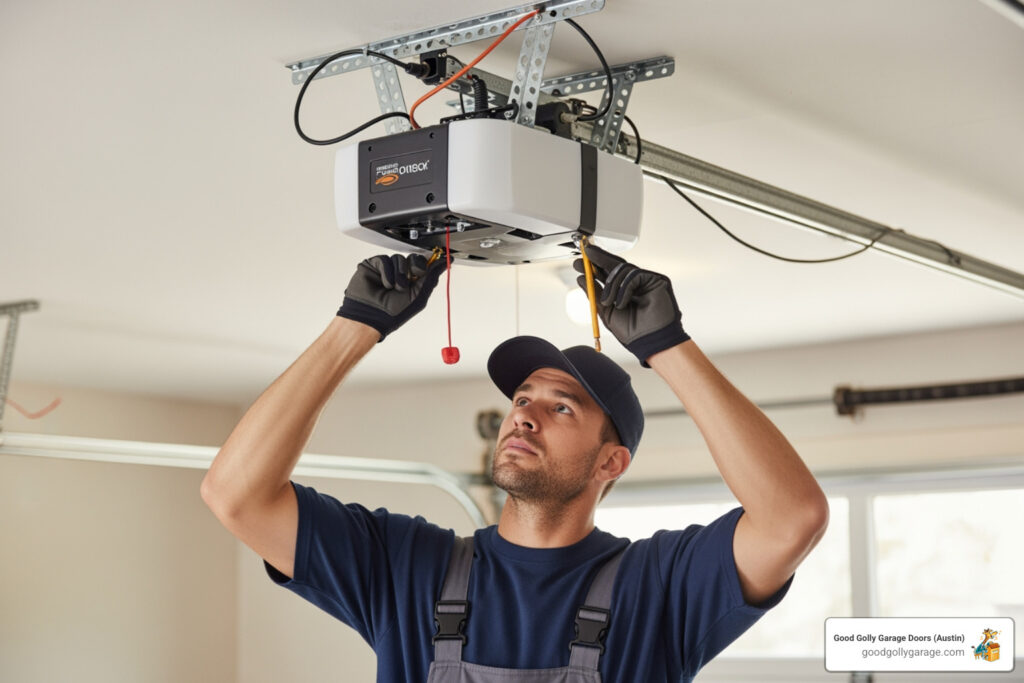
Our Repair Process: Quick, Efficient, and Transparent
We adhere to a strict, problem-solving protocol designed to isolate the fault and fix it without unnecessary upselling. We understand that you want the door to open when you press the button, and our process is built to achieve that outcome efficiently.
- Initial Site Inspection: Upon arrival at your Georgetown property, we inspect the physical condition of the remote and the opener. We look for signs of corrosion, water damage, or physical trauma to the casing.
- Frequency Analysis: We use specialized diagnostic tools to read the output of your remote control. This tells us immediately if the device is transmitting a signal and if that signal is strong enough to reach the receiver from the driveway.
- Receiver Testing: We trigger the opener manually and via a master remote to rule out motor failure. If the motor runs but ignores your specific remote, we isolate the issue to the receiver logic or the transmitter itself.
- Interference Scan: If both the remote and receiver appear healthy but range is poor, we scan for interference. Common household items, such as low-quality LED light bulbs installed in the opener, can emit frequencies that block the remote signal.
- Execution of Repair: Whether it involves soldering a circuit, replacing a specific capacitor, or reprogramming the security codes, we perform the fix on-site.
- Final Range Test: We do not leave until we have verified that the remote functions from a reasonable distance, ensuring you do not have to pull right up to the door for it to work.
Assessing When to Repair vs. Replace Your Garage Remote
Deciding between repairing an existing remote system or upgrading to a new one depends on several technical factors. While repair is often the most cost-effective route, there are scenarios where the technology is too obsolete or the damage is too extensive to warrant a fix.
You Should Repair When:
- The system is under 10 years old: Modern openers (manufactured after 2011) utilize advanced rolling code technology (Security+ 2.0 or similar) which is robust and worth maintaining.
- The issue is localized: If only one button on a three-button remote is failing, or if the casing is cracked but the board is intact, repair or shell replacement is viable.
- Interference is the culprit: If the hardware is fine but an LED bulb or nearby radio tower is causing issues, we can install a coaxial antenna extension to improve reception without replacing the equipment.
You Should Replace When:
- Dip Switch Technology is present: If your remote uses tiny internal switches to set the code, the technology is outdated and insecure. These “fixed code” systems are easily hacked. We recommend replacing these with modern, encrypted remotes.
- Logic Board Failure: If the receiver on the ceiling unit is dead and the part is discontinued or prohibitively expensive, it is often more economical to replace the entire opener head, which comes with new remotes included.
- Intermittent Security Issues: If your door opens on its own (phantom operation), this indicates a compromised frequency or a failing board. Replacement is a safety necessity in this case.
Adhering to Georgetown’s Standards and Seasonal Challenges
Operating in Georgetown, TX, presents specific challenges that generic troubleshooting guides do not address. The local climate significantly impacts the longevity and performance of garage door electronics.
Heat and Electronics:
The intense summer heat, often reaching the mid-90s, creates a kiln-like environment inside a closed garage. Electronics are sensitive to heat. The capacitors on the circuit board of your garage door opener can swell and fail, and the batteries inside a remote stored in a hot car can leak acid, destroying the contacts. Our technicians are trained to look for heat-related damage first. We use high-temperature grade components where possible and advise on proper remote storage to extend battery life.
Moisture and Corrosion:
While winters are generally mild, the spikes in rainfall during May and October introduce humidity. Moisture is the enemy of printed circuit boards. If your garage lacks proper insulation or weather sealing, humidity can cause oxidation on the remote’s internal chip or the opener’s antenna terminal. This oxidation creates high resistance, leading to intermittent signal failure. We clean these contacts with industrial deoxidizers and apply protective dielectric grease to prevent future corrosion.
Local Compliance:
All electrical repairs and installations we perform adhere to local Georgetown city codes. While swapping a battery does not require a permit, any work involving the hardwiring of the garage door opener unit to the home’s electrical system must comply with the National Electrical Code (NEC) as adopted by the city. We ensure that your system remains compliant, safe, and reliable.
Understanding Signal Interference Sources
One of the most complex aspects of remote repair is diagnosing “invisible” problems. You may find that your remote works perfectly in the evening but fails during the day, or works from inside the garage but not from the street. This is almost always due to Radio Frequency Interference (RFI).
Modern homes are filled with wireless devices, and the spectrum is crowded. Your garage door opener competes for “airtime” on the 315 MHz or 390 MHz frequencies.
- LED Lighting: This is the most common culprit. Cheap or non-compliant LED bulbs emit a frequency noise that sits exactly on the bandwidth used by garage door openers. When the light turns on, it jams the receiver. We identify these bulbs and replace them with shielded, low-interference alternatives.
- Nearby Radio Towers: In certain areas of Georgetown, proximity to commercial radio towers or emergency broadcast antennas can desensitize your opener’s receiver.
- Home Electronics: Wireless security cameras, baby monitors, and even battery chargers plugged into the same circuit as the opener can introduce noise.
Our diagnostic process involves isolating the opener from these sources. We may power down the home’s other circuits to verify if the interference is internal. If the interference is external and unavoidable, we can install an external receiver kit that operates on a different, less crowded frequency, effectively bypassing the interference.
Universal vs. OEM Remotes: Making the Right Choice
When a remote is beyond repair, the choice between a Universal remote and an Original Equipment Manufacturer (OEM) remote is critical. Many homeowners purchase generic remotes from big-box stores, only to find they lack range or lose programming after a few weeks.
Universal Remotes:
These are designed to work with multiple brands by mimicking various frequencies. While convenient, they often have a shorter transmission range. Furthermore, the programming steps can be complex, and they may not support the specialized features of your opener, such as light control or open-door indicators.
OEM Remotes:
An OEM remote is built specifically for your opener’s logic board. It uses the exact antenna geometry required for maximum range and reliability. It supports the proprietary encryption protocols (like Security+ 2.0 or MyQ) that universal remotes sometimes struggle to replicate perfectly.
We generally recommend and stock OEM replacements for major brands like LiftMaster, Chamberlain, Genie, and Craftsman. However, in cases where the original manufacturer has discontinued the part, we provide high-quality, professional-grade universal solutions that we have tested for reliability in the Georgetown area.
Why Choose Us? Experience and Trust in Georgetown
Fixing a garage door remote requires more than just guesswork; it requires an understanding of radio frequencies, circuit logic, and mechanical operations. We bring a level of technical expertise that ensures the problem is solved correctly on the first visit.
- Brand Agnostic Expertise: We are trained to service every major manufacturer. Whether you have a vintage screw-drive system or a modern wall-mount jackshaft opener, we understand the specific communication protocols required.
- Inventory on Hand: Our trucks are stocked with a wide variety of batteries, capacitors, logic boards, and replacement transmitters. This prevents the need for follow-up visits and shipping delays.
- Precision Programming: We don’t just get the door to open; we ensure the range is optimized. We adjust the antenna orientation and check the receiver’s sensitivity to give you the best possible performance from your driveway.
We treat every service call as an opportunity to demonstrate why we are the preferred choice for garage door solutions. We respect your time by offering accurate arrival windows and providing clear, upfront explanations of the technical issues affecting your system.
Secure Your Garage and Simplify Your Access
A non-responsive garage door remote is a breach of your home’s convenience and security. It forces you to leave your vehicle to open the door manually, which is not only an annoyance but a safety risk, especially at night or during inclement weather. You need a solution that is fast, permanent, and technically sound.
We provide the comprehensive diagnostics required to distinguish between a simple battery failure and a complex logic board issue. By addressing the root cause—whether it is interference, hardware failure, or programming errors—we restore the seamless operation of your entry system. Good Golly Garage Doors is committed to ensuring your garage door opens every time you press the button, giving you peace of mind and reliable access.
Don’t struggle with a remote that only works half the time. Restore effortless access to your home today.
Click here to schedule your same-day remote repairservice.
Proudly Serving Austin, TX, and Surrounding Areas
From the neighborhoods of Austin to Round Rock and Buda, we provide the best garage door services you can find across the area. Whether it’s the impact of Texas heat and sudden storms on garage door components, we ensure our solutions are tailored to your needs. Wherever you are, Good Golly Garage Doors is ready to deliver.
View All Cities
 All Service Areas