

Garage Door Remote Repair in Big Bear, CA
Struggling with a faulty garage door remote in Big Bear, CA? Contact us for same-day repair services, licensed technicians, and guaranteed results. Restore your home access now!
Is Your Clicker Not Communicating with the Opener?
You press the button, the LED light blinks, but the heavy door remains shut, leaving you stuck in the driveway or locked out of your home. This disconnect often happens at the worst times, especially during the extreme weather shifts common in Big Bear, CA, where a functional garage door is essential for protection against the elements. Contact us today to restore access to your home.
- Get same-day remote repair services, no more waiting in the cold.
- Licensed technicians ensure a safe, long-lasting fix for all major opener brands.
Rest easy with our guaranteed services and featured support designed to get you back inside quickly.
Expert Remote Repair Solutions
When a garage door remote stops working, it effectively renders your garage useless as a primary entry point. In the high desert climate, where temperatures drop significantly, dealing with a malfunction is more than just an inconvenience; it is a safety and comfort issue. Good Golly Garage Doors provides on-site diagnostics to determine why the signal is not reaching your opener.
Most homeowners assume a dead battery is the only culprit, but the issue often runs deeper.We do not simply swap batteries and leave; we analyze the radio frequency (RF) communication between the handheld transmitter and the overhead motor. If the remote has lost its programming due to power surges or electrical interference, we restore the connection on the spot.
The scope of our service includes inspecting the internal circuitry of the remote, checking the receiver logic board on the motor, and clearing the memory of the opener to ensure no unauthorized remotes have access. This is particularly important in areas with high rental turnover. We verify that every clicker in your possession, and the wireless keypad outside, is perfectly synchronized with the motor system. You receive a fully functional system that responds instantly to your command, eliminating the frustration of standing in the driveway pressing a button repeatedly without a response.
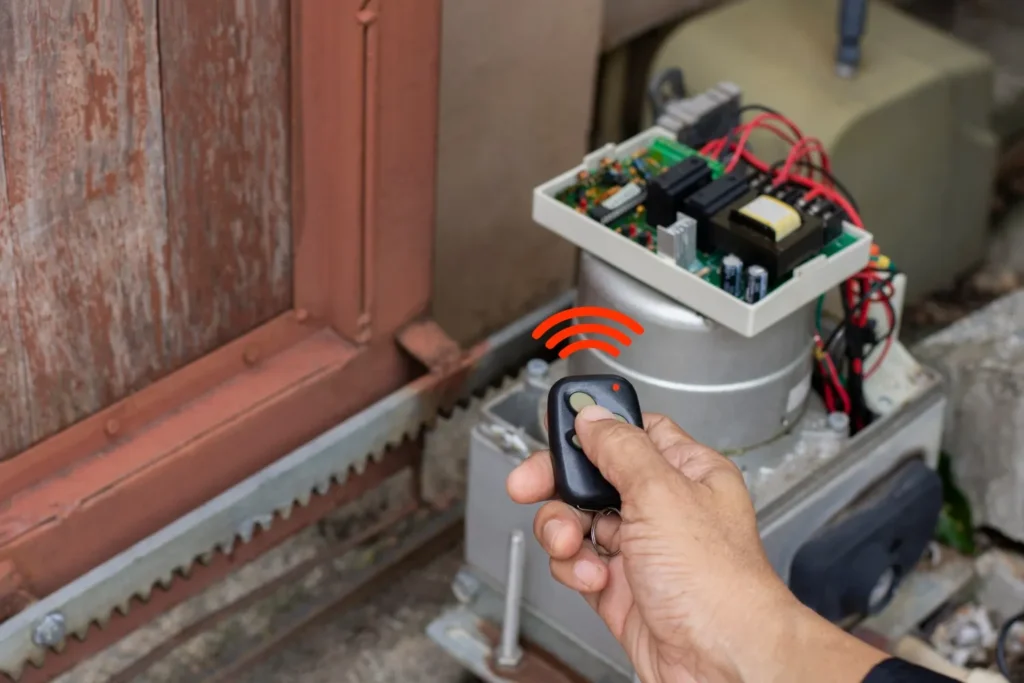
The Troubleshooting and Repair Process
Identifying the root cause of a remote failure requires a systematic approach. Our technicians follow a strict protocol to isolate the variable causing the communication breakdown. We do not guess; we test.
- Initial Signal Testing: First, the technician tests the signal strength of your current remote using specialized RF metering tools. This confirms whether the remote is actually transmitting a signal when the button is pressed or if the internal board is dead.
- Receiver Logic Board Inspection: Next, we inspect the garage door opener system hanging from the ceiling. The receiver, often part of the main logic board, must be able to “hear” the remote. If the opener works with the wall button but not the remote, the issue may lie with the receiver antenna or the board itself.
- Frequency Analysis: We determine if there is Radio Frequency Interference (RFI) in your garage. LED lights, nearby radio towers, or even appliances can emit signals that jam the frequency your remote uses. We identify these sources and suggest solutions, such as switching to a dual-frequency remote or installing ferrite cores.
- Memory Clearing and Reprogramming: For security and functionality, we clear the opener’s memory. This wipes out all previous codes. We then reprogram each remote one by one. This step ensures that any lost or stolen remotes can no longer open your door.
- Final Range Testing: Finally, we test the remote from various distances and angles outside the garage. A remote that only works when you are three feet away is not functional. We ensure you have the proper range to open the door before you pull into the driveway.
Deciding When to Replace the Remote vs. Repair
At a certain point, repairing an aging remote control becomes less cost-effective than replacing it with modern technology. Understanding the difference between a minor glitch and a hardware failure helps you make the right investment for your home access.
When to Repair
- Battery Issues: If the remote works intermittently and the LED light is dim, a battery replacement and contact cleaning usually suffice.
- De-synchronization: If the remote lost its programming due to a power outage, professional reprogramming will restore function without the need for new hardware.
- Dirty Contacts: Over time, dust and oxidation can build up on the battery terminals. A thorough cleaning often restores full power flow.
When to Replace
- Physical Damage: If the casing is cracked, the buttons are stuck, or the system has been dropped in water or snow, internal corrosion is likely. Replacement is the only reliable option.
- Obsolete Technology: If your system uses “dip switches” (a row of tiny switches inside the remote), you are using technology that is decades old and less secure. Upgrading to a “rolling code” remote prevents code grabbing and enhances home security.
- Circuit Failure: If the battery is fresh and the programming is correct, but the signal is still weak or non-existent, the internal transmitter chip has likely failed.
- Incompatible Aftermarket systems: If you are using a cheap “universal” remote bought from a big-box store that requires constant resetting, it is time to switch to a manufacturer-specific OEM remote or a high-quality universal system provided by a professional.
Local Factors Affecting Remote Performance
The specific environment in Big Bear presents unique challenges for garage door electronics. The high altitude and distinct seasonal changes directly impact the longevity and performance of remote controls and wireless keypads.
- Cold Weather Battery Drain: Extreme cold significantly reduces the voltage output of standard batteries. A battery that tests “good” at room temperature may fail to transmit a strong enough signal on a freezing morning. We recommend and supply lithium-based batteries or high-output alkaline options designed to withstand temperature drops.
- Signal Interference: In mountainous terrain with dense tree coverage, signal range can sometimes be affected. Furthermore, many homes in the area have metal siding or metal roofs, which can act as a Faraday cage, blocking radio waves. Our technicians can install antenna extensions to route the receiving wire outside the metal shielding, ensuring the remote works from the street.
- Vacation Home Security: Many properties in this region are second homes or vacation rentals. This makes access control vital. If you have guests coming and going, relying on a single old remote is risky. We can configure systems that allow for temporary codes or equip owners with remotes that can be easily reset between guest stays, ensuring that previous occupants cannot re-enter.
The Role of Modern Access Technology
If your current remote system is proving unreliable, it may be time to look at the receiver technology itself. Modern garage door openers utilize specific frequencies, typically 315 MHz or 390 MHz, that are designed to cut through interference better than older models.
- Rolling Code Security: Modern remotes use Security+ 2.0 or similar rolling code technology. Every time you press the button, the code changes. This renders “code grabbers” (devices thieves use to steal remote signals) useless. If your current remote is more than 15 years old, you likely lack this protection.
- Multi-Button Transmitters: If you have multiple garage doors, or a gate and a garage door, carrying multiple clickers is cumbersome. We provide 3-button mini remotes that can be programmed to operate different access points from a single device.
- Smart Connectivity: For homeowners who want to eliminate the remote entirely, we can integrate your opener with smartphone capabilities. This allows you to open and close the door from anywhere, which is an excellent feature for managing maintenance workers or guests at your Big Bear property without handing out physical keys or remotes.
Why Professional Diagnostics Matter
Attempting to fix a garage door remote with DIY methods often leads to wasted time and frustration. Buying a generic remote online frequently results in compatibility issues, as many openers require specific frequency matches that are not clearly labeled on the consumer packaging.
A professional assessment ensures that the problem is actually the remote. A “broken remote” is often a symptom of a locked “vacation switch” on the wall station, misaligned safety sensors preventing operation, or a burnt-out logic board on the motor. Good Golly Garage Doors technicians troubleshoot the entire system ecosystem. We verify that the wall console is not overriding the handheld signals and that the motor is receiving power correctly.
Furthermore, programming procedures vary wildly between brands like LiftMaster, Genie, Chamberlain, and Marantec. Incorrect programming sequences can inadvertently erase all remotes or desynchronize the wireless keypad. Our team handles the technical synchronization swiftly, ensuring that every device works in harmony. We also inspect the remote for “phantom operation,” a rare but dangerous condition where a shorted button sends a continuous signal, preventing other remotes from working and potentially opening the door unexpectedly.
Maintaining Your Remote System
Once your remote repair or replacement is complete, maintaining the signal strength is relatively simple but requires consistency.
- Regular Battery Checks: Do not wait for the remote to fail. Replace batteries every two years, or annually if the remote is kept in a car parked outside in freezing temperatures.
- Clean Operation: Keep the remote free of sticky residues and protect it from moisture. If you keep a remote on a keychain, ensure the buttons are not being pressed inadvertently in your pocket, which drains the battery prematurely.
- Visor Clip Care: Ensure the metal clip on your visor remote is tight. A loose remote can fall and crack the circuit board.
- Antenna Positioning: Ensure the antenna wire hanging from your garage door motor remains hanging straight down. If it gets tucked up into the motor housing or cut, your remote range will drop drastically.
Conclusion
A non-responsive garage door remote is a breach in your home’s convenience and security. Whether you are dealing with signal interference, dead circuitry, or outdated technology, the solution requires a professional touch to ensure reliability. You need a system that responds the moment you command it, keeping you out of the snow and safely inside your garage.
Good Golly Garage Doors delivers precise, effective solutions for all remote and opener issues. We move quickly to diagnose the fault, provide transparent options for repair or replacement, and ensure your home is secure. Do not let a small device cause a major disruption to your day.
Click here to schedule your remote repair service now.
Regain Control with Garage Door Remote Repair in Big Bear, CA
If your remote has stopped responding, it’s time for professional garage door remote repair in Big Bear, CA from Good Golly Garage Doors. We quickly identify the issue, whether it’s programming, signal, or battery, and restore full functionality. Don’t get stuck outside, book your repair before it disrupts your day.
Schedule Fast Remote Repair Service Now
Proudly Serving Victorville and Surrounding Areas
We provide the best garage door services you can find across Victorville, CA. Wherever you are, Good Golly Garage Doors is ready to deliver. Let’s get your garage door in Victorville, CA or beyond back in top shape with service that’s fast, friendly, and built to last.
Call (760) 979-0605 All Service Areas