

Garage Door Opener Repair in Summerlin, NV
Struggling with a faulty garage door opener in Summerlin, NV? Call Good Golly Garage Doors for 24/7 repair services. Fast, reliable repairs ensuring your safety and convenience.
Garage Door Opener Malfunctions Stopping Your Day?
Is your garage door refusing to open or close smoothly, leaving your vehicle trapped or your home exposed to the elements? You may be dealing with a mechanical failure, electrical fault, or sensor alignment issue that requires immediate professional attention to restore security and access. If you need urgent assistance, book your service now.
Good Golly Garage Doors understands that a broken opener is more than an inconvenience; it is a disruption to your safety and schedule. We provide targeted repair solutions for homeowners in Summerlin, NV, ensuring your automatic door system functions correctly.
- Quick, same-day repair services ensure minimal disruption to your daily routine.
- Experienced technicians available 24/7 to address urgent garage door issues.
- Comprehensive service covering all brands and systems for a guaranteed fix.
All repairs are fully licensed and come with a satisfaction guarantee to give you peace of mind.
What You Get With Our Opener Repair Service
When you schedule a service call, you receive a comprehensive diagnostic and repair solution designed to address the root cause of the failure, not just the symptoms. Garage door openers are complex electromechanical systems that rely on the synchronization of motors, gears, logic boards, and safety sensors. A surface-level fix often leads to recurring issues, which is why we focus on component-level inspection and repair.
Your service visit begins with a complete system evaluation. Technicians examine the drive mechanism—whether it is a chain, belt, or screw drive—to check for slack, stripped gears, or worn carriages. We test the motor’s torque to ensure it is lifting the door’s weight efficiently without overheating. If the motor hums but the door does not move, we investigate the internal plastic gears or the start capacitor, both of which are common failure points in older units.
We also address the electrical components that govern the opener’s logic. This includes testing the circuit board for burn marks or soldier joint failures, which can occur due to power surges. We reset and reprogram limit switches to ensure the door opens fully and closes tightly without reversing unexpectedly. Additionally, we troubleshoot connectivity issues between the opener unit, wall consoles, and remote transmitters to restore seamless operation.
- Full Safety Inspection: We verify the functionality of the auto-reverse safety mechanism and photo-eye sensors to ensure compliance with UL 325 safety standards.
- Drive System Adjustment: Technicians tighten chains or belts and lubricate the drive rail to reduce noise and friction during operation.
- Electrical Testing: We use multimeters to check voltage delivery to the motor and verify that the logic board is sending correct signals to all peripherals.
- Hardware Tightening: Vibration can loosen mounting hardware over time; we secure the motor head to the ceiling supports to prevent rattling and misalignment.
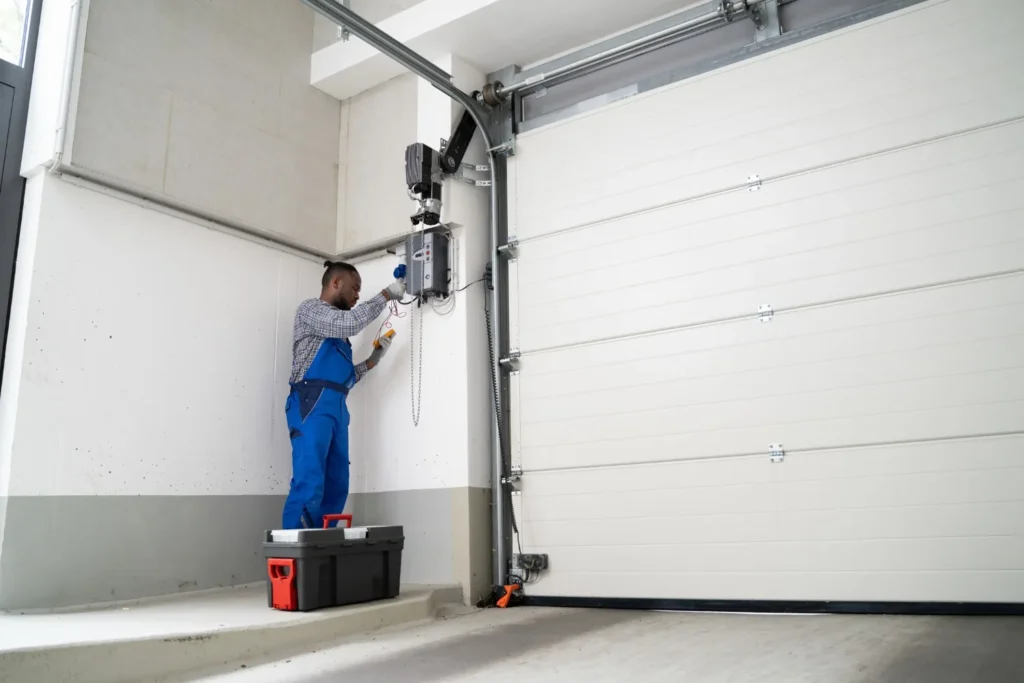
How the Repair and Troubleshooting Process Works
Restoring your garage door opener involves a systematic approach to isolate the issue. We do not guess; we test. This structured process allows us to identify whether the problem lies with the opener unit itself or with the counterbalance system affecting the opener’s performance — request an estimate.
First, the technician disconnects the opener from the door by pulling the emergency release cord. This allows us to manually operate the door. If the door is heavy or difficult to lift manually, the problem is likely a broken spring or cable, not the opener. The opener is designed to move a balanced door, not lift dead weight. If the door is balanced, we proceed to diagnose the opener unit.
Next, we analyze the diagnostic codes. Modern garage door openers feature self-diagnostic LED indicators that flash in specific patterns to signal the type of error. For example, a specific flash sequence might indicate a sensor obstruction, while another indicates a logic board failure. We decode these signals to pinpoint the exact component requiring attention.
Then, we perform the necessary mechanical or electrical repairs. This may involve replacing a stripped gear and sprocket assembly, swapping out a blown capacitor, or realigning the safety sensors. If the logic board is corrupted, we replace the circuit board and reprogram all remotes and keypads to match the new frequency.
Finally, we conduct a full cycle test. We run the opener through multiple open and close cycles to verify smooth operation. We also test the safety reversal system by placing a standardized object in the door’s path to ensure it reverses automatically upon contact. This final step confirms that the repair is successful and the system is safe for daily use.
- Diagnosis: Isolate the fault using manual testing and electronic diagnostic codes.
- Verification: specific component testing (motor, capacitor, sensors).
- Correction: Repair or replace the faulty part using OEM-grade components.
- Calibration: Adjust force and limit settings for optimal travel distance.
- Final Safety Check: Validate the auto-reverse mechanism and sensor alignment.
When Replacement Beats Repair
While repair is often the most cost-effective solution, there are scenarios where replacing the garage door opener is the smarter financial and practical decision. Garage door openers typically have a lifespan of 10 to 15 years. If your unit is approaching or exceeding this age, investing in a repair may be a temporary fix for a unit that will soon fail in other areas.
The primary factor in this decision is the cost-benefit analysis. If the cost of the repair—such as replacing a motor or a logic board—approaches 50% of the cost of a new, modern unit, replacement is generally recommended. New units come with fresh warranties, whereas a repair typically only warrants the specific part that was changed.
Safety technology is another critical consideration. Units manufactured before 1993 generally lack the external entrapment protection systems (photo-eye sensors) required by federal law. If your opener does not have these sensors, or if they are consistently malfunctioning due to obsolete wiring, we cannot repair the unit legally and must recommend replacement to ensure your home meets current safety codes.
Noise levels also drive the decision to upgrade. Older chain-drive models can be incredibly loud, causing vibrations that resonate through the home. If your garage is located below a bedroom or living space, switching to a modern DC-motor belt-drive opener can significantly reduce noise. These newer models utilize soft-start and soft-stop technology, which reduces wear on the door hardware and provides near-silent operation.
- Repeated Breakdowns: If you have required multiple repairs in the last two years, the unit is likely reaching the end of its service life.
- Obsolete Parts: If the manufacturer has discontinued support for your specific model, sourcing parts becomes difficult and expensive.
- Security Vulnerabilities: Older openers use fixed codes that are easily hacked. Newer models use rolling code technology that changes the access code every time the remote is used.
- Smart Integration Desires: If you want to control your garage door via a smartphone app, verify delivery schedules, or integrate with home automation, a replacement is necessary to gain Wi-Fi connectivity.
Local Factors Affecting Opener Performance
Operating a garage door opener in the Summerlin area presents unique challenges due to the regional climate and environmental conditions. The intense heat of the desert summer can have a detrimental effect on the electronic components of your garage door opener.
Heat and Electronics
Logic boards and capacitors are sensitive to extreme temperatures. In a non-insulated garage, ambient temperatures can soar well above outside air temperatures during the summer months. This heat can cause capacitors to swell and leak fluid, leading to motor failure. It can also cause intermittent failures in the logic board, where the opener behaves erratically during the hottest part of the day but functions normally at night. We use components rated for high-temperature variance to mitigate this risk.
Sensor Alignment and Sunlight
The bright desert sun can interfere with the photo-eye safety sensors. At certain times of the day, direct sunlight hitting the receiving sensor can “blind” it, breaking the infrared beam connection. This causes the opener to interpret a false obstruction, preventing the door from closing. We can install sun shields or swap the placement of the sending and receiving sensors to prevent sunlight interference.
Power Fluctuations
High energy demand during summer months often leads to power surges or brownouts. These electrical inconsistencies can blow the fuse on an opener’s circuit board or scramble the memory, causing it to forget programmed remote codes. We recommend and can install surge protectors specifically designed for garage door openers to protect the sensitive electronics from voltage spikes.
Backup Battery Requirements
Given the occasional power outages associated with storms or grid strain, a battery backup system is highly valuable. Modern openers often comply with regulations (such as those seen in neighboring states like California) requiring battery backups. While not strictly mandatory everywhere, having a battery backup ensures you can still get your car out of the garage during a power failure without needing to physically lift the door.
- Lubrication Needs: The dry desert air dries out factory grease quickly. We use lithium-based grease that withstands high heat without dripping, unlike standard oil which evaporates or attracts dust.
- Dust and Debris: Wind-blown dust can accumulate inside the opener housing and on sensor lenses. Regular cleaning is required to prevent signal blockage and gear clogging.
- HOA Compliance: Many neighborhoods in this region have strict Homeowners Association guidelines regarding external keypads and noise levels. We ensure all installations and repairs comply with local community standards.
Why Professional Troubleshooting Matters
Attempting to DIY a garage door opener repair often leads to misdiagnosis and potential injury. The opener connects directly to the heavy torsion spring system; improper disconnection can cause the door to crash down. Furthermore, modern openers involve complex circuitry that requires specific voltage testing. Good Golly Garage Doors provides the expertise required to handle these systems safely.
We prioritize specific, durable repairs over quick patches. Our technicians carry a wide inventory of parts for major brands like LiftMaster, Chamberlain, Genie, and Craftsman, allowing us to complete most repairs in a single visit. We focus on the “why” behind the failure—whether it is a heat-damaged board, a misaligned rail, or a stripped gear—to ensure the solution lasts.
You receive transparent communication regarding the state of your system. We explain the difference between a sensor adjustment and a motor failure clearly, helping you make an informed decision about your property. By focusing on the specific needs of homes in the desert climate, we ensure your opener is calibrated to withstand the environment.
- Brand Agnostic Expertise: We service all major manufacturers and drive types.
- Licensed and Insured: Fully compliant with state contractor requirements.
- Inventory on Hand: Trucks stocked with gears, sprockets, capacitors, and sensors to avoid delays.
- Precision Calibration: We use specialized tools to set force limits exactly, preventing unnecessary wear on the opener.
Don’t Get Stranded: Fix Your Garage Door Opener Today
Your garage door is the largest moving object in your home and the primary entry point for many families. Ensuring the automatic opener functions reliably is essential for security and convenience. Don’t let a malfunction leave you stranded or your home unsecured. If your opener is humming, grinding, or simply refusing to move, take action today. Need immediate help? Contact us now.
Proudly Serving Las Vegas and Surrounding Areas
From Summerlin to Henderson, we provide the best garage door services you can find across Las Vegas. Wherever you are, Good Golly Garage Doors is ready to deliver. Let’s get your garage door in Las Vegas or beyond back in top shape with service that’s fast, friendly, and built to last.
View All Cities
 All Service Areas