

Garage Door Opener Repair in Round Rock, TX
Struggling with a garage door opener malfunction in Round Rock? Get fast, professional repair services today. Schedule your appointment for rapid, expert help!
Garage Door Opener Malfunctions Stopping Your Day?
Is your garage door refusing to open when you press the remote, or is the motor making a grinding noise without lifting the door? You are likely dealing with a mechanical failure or electrical fault that compromises your home’s security and convenience in Round Rock.
Schedule your same-day diagnostic and repair service here.
A malfunctioning opener traps your vehicle inside or leaves your home exposed. When the mechanism fails, you need a solution that restores access immediately without complex troubleshooting on your part. Good Golly Garage Doors provides rapid response times to address these critical failures.
- Receive same-day repair services to restore your garage access immediately.
- Access 24/7 emergency availability for when openers fail outside of standard business hours.
- Rely on experienced technicians who carry the parts necessary to fix most major brands in a single visit.
All repairs are performed by licensed professionals backed by comprehensive warranties for your peace of mind.
What to Expect From Professional Opener Repair Services
When a garage door opener fails, the priority is diagnosing the root cause accurately to prevent recurring issues. The symptoms are often obvious—a humming motor that won’t lift, a door that reverses immediately after touching the floor, or a remote that has ceased to function—but the internal causes vary. In Round Rock, where heat and humidity fluctuate, internal components often degrade faster than in milder climates.
A professional service call focuses on isolating the issue within the logic board, the motor assembly, or the drive mechanism. Technicians arrive with fully stocked trucks containing capacitors, gears, sensors, and trolleys compatible with major manufacturers like LiftMaster, Chamberlain, Genie, and Craftsman. The goal is to move from diagnosis to completed repair in one visit.
Service includes a full inspection of the safety reversal system. This is not just a functional check but a safety requirement. Technicians verify that the photo-eye sensors are aligned and that the door reverses properly upon meeting resistance. If the issue stems from the traveler module or a stripped gear, these parts are swapped out for high-cycle replacements designed to withstand daily use. The service concludes with a recalibration of the travel limits, ensuring the door opens fully to the header and closes tightly against the concrete without excessive force.
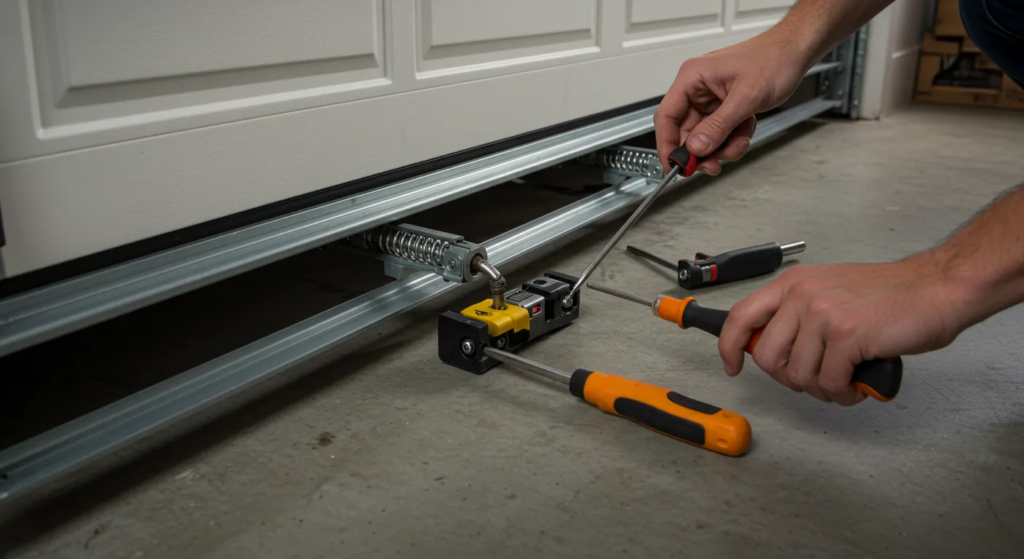
The Repair Process: From Diagnostics to Operation
Restoring a garage door opener involves a systematic approach to ensure every electrical and mechanical pathway functions correctly. Technicians do not guess; they test. The process is streamlined to minimize downtime for the homeowner while ensuring safety standards are met.
- System Diagnosis and Power Check: The technician begins by verifying power flow. This involves checking the outlet, the circuit breaker, and the internal fuse on the logic board. Electrical surges, common during Texas spring storms, can often fry the logic board while leaving the motor intact.
- Drive Mechanism Inspection: The technician examines the drive system—whether chain, belt, or screw drive. For chain drives, they check for slack that indicates a worn gear or sprocket. For belt drives, they look for missing teeth or fraying. If the motor runs but the chain does not move, the internal nylon gear is likely stripped and requires replacement.
- Sensor Alignment and Wiring Review: Safety sensors are the most common cause of non-operation. The technician checks the alignment of the photo-eyes and inspects the low-voltage wiring for staples that may have cut the insulation, causing a short. In Round Rock, shifting soil can sometimes cause slight misalignments in the door tracks, which in turn throws off the sensor path.
- Limit Switch Adjustment: If a door opens halfway and stops, or hits the floor and reverses, the travel limits are incorrect. The technician adjusts the force and travel settings on the motor head to match the specific weight and balance of the door.
- Final Safety Test and Lubrication: Once the repair is made, the opener is tested against a 2×4 block to ensure the reversal mechanism triggers correctly. The rail and trolley are lubricated with lithium-based grease to reduce friction and noise.
Repair vs. Replacement: Making the Right Decision
Deciding whether to repair an existing unit or install a new one depends on the age of the unit, the cost of the repair, and current safety standards. While repair is often the most cost-effective route for minor issues, there are specific scenarios where replacement is the smarter financial move.
If your garage door opener was manufactured prior to 1993, it likely lacks the federally mandated safety sensor system (photo-eyes). In this case, repair is often not an option due to liability and safety risks; replacement is required to bring the home up to code. Similarly, if the unit is over 15 years old, internal parts like the motor capacitor and logic board are nearing the end of their service life. Fixing one part may only be a temporary solution before another component fails.
Consider replacement if the cost of the repair exceeds 50% of the cost of a new unit. Modern openers offer distinct advantages over older models, including:
- Battery Backup: Essential for operating the door during power outages.
- Wi-Fi Connectivity: Allows for control and monitoring via smartphone apps.
- Rolling Code Technology: Prevents code grabbers from intercepting your opener signal.
- Quieter Operation: DC motors and belt drives significantly reduce vibration and noise compared to older AC chain drive units.
However, if the unit is relatively new (under 10 years) and the issue is an isolated component like a stripped gear, a bad capacitor, or a misaligned sensor, repair is the correct course of action. Good Golly Garage Doors provides honest assessments to help you choose the path that offers the best long-term value.
Local Factors Affecting Garage Door Openers
Operating a garage door opener in Round Rock presents specific challenges due to the local climate and environmental conditions. Understanding these factors explains why certain components fail and how to prevent future issues.
- Heat Impact on Electronics: Summer temperatures in this region frequently exceed 90°F, and temperatures inside a garage ceiling can soar much higher. This intense heat puts stress on the electronic components of the opener, specifically the capacitor and the logic board. Overheating can cause capacitors to swell and fail, resulting in a motor that hums but lacks the torque to lift the door.
- Storm Activity and Power Surges: Spring brings increased rainfall and storm activity. Lightning strikes and power grid fluctuations can send surges through the home’s electrical system. Garage door openers are sensitive to these variances. A surge can scramble the memory of the logic board or burn it out completely. Using a surge protector for the opener outlet is a recommended preventative measure.
- Humidity and Sensor Corrosion: While winters are mild, periods of humidity can lead to oxidation on the wiring contacts of the safety sensors. If the sensors flicker or fail intermittently, it is often due to corrosion at the connection points or within the wire nuts.
- Foundation Shifts: The clay-heavy soil in the region expands and contracts with moisture levels. This movement can shift the garage door frame slightly. While the opener is designed to pull the door, it forces the motor to work harder if the tracks become misaligned due to structural shifting. This extra strain can shorten the lifespan of the motor gear.
Why Professional Troubleshooting is Essential
Attempting DIY repairs on a garage door opener carries significant safety risks and often leads to misdiagnosis. The opener is merely the motorized arm; the heavy lifting is done by the door’s spring system. If an opener is struggling, it is frequently a symptom of a broken or unbalanced spring. Disconnecting the opener from the door without understanding the tension involved can cause the door to crash down, leading to injury or property damage.
Professional technicians understand the relationship between the opener and the counterbalance system. They have the tools to measure electrical continuity and the experience to hear the difference between a dry roller and a failing motor bearing.
Furthermore, professional repair guarantees warranty protection. Manufacturers often void warranties if the unit is not serviced by a certified professional. Using the correct OEM parts ensures that the machine operates within its engineered specifications. Generic parts bought online may fit but often lack the durability required for daily cycling.
Operational Reliability for Your Home
A functioning garage door opener is vital for the security and accessibility of your home. Ignoring minor signs like slow operation, unusual noises, or intermittent response can lead to a complete system failure, leaving your vehicle trapped or your home unsecured. Addressing these issues promptly with professional repair extends the lifespan of your equipment and ensures safe operation for your family.
When your opener fails to perform, you need a solution that is fast, transparent, and technically sound. Whether it is a simple sensor alignment or a complex gear replacement, the goal is to restore normal operation without delay. For reliable service that gets your door moving again, contact Good Golly Garage Doors.
Get your garage door opener fixed today—click here to schedule immediately.
Proudly Serving Austin, TX, and Surrounding Areas
From the neighborhoods of Austin to Round Rock and Buda, we provide the best garage door services you can find across the area. Whether it’s the impact of Texas heat and sudden storms on garage door components, we ensure our solutions are tailored to your needs. Wherever you are, Good Golly Garage Doors is ready to deliver.
View All Cities
 All Service Areas