

Garage Door Opener Repair in Phelan, CA
Fix opener issues fast with garage door opener repair in Phelan, CA from Good Golly Garage Doors. Contact today for reliable service and restored access!
Is Your Garage Door Opener Refusing to Respond?
A malfunctioning garage door opener disrupts your daily routine, compromises your home’s security, and leaves you stranded either inside or outside your garage. If your opener is making grinding noises, failing to lift the door, or simply not responding to the remote, you are facing a mechanical or electrical failure that requires professional attention. Schedule a diagnostic and repair service to restore access to your garage.
Residents in Phelan often experience opener failures due to a combination of mechanical wear and environmental stress. When the button is pressed and nothing happens, or the motor runs but the door remains stationary, the mechanism has failed. We provide a solution that focuses on restoring service efficiently, ensuring your hardware functions correctly and safely.
- Schedule repair services to restore your home’s security.
- Receive clear, upfront pricing explained before work begins.
- Benefit from a standard manufacturer-backed warranty on repairs and replacement parts, typically around one year.
All services are fully licensed and include applicable manufacturer warranties for your peace of mind. Good Golly Garage Doors is committed to resolving these issues with precision and care.
Comprehensive Opener Repair Services
When a garage door opener fails, the symptoms are often distinct, but the root causes can vary significantly. A professional repair service goes beyond simply hitting a reset button, it involves a systematic diagnosis of the motor, the logic board, the drive system, and the safety sensors. Our approach ensures that every component of the automatic opening system is inspected and verified for functionality.
The scope of repair covers the entire electromechanical assembly. This includes the motor mounted to the ceiling, the rail assembly, the trolley, and the remote control systems. Technicians arrive equipped with commonly required components to address many failures during the visit. Whether the opener uses a chain drive, belt drive, or screw drive, the internal gears and sprockets are subject to immense tension and eventual stripping.
Service appointments prioritize identifying the exact point of failure. If the motor hums but the chain does not move, the internal nylon gears have likely been stripped. If the opener is completely unresponsive, the issue often lies within the logic board or capacitor. By focusing on component-level repair, homeowners can avoid the expense of a full replacement when a smaller fix is appropriate.
- Internal Gear Replacement: Replacement of stripped main drive gears and worm gears to restore lifting power.
- Logic Board Replacement: Installation of new circuit boards when electrical surges or age cause remote signal failure.
- Safety Sensor Alignment and Wiring: Realigning photo-eyes and repairing damaged low-voltage wiring to ensure the door closes only when safe.
- Capacitor Replacement: Swapping out failed start capacitors that prevent the motor from initiating the lift cycle.
- Trolley and Carriage Repair: Replacing cracked or broken carriages that disconnect the door arm from the drive mechanism.
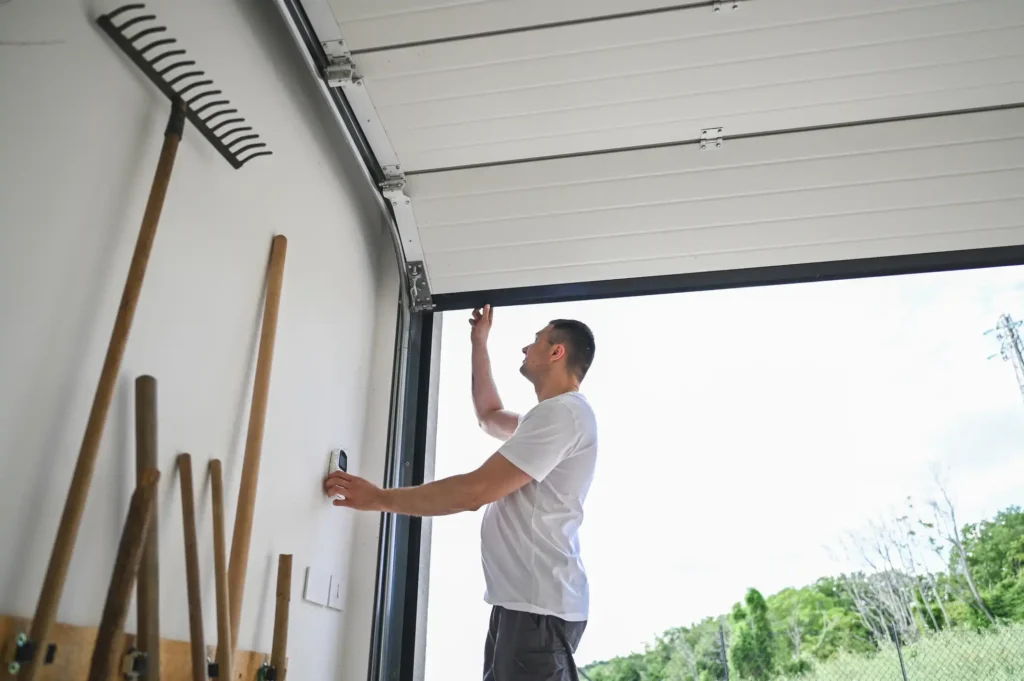
The Repair Process: From Diagnosis to Operation
Restoring a garage door opener involves a strict technical protocol to ensure safety and longevity. The process begins with a complete disconnect of power to prevent accidental activation during inspection. Technicians examine the mounting hardware, checking for vibrations that may have compromised the structural integrity of the motor mount.
Following the structural check, the focus shifts to the electrical system. Multimeters are used to test the voltage reaching the outlet and the output from the transformer. In Phelan, where electrical fluctuations can occur, verifying consistent power is a critical step. If the electrical input is stable, the logic board is tested for burn marks or cold solder joints. This attention to the circuit board is necessary because modern openers rely heavily on electronics to manage force limits and safety reversals.
Once the electrical health is established, the mechanical drive system is dismantled as needed. For chain drive openers, the tension is adjusted to prevent slapping against the rail. For belt drives, the belt teeth are inspected for wear or fraying. If the trolley is jammed, it is released, and the rail is lubricated with lithium-based grease, avoiding oil-based products that attract dust and grit.
- Initial Safety Inspection: Verification of the door’s manual balance to ensure the spring system is not the actual cause of the opener failure.
- Component Isolation: Testing the motor, capacitor, and circuit board individually to pinpoint the faulty part.
- Mechanical Restoration: Replacing gears, sprockets, or belts and lubricating the drive rail.
- Force and Limit Adjustment: Recalibrating the travel limits to ensure the door opens fully and closes properly without unnecessary reversal.
- Final Safety Test: Conducting the UL 325 safety reversal test to confirm the door reverses upon contact with an object.
Deciding Between Repair and Replacement
Determining whether to repair an existing opener or invest in a new one is a decision based on cost-efficiency, age, and safety features. While repair is often the most economical choice for newer systems, there are thresholds where replacement becomes the smarter long-term investment.
The primary factor is the age of the opener. Most garage door openers have a typical service life of 10 to 15 years. Systems beyond this range may lack modern safety features or parts support. In these cases, replacement is often recommended to align with current safety standards.
Another critical metric is the cost of repair versus the cost of a new installation. If the repair costs exceed roughly 50 percent of the price of a new opener, replacement is typically advised. This is particularly true if the motor itself has failed, as the motor is among the most expensive components. However, if the issue is a stripped gear, a bad capacitor, or a misaligned sensor, repair is usually the most practical option.
- Repair the Opener: If the opener is under 10 years old, the issue is a minor electrical or mechanical component, and parts remain available from the manufacturer.
- Replace the Opener: If the opener is beyond its expected service life or requires a repair approaching the cost of replacement.
- Consider Technology: If improved security features like rolling codes or smartphone connectivity are desired, replacement may offer added value.
- Noise Levels: If the current opener is a noisy chain drive and quieter operation is preferred, switching to a belt drive replacement can address that concern.
Troubleshooting Common Opener Behaviors
Before a technician arrives, understanding the behavior of the opener can help streamline diagnosis. Different sounds and movements provide clues about internal issues. A humming noise followed by silence often indicates a seized motor or failed capacitor. A grinding noise typically points to worn internal gears.
Intermittent operation, where the door opens inconsistently, can suggest logic board issues or radio frequency interference. In some cases, certain LED light bulbs installed nearby may interfere with remote signals, reducing range.
If the door begins to close and then reverses while the main light flashes, this is commonly related to the safety sensor system. Sensors may be misaligned, obstructed, or affected by wiring issues. This behavior is part of standard safety programming designed to prevent accidents.
- Humming but No Movement: Indicates a locked motor, failed capacitor, or stripped trolley.
- Grinding Noise: Commonly caused by worn internal gears.
- Reversing and Flashing Lights: Often related to safety sensor alignment or obstruction.
- Remote Failure: Can result from depleted batteries, receiver issues, or signal interference.
Expertise Across All Major Brands
Effective repair requires familiarity with the designs of LiftMaster, Chamberlain, Genie, Craftsman, and other major manufacturers. Different brands use varying rail systems, electronics, and programming standards.
For example, Genie openers often rely on screw drive systems that require specific lubrication practices. LiftMaster and Chamberlain models commonly share internal gear assemblies but differ in logic board technologies. Understanding these differences ensures compatible parts are installed and existing remotes continue to function properly.
Technicians carry commonly used OEM components to service a wide range of models found in the area. This includes compatible gears, carriages, and circuit boards for many residential openers.
- LiftMaster and Chamberlain: Experience with gear kit replacement and logic board service for Security+ systems.
- Genie: Familiarity with screw drive maintenance and Intellicode programming.
- Craftsman: Service for chain drive models commonly found in established neighborhoods.
- Linear and Marantec: Troubleshooting support for less common precision openers.
Ensuring Security and Functionality
A malfunctioning garage door opener affects both convenience and security. The opener helps secure one of the largest access points of the home. When it does not operate correctly, the door may not remain fully secured. Professional repair restores proper engagement so the garage door remains closed as intended.
Correct force settings are also critical for safety. An opener applying excessive force can damage property or create hazards. Part of the repair process includes testing down-force settings to confirm the door reverses when contacting an object, following standard safety guidelines.
When service is complete, operation should be smooth and consistent. The door should move without hesitation or unusual noise, and controls should respond reliably.
- Positive Lock Verification: Confirming the opener holds the garage door closed properly.
- Safety Reversal Testing: Verifying the door reverses upon contact with an obstruction.
- Remote Range Check: Confirming the receiver responds appropriately from the driveway.
- Emergency Release Test: Ensuring the manual release functions correctly during power outages.
Finalizing Your Repair Choice
Ignoring the warning signs of a failing garage door opener can lead to the door becoming stuck closed or remaining open longer than intended. Addressing issues early helps prevent further wear. Whether the repair involves replacing a worn gear, installing a new capacitor, or realigning safety sensors, professional service helps restore reliable operation.
Residents in Phelan benefit from solutions suited to local climate conditions and regular use. Good Golly Garage Doors provides experienced service to address opener concerns and support long-term functionality.
Contact our team today to schedule your garage door opener repair and restore convenience to your home.
Proudly Serving Victorville and Surrounding Areas
We provide the best garage door services you can find across Victorville, CA. Wherever you are, Good Golly Garage Doors is ready to deliver. Let’s get your garage door in Victorville, CA or beyond back in top shape with service that’s fast, friendly, and built to last.
Call (760) 979-0605 All Service Areas