

Garage Door Opener Repair in Georgetown, TX
Struggling with a faulty garage door opener in Georgetown? Contact us to schedule quick and reliable repairs. Ensure your home's security with our expert service.
Unresponsive Garage Door Openers Halt Daily Operations
Is your garage door refusing to open upon command or emitting grinding noises without lifting the heavy panels? You are likely dealing with a mechanical failure or electronic malfunction within the opener unit, a situation that leaves your home vulnerable and your vehicle trapped. Contact us today to schedule immediate diagnostic and repair services for your garage door opener.
Homeowners in Georgetown often face these disruptions unexpectedly, finding their daily routine paralyzed by a system that was working perfectly just hours before. A motorized opener is a complex assembly of gears, circuit boards, and sensors, all of which must synchronize perfectly to lift a heavy door safely. When one component fails, the entire system locks down. Good Golly Garage Doors provides specialized intervention to restore automation and security to your home entry points.
- Get a same-day, on-site repair diagnosis and resolution from certified technicians.
- Enjoy lasting peace of mind with extended warranties on replaced components and labor.
- Take advantage of available financing options to manage unexpected repair costs comfortably.
- All services are performed by licensed professionals, ensuring compliance with local regulations and industry safety standards.
Immediate Restoration of Motor and Electronic Functions
When a garage door opener fails, the objective is to minimize downtime and restore the security of the home immediately. Professional service calls prioritize a thorough diagnostic assessment to pinpoint whether the issue is mechanical, such as a stripped gear, or electrical, such as a fried capacitor or logic board. In Georgetown, where heat and weather fluctuations are common, specific internal components are prone to degradation faster than in milder climates.
The scope of a repair visit focuses on isolating the faulty part and replacing it with high-grade, OEM (Original Equipment Manufacturer) components. Technicians arrive with service vehicles fully stocked with the most common failure points for major brands like LiftMaster, Chamberlain, Genie, and Craftsman. This preparation ensures that most issues are resolved in a single visit, eliminating the need for return trips or long waits for parts shipping.
Specific repair protocols often include:
- Gear and Sprocket Assembly Replacement: A common issue where the motor hums but the chain or belt does not move. The internal plastic gears often shear under stress or age.
- Logic Board Replacement: If the opener acts erratically, operates phantomly, or refuses to accept remote signals, the main circuit board is likely damaged by power surges or age.
- Capacitor Replacement: A failing starting capacitor will often cause the motor to buzz loudly but fail to generate enough torque to lift the door.
- Safety Sensor Realignment and Wiring: Misaligned or damaged photo-eyes prevent the door from closing. Technicians trace wiring for shorts and verify alignment.
- Limit Switch Adjustment: Incorrect travel limits cause the door to reverse immediately after touching the floor or stop halfway up.
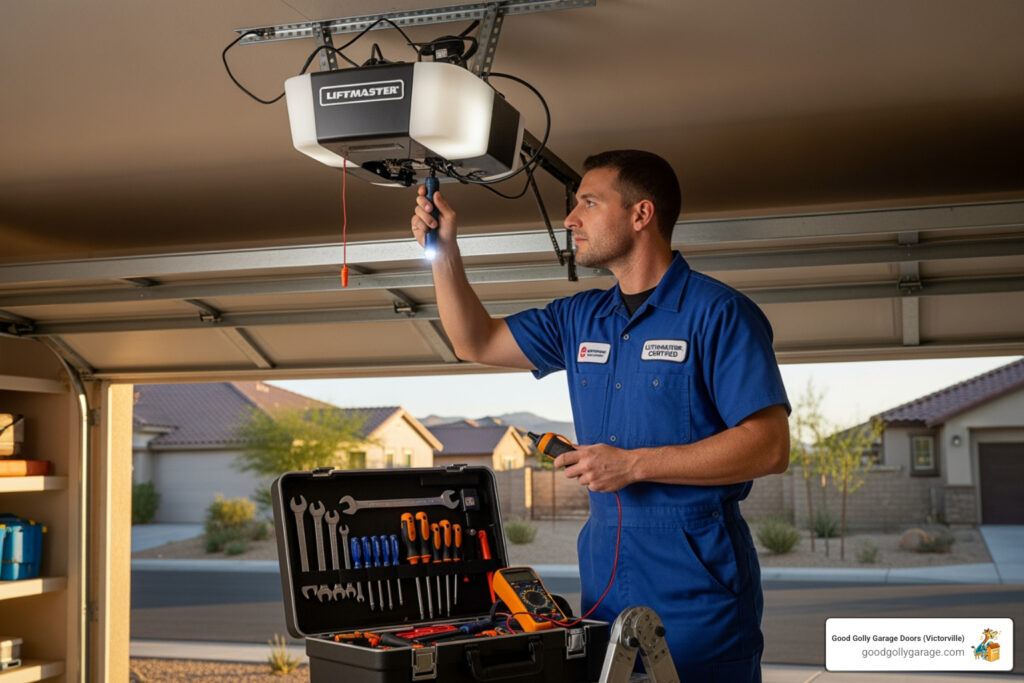
The Technical Process of Opener Diagnostics and Repair
Restoring a garage door opener is a systematic process that moves from safety verification to component replacement and final calibration. DIY attempts often bypass critical safety checks, leading to further damage or injury. Professional repair follows a strict workflow to ensure the system is not only working but operating within safe force parameters.
The service begins with a static inspection of the door itself. A heavy or unbalanced door places excessive strain on the opener. If the springs are broken or the track is misaligned, the opener repair cannot proceed until the counterbalance system is rectified. The opener is merely the pilot; the springs are the engine. Once the door balance is verified, the technician proceeds to the motor head.
- Power Disconnection and Casing Removal: Technicians first disconnect power to prevent electrical shock. The motor cover is removed to expose the internal drive mechanism and electronics.
- Internal Inspection: The technician inspects the drive gear for shavings (indicating stripping), looks for swollen capacitors, and checks the logic board for burn marks or corrosion.
- Component Swap: Faulty parts are removed. For gear kits, the entire shaft assembly is often replaced to ensure smooth interaction between the worm drive and the sprocket.
- Force and Limit Calibration: After reassembly, the travel limits (how far up and down the door goes) are reset. The force settings are adjusted to ensure the door reverses if it hits an obstruction, but pulls hard enough to overcome minor friction.
- Safety Reversal Test: The final step involves placing a standard 2-by-4 board in the door’s path. The door must strike the object and reverse automatically. This is a non-negotiable safety standard.
Determining When to Repair vs. Replace the Unit
A critical decision point for homeowners is determining whether a repair is cost-effective or if the entire unit has reached the end of its service life. While many issues are repairable, there are distinct thresholds where investment in a new unit offers better value, safety, and reliability. Good Golly Garage Doors technicians provide transparent data to help facilitate this decision.
The primary factor is the age of the unit. Openers manufactured prior to 1993 lack modern safety entrapment protection (photo-eyes) and should invariably be replaced rather than repaired to comply with current federal safety standards. For units built after this date, the decision often comes down to the cost-benefit analysis of the repair bill versus a new installation.
Consider replacement if:
- The 50% Rule: If the cost of the repair (parts and labor) exceeds 50% of the cost of a new, installed unit, replacement is financially prudent.
- Recurring Failures: If the unit has required multiple repairs in the last two years, the internal components are likely failing systematically.
- Noise Levels: Older chain-drive models are inherently noisy. If quiet operation is a priority due to living space above the garage, upgrading to a modern belt-drive unit provides a significant lifestyle improvement.
- Connectivity Needs: Older units cannot connect to Wi-Fi or smartphone apps. If remote monitoring and Amazon Key delivery are desired features, a replacement is necessary.
- Motor Type: AC motors are durable but loud and use more power. DC motors offer soft-start/soft-stop features, battery backup capability, and quieter operation.
Regional Considerations Impacting Garage Door Systems
Operating a garage door opener in Central Texas presents specific challenges that dictate maintenance needs and failure rates. The climate in Georgetown is characterized by intense summer heat, which affects both the mechanical and electronic aspects of the garage door system.
Electronics are particularly sensitive to heat. The capacitors and logic boards located inside the motor housing can degrade faster when garage temperatures soar above 100 degrees Fahrenheit. Heat causes expansion in metal tracks and hardware, which can increase friction. If the opener force sensitivity is set too lightly, this thermal expansion can cause the door to false-reverse during the hottest part of the day.
Additional local factors include:
- Electrical Surges: Lightning storms and grid fluctuations can send voltage spikes through the home’s wiring. Garage door openers are sensitive appliances. The logic board is often the first casualty of a nearby lightning strike or power surge, requiring replacement or the installation of a surge protector.
- Insect Intrusion: Fire ants and other small insects are attracted to the warmth and electromagnetic fields of the motor housing. They can bridge contacts on circuit boards, causing short circuits.
- Utility Rebates and Efficiency: While standard openers do not consume massive amounts of electricity, upgrading to energy-efficient models with battery backups is often encouraged.
- Permit Requirements: While simple component repairs (like changing a gear or sensor) generally do not require a permit, significant structural alterations or new electrical circuit installations may trigger local code requirements.
Troubleshooting Common Drive Types
Different opener drive mechanisms have distinct failure profiles. Understanding which system is installed helps in diagnosing the issue before the technician arrives.
- Chain Drive Openers: These use a metal chain similar to a bicycle. They are durable but loud. Common issues include chain slack, which causes a slapping sound against the rail, and broken sprockets. Over time, the chain can stretch, requiring tension adjustments.
- Belt Drive Openers: These utilize a rubber belt reinforced with steel or fiberglass. They are the quietest option. Failure points often involve the belt teeth stripping out over many years or the DC motor requiring calibration.
- Screw Drive Openers: These use a threaded steel rod. They are powerful and have fewer moving parts but are sensitive to temperature changes. The plastic coupler that connects the motor to the screw is a designed fail-safe point that frequently breaks to protect the motor when the door is obstructed.
- Jackshaft (Wall Mount) Openers: These mount on the wall beside the door, freeing up ceiling space. Issues here often relate to the cable tension monitor or the electronic lock mechanism that secures the door when closed.
Diagnosing Intermittent Opener Behavior
Few things are more frustrating than a garage door that works sporadically. Intermittent issues are often harder to diagnose than total failures, but they usually point to specific electrical interferences or sensor issues.
One frequent culprit is Radio Frequency (RF) interference. LED light bulbs installed in the opener unit that are not rated for garage door use can emit frequencies that block the remote control signal. If the door opens from the wall button but not the remote, incompatible LED bulbs are often the cause.
Another source of intermittent failure is wiring degradation. The low-voltage wires running from the motor to the safety sensors or the wall console can become brittle or damaged by staples. A technician will perform a continuity test on these wires to ensure a solid connection. If the safety sensors flicker, the door will not close; this is a safety default, not a motor failure.
Why Professional Calibration is Essential
Repairing a garage door opener is not simply about swapping parts; it is about calibrating the machine to handle the specific weight and geometry of the door. An opener that is set with too much force becomes a safety hazard, capable of crushing objects or injuring people before the reversal mechanism engages. Conversely, an opener with insufficient force will stop unnecessarily, creating a nuisance.
Technicians use force gauges and established safety protocols to set the opening and closing force limits precisely. This calibration ensures that the motor is not overworking, which prolongs the lifespan of the new components. Furthermore, professional repair includes the lubrication of the drive rail (using lithium grease, not oil) and the inspection of the door’s rollers and hinges to ensure the opener is not fighting against a seized bearing.
Correct tensioning of the chain or belt is also vital. A loose chain can jump the sprocket, while an overly tight chain wears out the front bearing of the motor assembly. Professional service ensures these tolerances are met exactly according to manufacturer specifications.
Restoring Security and Convenience
A functioning garage door opener is the primary entrance for most modern families, acting as a key to the home’s security. When this system fails, it requires immediate, knowledgeable attention to prevent security risks and restore convenience. From replacing stripped gears in a chain drive to programming a new logic board for a smart opener, the focus is always on longevity and safety.
Residents in Georgetown rely on functional automated systems to combat the elements and maintain home access. Whether the solution requires a targeted repair of internal components or a strategic replacement of an outdated unit, the goal remains the same: reliable, safe operation at the push of a button. Good Golly Garage Doors delivers the expertise required to diagnose complex motor issues and the inventory to resolve them instantly.
Fast, Reliable, and Safe Opener Repair You Can Trust
Your garage door opener is more than a convenience—it’s a primary access point and a critical part of your home’s security. When it malfunctions, quick and professional service ensures your family’s safety, restores reliable access, and prevents small issues from becoming expensive emergencies. Whether you need diagnostics, targeted repairs, or guidance on whether replacement is the smarter investment, Good Golly Garage Doors is here to deliver dependable solutions with industry-leading expertise.
Don’t let a broken opener leave you stuck outside; schedule your repair service now.
Proudly Serving Austin, TX, and Surrounding Areas
From the neighborhoods of Austin to Round Rock and Buda, we provide the best garage door services you can find across the area. Whether it’s the impact of Texas heat and sudden storms on garage door components, we ensure our solutions are tailored to your needs. Wherever you are, Good Golly Garage Doors is ready to deliver.
View All Cities
 All Service Areas