

Garage Door Maintenance in Las Vegas, NV
Garage door maintenance in Las Vegas NV helps avoid unexpected breakdowns. Good Golly Garage Doors offers full tune-ups. Call today to schedule service.
Is Your Garage Door Making Loud Grinding Noises or Moving Unpredictably?
Is your garage door refusing to close fully, or do you hear it straining against the tracks with a loud screeching sound during operation? You may find it sticking midway or reversing unexpectedly, leaving your home vulnerable and your daily routine disrupted. Schedule a comprehensive safety inspection and tune-up today to restore smooth, quiet operation.
In Las Vegas, the intense heat and dry climate can accelerate wear and tear on your system, turning minor squeaks into major mechanical failures. Our technicians provide focused, same-day maintenance designed to catch these issues before they require expensive repairs.
- Rapid, same-day service availability to get your garage door back to optimal performance immediately.
- Comprehensive 21-point safety checks and lubrication to prevent sudden spring failure or off-track incidents.
- Transparent, flat-rate pricing with no hidden service fees or surprise upcharges.
All maintenance services are fully licensed and include a satisfaction guarantee to ensure your peace of mind.
What A Professional Garage Door Tune-Up Includes
A garage door is the largest moving object in most homes, comprised of heavy panels and high-tension parts. Maintenance is not simply glancing at the door to see if it moves; it is a rigorous mechanical audit of the entire counterbalance system and opener logic board. Good Golly Garage Doors approaches maintenance as a preventative measure to extend the lifespan of your hardware and ensure the safety of your family.
The scope of a professional tune-up involves a granular inspection of hardware that is under constant stress. Over time, vibration loosens bolts, and thermal expansion shifts track alignment. A proper maintenance visit addresses these specific mechanical realities.
- Torsion and Extension Spring Adjustment: Springs provide the heavy lifting. Over time, they lose tension (fatigue), making the door “heavy.” This puts excess strain on the electric opener. We test the balance and adjust tension to ensure the door is weightless in the manual mode.
- Roller Inspection and Lubrication: Nylon or steel rollers allow the door to glide. We check for cracked wheels or worn bearings. Worn rollers are the primary cause of “bumping” or “chattering” noises.
- Cable Integrity Checks: The lift cables carry the full weight of the door. We inspect for fraying, kinking, or rust. A snapped cable can cause the door to slam shut instantly, creating a severe safety hazard.
- Track Alignment and Cleaning: Tracks must be perfectly parallel and plumb. If they shift, the rollers will bind. We clean out debris and old grease that hardens into an adhesive paste, and we re-align the vertical and horizontal tracks.
- Hinge and Hardware Tightening: Vibration from daily use loosens the fasteners holding the hinges and brackets. We tighten every bolt and screw on the door panels to reinforce structural integrity.
- Opener Gear and Chain/Belt Inspection: We open the motor housing to check the internal plastic gears for shavings, which indicate imminent failure. We also adjust the tension of the drive chain or belt to prevent slippage.
- Safety Sensor Calibration: The photo-eye sensors must be aligned to a fraction of an inch. We clean the lenses and verify that the reverse mechanism triggers instantly when the beam is broken.
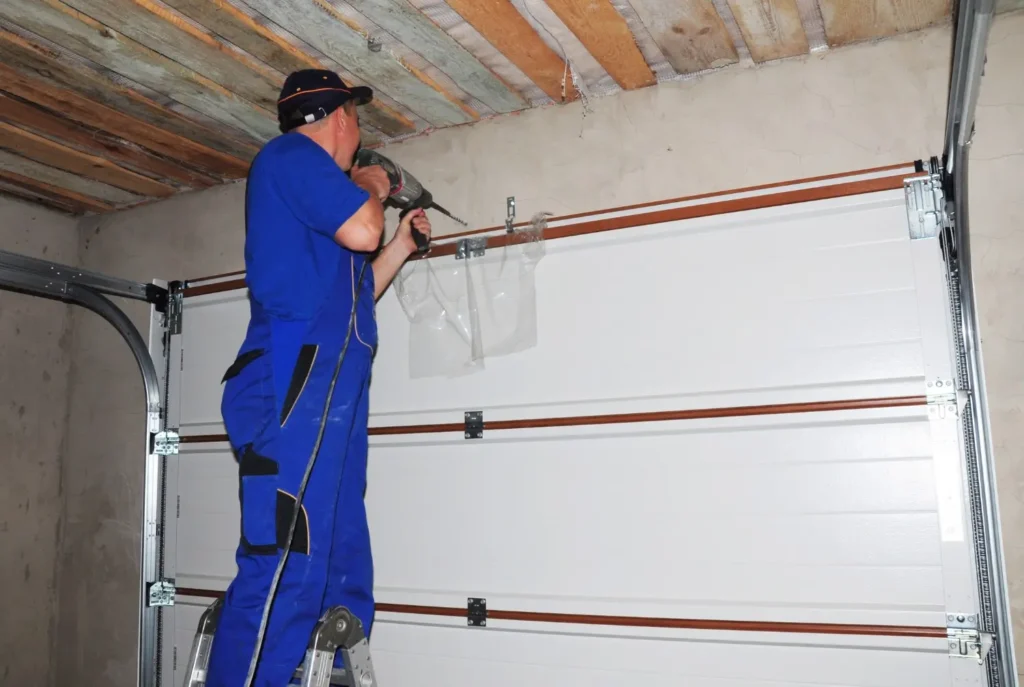
The Step-by-Step Maintenance Process
Understanding how a technician services your system helps you recognize the value of professional intervention versus a DIY attempt. The process is methodical, moving from visual inspection to physical adjustment and final safety testing.
- First, the Balance Test: The technician disconnects the electric opener to operate the door manually. A properly balanced door should sit halfway open without falling or shooting up. If the door drops, the springs are weak. If it flies up, they are too tight. This is the baseline for all subsequent adjustments.
- Next, Hardware Torque and Tightening: Using impact drivers and wrenches, the technician moves from the bottom panel up, tightening every hinge and roller bracket. This eliminates the “rattle” often heard in older doors.
- Then, Lubrication: We apply a specialized non-silicon-based lithium grease or garage door lubricant to the springs, rollers, and hinges. Standard WD-40 is a solvent, not a lubricant, and can actually strip away protection. Proper lubrication reduces friction and noise significantly.
- Followed by Opener Force Adjustments: Modern openers have force sensitivity settings. If set too high, the door won’t stop for an obstruction. If set too low, it stops for no reason. We recalibrate these force limits to manufacturer specifications.
- Finally, the Safety Reversal Test: We place a 2×4 block of wood under the door and close it. The door must reverse automatically upon contact. If it does not, the down-force limit is adjusted until safety is verified.
Critical Signs You Need Maintenance Now
Waiting until the door fails completely usually results in a car trapped in the garage or a home left unsecured. Your system gives off warning signs long before a catastrophic break occurs. Recognizing these symptoms allows for a simple service call rather than an emergency replacement — request service today.
- Excessive Noise: While no garage door is silent, grinding, scraping, or loud banging indicates metal-on-metal contact or worn bearings. Screeching usually points to dry, unlubricated rollers or hinges.
- Slow or Jerky Movement: If the door hesitates, shimmies, or moves significantly slower than usual, the rollers may be sticking, or the spring tension may be uneven.
- Sagging Sections: When the door is in the midway position, check the sections. If they sag or bend, the hinges are worn, or the strut reinforcement is damaged.
- The Opener Hums but the Door Won’t Move: This often indicates that the capacitor in the motor is blown or the trolley is jammed. It can also mean the door is physically locked or the springs have snapped, making the door too heavy for the motor to lift.
- Loose or Hanging Wires: Any visible cable that looks slack when the door is open is a danger signal. Cables should remain taut. Slack cables can slip off the drums, causing the door to become crooked.
Repair vs. Maintenance vs. Replacement
Homeowners often wonder if a tune-up is enough or if they need to invest in new hardware. This decision depends on the age of the system, the severity of the wear, and the cost-effectiveness of the repair.
- Choose Maintenance When: The door is generally in good condition (under 10 years old), but has become noisy or sluggish. If all components are intact but dry or loose, a tune-up is the correct path. This is appropriate for annual upkeep to maintain warranties.
- Choose Repair When: A specific part has failed, but the rest of the system is healthy. For example, if a single spring breaks or a logic board fries due to a power surge, replacing that specific component is cost-effective. Repair is also viable if a panel is damaged but the manufacturer still produces matching sections.
- Choose Replacement When: The door has severe structural damage, such as rust, rot, or extensive dents that prevent sealing. If the repair cost exceeds 50% of the cost of a new door, replacement is the better financial decision. Older openers (pre-1993) that lack safety eyes should also be replaced rather than repaired for liability and safety reasons.
Local Considerations for Las Vegas Homeowners
Operating a garage door in Southern Nevada presents unique challenges compared to other regions. The environment in Las Vegas plays a significant role in how frequently maintenance is required and what components fail first.
- Extreme Heat Impact: Summer temperatures in the valley frequently exceed 100°F. Inside a closed garage, temperatures can soar even higher. This heat thins out standard grease, causing it to drip off the opener rail and springs, leaving metal parts unprotected. It also causes metal tracks to expand, which can cause the door to bind if the spacing is too tight.
- Plastic Component Fatigue: The intense heat dries out plastic and nylon components. The gears inside your opener and the wheels on your rollers can become brittle and crack prematurely. In this climate, we often recommend high-cycle nylon rollers with sealed bearings that withstand heat better than standard builder-grade wheels.
- Dust and Grit Accumulation: The desert environment means dust and sand are constant factors. When dust mixes with wet grease in the tracks, it forms a gritty paste that acts like sandpaper, grinding down rollers and jamming the tracks. Maintenance in this region requires degreasing and cleaning the tracks thoroughly before re-lubricating with a dry-film lubricant that does not attract dust.
- Monsoon Season Humidity: While generally dry, the brief monsoon season brings humidity that can cause flash rusting on springs and ungalvanized steel parts. Keeping these parts oiled is the only defense against oxidation.
Why Professional Inspection Beats DIY
Many homeowners attempt to lubricate their doors themselves, but professional maintenance goes beyond a can of spray. The garage door system operates under massive tension. The torsion springs, in particular, are wound tight enough to lift hundreds of pounds. Mishandling these springs or the bottom brackets to which cables are attached can result in severe injury or property damage.
Professionals possess the correct winding bars to adjust spring tension safely. They also have the training to spot “silent killers”—issues like frayed internal cable strands that are not visible from the outside but are moments away from snapping. Furthermore, technicians can diagnose logic board faults in the opener that a visual inspection will not reveal. A professional tune-up ensures that the auto-reverse safety features meet current UL 325 safety standards, protecting pets and children from entrapment.
Preventing Future Breakdowns
The goal of a maintenance visit is to reset the clock on your garage door’s wear and tear. By neutralizing the friction and ensuring the door is perfectly balanced, you significantly reduce the workload on your electric opener. An opener that doesn’t have to struggle to lift a heavy or sticking door will last years longer than one fighting against poor maintenance.
Regular service also maintains the validity of your manufacturer’s warranty. Many door and opener manufacturers require proof of regular maintenance to honor warranty claims on parts. Neglect is often cited as a reason for voiding coverage. Establishing a routine maintenance schedule ensures you are covered should a major component fail due to a manufacturing defect.
Ready to Restore Your Garage Door’s Performance?
A noisy, sticking, or unbalanced garage door is more than a nuisance; it is a safety hazard and a security risk. Don’t wait for the spring to snap or the opener to strip its gears. Proactive maintenance saves money on emergency repairs and extends the life of your entire system.
Get your door running smoothly, quietly, and safely today.
Contact us now to schedule your comprehensive garage door tune-up and safety inspection.
Proudly Serving Las Vegas and Surrounding Areas
From Summerlin to Henderson, we provide the best garage door services you can find across Las Vegas. Wherever you are, Good Golly Garage Doors is ready to deliver. Let’s get your garage door in Las Vegas or beyond back in top shape with service that’s fast, friendly, and built to last.
View All Cities
 All Service Areas