

Flashy Hero Title Second Line
Is Your Garage Door Operating Loudly or Unreliably?
A squeaking, grinding, or slow-moving garage door is often a warning sign of imminent mechanical failure that threatens your home’s security and convenience. Ignoring these auditory cues and performance lags can lead to the door becoming stuck shut or, worse, falling unexpectedly due to snapped components. Contact us to schedule a comprehensive safety inspection and tune-up today.
Homeowners in Austin frequently encounter garage door issues stemming from intense usage cycles and environmental stress. Good Golly Garage Doors provides proactive maintenance solutions designed to catch small issues before they evolve into expensive emergency repairs. A routine tune-up restores quiet operation and ensures your heavy door system remains safe for your family and vehicles.
Our maintenance service delivers specific outcomes:
- Restoration of smooth, quiet door travel through targeted lubrication and adjustment.
- Identification of worn springs and cables before they snap and trap your vehicle.
- Calibration of safety sensors and auto-reverse mechanisms to prevent injury.
- Extension of the lifespan of your opener motor and hardware.
All services are performed by licensed, insured technicians and backed by a satisfaction guarantee.
Comprehensive Garage Door System Evaluation
Effective maintenance goes beyond simply spraying lubricant on a hinge. It requires a systematic evaluation of the entire counterbalance system, the opener mechanism, and the structural hardware. A garage door is the largest moving object in a home, often weighing several hundred pounds, and relies on high-tension physics to operate. Over time, vibration loosens hardware, and thermal cycles degrade materials.
Our technicians perform a multi-point inspection that scrutinizes every critical component. This includes checking the torsion or extension springs for signs of fatigue, such as gaps in the coils or elongation. We inspect lifting cables for fraying, which is a leading cause of sudden door failure. The tracks are examined for bends, misalignments, or debris accumulation that causes friction and puts unnecessary strain on the opener motor.
We also focus on the opener unit itself. Whether you utilize a chain drive, belt drive, or screw drive system, the motor gears and sprockets require inspection for wear. We check the force settings—the amount of power the opener uses to lift and close the door. If these settings are off, the door may not close all the way, or it may pose a crushing hazard. We verify that the trolley carriage engages and disengages correctly for manual operation during power outages.
Specific components addressed during maintenance include:
- Rollers: Inspection for flat spots or worn bearings; recommendation for replacement with nylon rollers for noise reduction if necessary.
- Hinges and Brackets: Tightening of all loose nuts and bolts that have vibrated free during daily operation.
- Drums: Ensuring lifting cables are winding evenly and securely onto the drums without overlapping.
- Weather Stripping: Checking the bottom seal and perimeter weather stripping for cracks or brittleness that allow moisture and pests to enter.
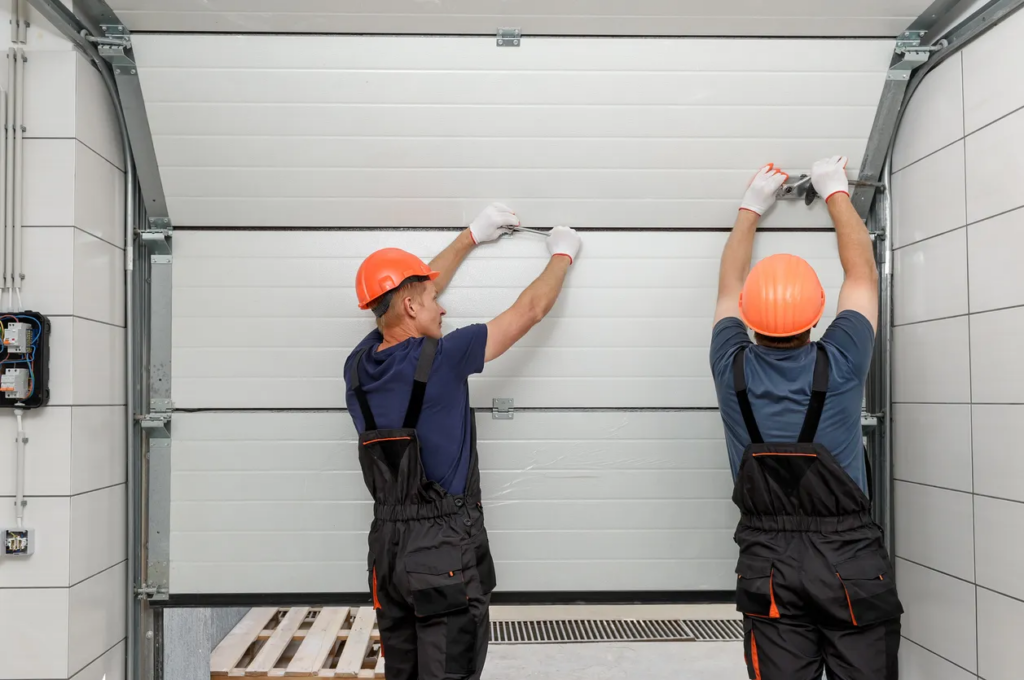
The Professional Maintenance Process
We utilize a structured workflow to ensure no part of the system is overlooked. The goal is to return the door to factory specifications regarding balance and movement. A well-balanced door should be easily liftable with one hand when disconnected from the opener; if it slams shut or shoots up, the spring tension requires professional adjustment.
First, the technician conducts a balance test. This is the most critical step in determining the health of your springs. If the springs are too weak, the electric opener is forced to lift “dead weight,” which rapidly burns out the motor’s logic board or gears. We adjust the tension on the torsion spring system to ensure the door hovers in place when manually lifted halfway. This relieves strain on the motor and ensures smooth automated operation.
Next, we proceed to lubrication and alignment. We use specific, non-tacky lubricants designed for garage doors—never standard grease or WD-40, which attract dust and grit that ruin bearings. We lubricate the springs, rollers, hinges, and the opener rail. Following lubrication, we tighten all hardware. Garage doors vibrate significantly; over hundreds of cycles, this vibration backs screws out of their anchor points. We secure the track brackets to the wall framing and tighten the flag brackets and center bearing plates.
Finally, we perform rigorous safety testing. This involves testing the photo-eye sensors to ensure they break the beam and reverse the door immediately upon detecting an obstruction. We also test the force settings by placing a standard 2×4 board in the door’s path; the door must reverse automatically upon contact. If it does not, we calibrate the down-force limit settings to meet current safety standards. Professional technicians possess the specific tools required to safely manipulate tension, align tracks, and diagnose electrical faults in the opener circuitry.
Deciding Between Repair and Replacement
While maintenance extends the life of your system, there comes a point where components are mechanically totaled or the technology is obsolete. Understanding when to invest in a tune-up versus when to replace the unit is vital for long-term cost savings.
If a door has significant structural damage, such as cracked sections or rusted-through bottom panels, maintenance will not resolve the underlying integrity issues. Panels that sag when the door is in the open position indicate that the internal stiles have failed. In this scenario, adding struts can temporarily reinforce the panel, but replacement is often the more economically sound decision. Similarly, if your system utilizes extension springs that lack safety containment cables, we strongly recommend an upgrade or conversion to a torsion system for safety.
Consider replacement over maintenance if:
- Hardware Obsolescence: Parts for the specific door model or opener are no longer manufactured, making repairs impossible.
- Recurring Breakdowns: You are calling for service multiple times a year for the same issues, indicating the system has reached the end of its duty cycle.
- Lack of Safety Features: Your opener was manufactured before 1993 and lacks non-contact safety sensors (photo-eyes).
- Energy Efficiency: You have a non-insulated door in a detached garage that you are converting to a workspace, requiring better thermal control.
Mid-page, it is important to note that Good Golly Garage Doors provides honest assessments regarding the viability of your current system. We focus on data-driven recommendations based on the age and condition of your hardware.
Local Compliance and Seasonal Considerations
Operating a garage door in Austin presents unique challenges due to the regional climate and soil conditions. The area is subject to significant humidity and heat, particularly in the summer months when temperatures consistently exceed 90°F. This heat can cause the lubricant in the opener rail and on the springs to dry out or become gummy, leading to increased friction and noise.
Furthermore, the high precipitation in the spring can lead to moisture intrusion. Wooden garage doors are particularly susceptible to swelling in this environment. As the wood absorbs moisture, it expands and becomes heavier. This added weight alters the balance of the door, rendering the previous spring tension settings insufficient. If the springs are not adjusted to compensate for this “water weight,” the opener may fail to lift the door, or a spring may snap under the excess load.
Foundation shifting is another local variable. The expansive clay soil common in the region expands when wet and contracts when dry. This movement can shift the garage foundation and driveway slab. Even a minor shift can misalign the vertical tracks, causing the door to bind or rub against the frame. Our maintenance process includes checking the track plumb and level to account for these structural shifts.
Regional factors we monitor include:
- Salt and Rust: While not coastal, humidity accelerates oxidation on galvanized steel tracks and springs; we apply rust-inhibiting lubricants.
- Pest Intrusion: Scorpions and rodents seek refuge from the heat; ensuring the bottom seal is intact is a critical preventative measure.
- Power Surges: Central Texas storms bring lightning that can fry opener logic boards; we check for proper grounding and recommend surge protection.
Why Professional Maintenance is Necessary
Attempting to service a garage door without proper training and tools is dangerous. The torsion springs are wound under extreme tension to lift a weight of 300 pounds or more. One slip with a winding bar can result in severe physical injury or property damage. Beyond safety, professional maintenance ensures compliance with warranty requirements. Most garage door manufacturers require proof of regular maintenance to honor warranties on panels and hardware. Neglecting this maintenance can void your coverage, leaving you liable for the full cost of panel replacement if rust or delamination occurs.
We also provide a level of diagnostic accuracy that DIY methods cannot match. A noise that sounds like a roller issue to a homeowner might actually be a symptom of a fraying cable or a failing bearing plate. Misdiagnosing the root cause often leads to treating the symptom while the catastrophic failure continues to develop unnoticed.
Ensuring Long-Term Reliability
Consistent maintenance is the only way to safeguard the investment you have made in your garage door system. It transforms a reactive approach—waiting for the door to break and trapping your car inside—into a proactive strategy that guarantees daily reliability.
We prioritize clear communication regarding the health of your system. You receive a detailed report of what was inspected, adjusted, and any potential issues that require monitoring. This transparency allows you to budget for future replacements rather than being blindsided by an emergency.
Whether it is adjusting the sensitivity on a modern smart-opener or realigning the tracks on a heavy carriage-house door, precise execution is key. Our focus remains on the mechanical integrity of the system, ensuring that every time you press the button, the door responds instantly and safely. Good Golly Garage Doors is committed to keeping your access points secure and functional year-round.
Secure Your Garage Door Today
A squeaking, grinding, or slow-moving garage door is a warning sign that your system may be failing. Good Golly Garage Doors provides comprehensive garage door maintenance in Austin, TX, ensuring smooth operation, safety, and long-term reliability. Our licensed technicians inspect springs, cables, rollers, tracks, and openers, lubricate moving parts, calibrate safety sensors, and address any issues before they become costly emergencies. Protect your home and family while extending the life of your garage door—schedule your professional maintenance today.
 All Service Areas