
Garage Door Repair in Carefree - Quick & Reliable Service
Experiencing a garage door issue in Carefree? Contact Good Golly Garage Doors for fast, professional repair services. Ensure your safety and convenience with our expert team.
Is Your Garage Door Not Performing? Let’s Fix It!
Facing a garage door that just won’t behave, or worried about the security risk it poses? Good Golly Garage Doors offers rapid, reliable repairs and replacements to ensure your peace of mind. Call us to schedule an inspection.
When your door fails, your vehicle is trapped, your home security is compromised, and your daily schedule is disrupted. We understand that homeowners in Carefree require prompt solutions, not delays. Our technicians arrive prepared to diagnose the issue and provide options that restore functionality.
Get expert advice on maintaining your garage door to avoid future issues. All services are conducted with requisite local permits.
Repair Solutions Available Today
When a garage door malfunctions, the root cause often lies in the high-tension components or the electronic operating system. Homeowners need to know exactly what is included in a service visit and how functionality can be restored. The focus of a professional repair visit is to identify the failure point, assess the safety of the remaining hardware, and implement a permanent fix rather than a temporary patch.
Upon arrival at your property in Carefree, the technician performs a multi-point safety inspection. This diagnostic covers the balance of the door, the integrity of the lift cables, the tension of the springs, and the response of the safety sensors.
Common components addressed during a service call include:
- Torsion and Extension Springs: Springs do the heavy lifting. When they snap, the door becomes dead weight. Professional replacement involves winding new, high-cycle springs that match the specific weight of your door.
- Opener Logic Boards and Gears: Service includes testing circuit boards, replacing stripped gears, and reprogramming remotes.
- Cables and Drums: Frayed cables are a snap hazard. Technicians replace these in pairs to ensure even lifting and prevent the door from becoming crooked.
- Rollers and Tracks: A noisy, grinding door often signals worn rollers or bent tracks. Nylon rollers are installed to silence operation, and tracks are aligned to precision standards.
- Safety Eye Sensors: Misalignment or sun interference can prevent the door from closing. Sensors are cleaned, realigned, and tested to meet safety codes.
The Installation and Replacement Process
There comes a time when a repair is no longer cost-effective, or a homeowner desires an aesthetic upgrade. Installing a new garage door is a construction project that alters the façade of the home and improves thermal efficiency. Understanding the workflow helps you prepare for the installation day and ensures you know exactly what is happening at every stage.
The process is systematic, prioritizing safety and structural integrity. It is designed to minimize disruption to your home while ensuring the new system operates smoothly for years.
The garage door installation workflow typically follows this sequence:
- Site Inspection and Measurement: Before any ordering happens, the opening is measured to the fraction of an inch. This includes checking headroom (clearance above the door) and backroom (depth for the opener) to ensure the selected model fits perfectly.
- Door Selection and Customization: You select the material, style, and insulation level. In desert environments, insulated steel or composite overlays are often chosen for their durability against the sun.
- Safe Removal and Disposal: The old door is dangerous due to spring tension. Technicians safely release the tension, dismantle the panels, and remove the old hardware. Disposal is handled entirely by the crew.
- Track and Hardware Installation: New vertical and horizontal tracks are bolted to the framing. This creates the skeleton for the new door.
- Panel Assembly: Panels are stacked and hinged together. If the door is insulated, weather seals are applied between sections.
- Spring and Cable Setup: The counterbalance system is installed. This is the most critical step for safety. Springs are wound to the precise tension required to make the door feel weightless when moved manually.
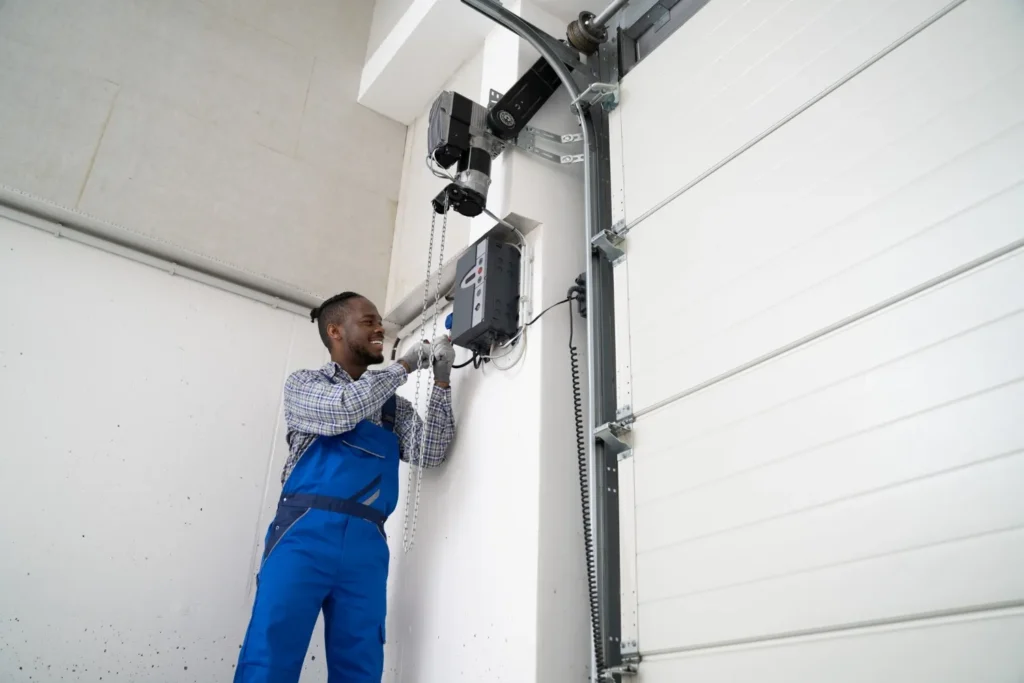
- Opener Connection: The motor is mounted, connected to the door arm, and wired into the home’s electrical system.
- Final Safety Testing: The technician tests the auto-reverse mechanism, sets the travel limits, and ensures the door creates a tight seal against the floor.
Determining When to Replace vs. Repair
Deciding between sinking money into a repair or investing in a replacement is a common dilemma. While many issues are fixable, there are specific thresholds where replacement becomes the smarter financial and functional choice. Continuing to repair an end-of-life system can result in diminishing returns and recurring safety hazards.
You should evaluate the age of your current system. Most garage doors have a lifespan of 15 to 20 years, while openers typically last 10 to 15 years. If your equipment is approaching these milestones, a major repair might just be a stopgap before another component fails.
Consider replacement if you encounter the following:
- Severe Impact Damage: If a vehicle has hit the door, structural integrity is often compromised. While single panels can sometimes be swapped, multiple damaged panels usually necessitate a full replacement.
- Lack of Safety Features: Older openers lacking photo-eye sensors or auto-reverse mechanisms are non-compliant with modern safety standards. Upgrading ensures the safety of pets and family members.
- Excessive Noise and Vibration: If the door rattles, shakes, or screeches despite lubrication and roller replacement, the track system or door sections may be warped beyond repair.
- Cost of Repair: A general rule of thumb is to replace the system if the repair estimate exceeds 50% of the cost of a new door.
Professional Standards and Service Differentiators
Choosing a service provider involves looking beyond the price tag and examining the quality of the workmanship and the hardware provided. The difference between a temporary fix and a long-term solution lies in the details of how the service is executed. Professional technicians do not cut corners on safety checks or hardware quality.
Good Golly Garage Doors prioritizes transparency and technical excellence. A professional service call is not just about fixing the symptom but ensuring the entire system is balanced and safe.
Key indicators of professional service include:
- High-Cycle Parts: Standard springs may last 10,000 cycles, but professional-grade springs are often rated for 25,000 cycles or more. This significantly extends the time between required repairs.
- Torque and Tension Balance: A door that is not perfectly balanced puts strain on the opener, shortening its life. Technicians use specific protocols to verify balance at the halfway point of the door’s travel.
- Safety Protocol Adherence: Every visit includes a mandatory check of the reversal system. This is a non-negotiable safety standard to prevent entrapment accidents.
Clear Communication: Explanations are given in plain English. You will understand why a part failed and what options you have before any work begins.
Secure Your Garage and Home Today
A malfunctioning garage door is more than an inconvenience; it is a breach in your home’s security and a disruption to your daily life. Whether you are dealing with a broken spring, a stubborn opener, or are looking to upgrade your home’s curb appeal with a new installation, prompt and professional action is required. Do not let a small issue escalate into a major structural failure.Ensure your home remains accessible and secure with expert service.
Contact us now to schedule your repair or installation and restore the reliability of your garage door.
Proudly Serving Phoenix, AZ, and Surrounding Areas
We provide the best garage door services you can find across Phoenix, AZ. Whether it’s the impact of Phoenix’s heat and sudden storms on garage door components, we ensure our solutions are tailored to your needs. Wherever you are, Good Golly Garage Doors is ready to deliver.
Call (602) 399-7054 All Service Areas