

Wrightwood Garage Door Woes: Top Reasons Your Door Won’t Budge
Expert Garage Door Services Powered by Good Golly Garage Doors
Why Your Garage Door Won’t Open in Wrightwood, CA
Why Is My Garage Door Won’t Open In Wrightwood CA? The most common culprits include broken springs, power issues, blocked or misaligned safety sensors, opener malfunctions, and track obstructions. Wrightwood’s high-altitude desert climate—with its dramatic temperature swings, fine dust, and low humidity—accelerates wear on these components, making failures more frequent than in milder climates.
Quick Answer: Top 5 Reasons Your Wrightwood Garage Door Won’t Open
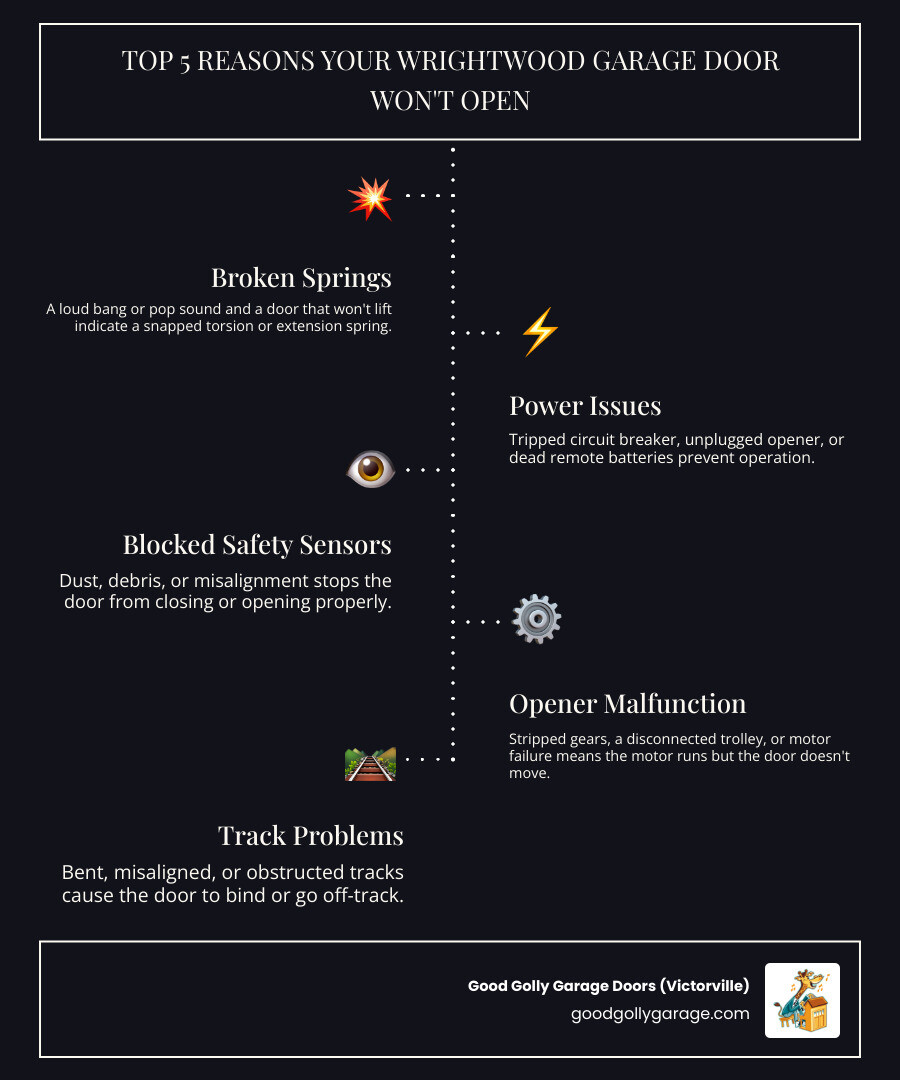
- Broken Springs – A loud bang or pop sound and a door that won’t lift indicate a snapped torsion or extension spring
- Power Issues – Tripped circuit breaker, unplugged opener, or dead remote batteries prevent operation
- Blocked Safety Sensors – Dust, debris, or misalignment stops the door from closing or opening properly
- Opener Malfunction – Stripped gears, a disconnected trolley, or motor failure means the motor runs but the door doesn’t move
- Track Problems – Bent, misaligned, or obstructed tracks cause the door to bind or go off-track
A garage door that won’t open is more than an inconvenience—it disrupts your routine, traps your vehicle, and compromises your home’s security. In Wrightwood, where freezing nights, intense sun, and constant dust take a toll on every moving part, garage door problems can escalate quickly. The same climate that makes this mountain town beautiful also makes your garage door work harder, wear faster, and fail more often.
For comprehensive maintenance to prevent these issues, check out our Wrightwood, CA Garage Door Tune Up services, or if you’re dealing with a breakdown right now, visit our Garage Door Repair page.
I’m Jason Henderson, founder and CEO of Good Golly Garage Doors, and I’ve spent years helping homeowners understand Why Is My Garage Door Won’t Open In Wrightwood CA and other mountain communities where climate plays a major role in system failures. My team and I focus on diagnosing these issues quickly and getting your door back in safe, reliable working order.
The Wrightwood Factor: How Mountain Climate Accelerates Wear and Tear
Living in Wrightwood, CA, offers stunning mountain views and a unique high-altitude desert climate. While beautiful, this environment presents specific challenges for your garage door system. The intense sun, low humidity, and dramatic temperature swings aren’t just minor inconveniences; they actively accelerate wear on every component of your garage door, pushing it to its limits.
We’ve observed that metal parts in garage doors in Wrightwood, as well as in nearby communities like Apple Valley, Victorville, Hesperia, and Lake Arrowhead, constantly expand and contract due to significant temperature fluctuations. This constant movement can lead to metal fatigue, making components brittle and more prone to failure. Tracks can misalign, rollers can bind, and the entire system experiences increased stress, especially the opener motor, which has to work harder to compensate.
The low humidity characteristic of our desert climate causes lubricants to dry out much faster than in other regions. This means that without frequent lubrication, moving parts experience metal-on-metal grinding, leading to premature wear and loud, annoying noises. The intense UV exposure from the sun can also cause weather seals to crack and door panels to warp, further contributing to operational issues and potential noise.
Adding to these woes is the fine desert dust that is ubiquitous in Wrightwood. This pervasive dust infiltrates every nook and cranny of your garage door system, from tracks and rollers to sensitive safety sensors. It acts as an abrasive, causing friction, grinding, and scraping, which can quickly lead to parts seizing up or the door becoming stuck.
Even moisture, such as morning dew or occasional storms, can contribute to problems. When combined with dust and temperature swings, it can accelerate corrosion on metal components, weakening them over time.
This unique combination of environmental factors means that your garage door in Wrightwood needs more diligent care and attention. Regular maintenance and a proper Wrightwood, CA Garage Door Tune Up are not just recommendations; they are necessities to keep your door functioning smoothly and reliably.
The Impact of Dust and Debris
The fine desert dust prevalent in Wrightwood, as well as in Phelan, Adelanto, and Helendale, is a silent saboteur of garage door systems. This dust doesn’t just settle on surfaces; it infiltrates. It gets into the intricate mechanisms of your garage door tracks and rollers, mixing with any dried-out lubricant to create a thick, abrasive paste. This significantly increases friction, leading to grinding and scraping sounds that are not only annoying but also indicative of accelerated wear. Over time, this friction can cause rollers to seize or wear down prematurely, and the door itself can become difficult to move or even completely stuck.
Beyond the mechanical parts, dust also poses a threat to your garage door’s safety sensors. These photo-eye sensors rely on a clear beam of light to detect obstructions. When dust accumulates on their lenses, it can block this invisible beam, causing the door to behave erratically—reversing unexpectedly or refusing to close. Regular cleaning of these components is crucial to prevent these dust-related malfunctions.
Temperature Swings and Metal Fatigue
Wrightwood’s climate is characterized by dramatic temperature swings, often experiencing hot days and cold nights, especially in high-altitude areas like Crestline and Lake Arrowhead. This constant fluctuation causes the metal components of your garage door system to repeatedly expand and contract. While seemingly minor, this repeated stress leads to metal fatigue. Over time, parts like springs, tracks, and hinges can become brittle and lose their structural integrity, making them more susceptible to breaking.
This expansion and contraction can also lead to track misalignment. A perfectly aligned track can become slightly bent or shifted, causing rollers to bind or catch. This puts immense strain on the entire system, particularly the garage door opener motor, which must exert more force to move the door. This increased strain shortens the opener’s lifespan and can lead to internal damage, such as stripped gears. Seasonal adjustments and inspections are vital to counteract the effects of these temperature extremes and ensure your door remains properly aligned and balanced.
Simple Troubleshooting Steps for Wrightwood Homeowners
When your garage door refuses to open, it’s natural to feel frustrated. Before you call for professional help, there are a few simple troubleshooting steps you can take. However, safety is always our top priority. We cannot stress this enough: garage doors operate under immense tension and contain heavy components that can cause severe injury or even death if mishandled.
DIY Safety Checklist:
- Disconnect Power: Always unplug the garage door opener from its power source before attempting any visual inspection or manual manipulation of the door. This prevents accidental operation.
- Visually Inspect: Look for obvious signs of damage, like broken springs, frayed cables, or obstructions in the tracks.
- Listen for Sounds: Pay attention to any unusual sounds the door or opener might make (or not make) when you try to operate it.
- Do Not Touch Springs/Cables: These components are under extreme tension. Never attempt to repair or adjust them yourself. They require specialized tools and expertise.
Why Is My Garage Door Won’t Open In Wrightwood CA? Power and Remote Issues
Often, the problem isn’t with the door itself but with its power supply or control. Here’s what to check:
- Check the Power Source: First, ensure your garage door opener is securely plugged into the ceiling outlet. Vibrations can sometimes cause it to wiggle loose.
- Tripped Circuit Breaker: Head to your home’s electrical panel and check if the circuit breaker connected to your garage is tripped. If it is, simply flip it back on. If it trips again immediately, you likely have a more serious electrical issue that requires a professional.
- GFCI Outlet Reset: Many garage outlets are GFCI (Ground Fault Circuit Interrupter) outlets, which have “Test” and “Reset” buttons. If your opener isn’t receiving power, press the “Reset” button.
- Dead Remote Batteries: This might sound obvious, but it’s a common oversight! Try replacing the batteries in your remote control. If you have multiple remotes, test them all.
- Wall Switch Failure: If your remote isn’t working, try operating the door using the wall-mounted control button inside your garage. If the wall switch works but the remote doesn’t, the issue is likely with the remote or its signal. If neither works, the problem is closer to the opener or its power supply.
- Reprogramming Remotes: Sometimes, remotes can fall out of sync with the opener, especially after a power outage. Consult your opener’s manual for instructions on how to reprogram your remote and keypad. Unplugging the opener for 10-15 seconds and plugging it back in can also sometimes reset it.
If you’ve checked all these power and remote issues and your garage door still won’t open, we need to dig a little deeper.
Why Is My Garage Door Won’t Open In Wrightwood CA? Sensor and Safety Feature Problems
Modern garage doors are equipped with safety features designed to prevent accidents. When these features malfunction, they can prevent your door from opening or closing.
- Blocked Photo-Eye Sensors: These are the small, electric “eyes” located a few inches off the ground on either side of your garage door tracks. They project an invisible infrared beam. If anything blocks this beam—dust, cobwebs, leaves, or even direct sunlight—the door will often refuse to close fully or may open a little and then reverse.
- Dirty Sensor Lenses: Fine desert dust from Wrightwood can accumulate on the sensor lenses, obscuring their view. Use a soft, clean cloth to wipe them gently.
- Misaligned Sensors: The sensors must be perfectly aligned with each other. If one is bumped or moved, the beam can be broken. Check the indicator lights on the sensors; a solid light usually means they are aligned and working, while a blinking light or no light indicates a problem. Gently adjust the sensors until the indicator lights become solid.
- Emergency Release Cord: This is the red cord hanging from the opener’s trolley on the ceiling. If it has been pulled, it disengages the garage door from the opener, allowing for manual operation. If your opener motor is running but the door isn’t moving, check if this cord has been pulled. To re-engage, ensure the door is fully closed, then pull the cord straight down and then toward the opener until you hear a click.
- Manual Lock Engaged: Some garage doors have a manual slide lock or keyed lock for added security. Accidentally engaging this lock and then trying to open the door with the automatic opener can cause significant damage to the opener’s internal components or the top section of the door. Always ensure any manual locks are disengaged before operating your garage door.
Why Is My Garage Door Won’t Open In Wrightwood CA? Common Mechanical Failures
When the simpler electrical and sensor checks don’t resolve the issue, it’s time to consider mechanical failures. These problems are often more serious and typically require professional intervention due to safety risks and specialized knowledge.
How do you identify mechanical problems?
- Loud Bang or Pop Sound: This is often the telltale sign of a broken spring.
- Door Feels Extremely Heavy: If you try to lift the door manually (after disengaging the opener) and it feels impossibly heavy, it’s a strong indicator of spring failure.
- Crooked or Sagging Door: A door that looks uneven, or has one side lower than the other, often points to issues with springs, cables, or tracks.
- Grinding Motor Sounds: If your opener motor is making grinding or straining noises, it could indicate internal damage within the opener itself.
Broken Torsion or Extension Springs
This is perhaps the most common and dangerous reason Why Is My Garage Door Won’t Open In Wrightwood CA. Garage door springs, whether torsion (mounted above the door) or extension (running along the side tracks), are under extreme tension. They counterbalance the immense weight of the door, making it easy for the opener to lift.
When a spring breaks, you’ll almost always hear a very loud “bang” or “pop” – similar to a firecracker or gunshot. If you inspect the spring, you’ll likely see a visible gap in the coil. Once a spring breaks, the door loses its counterbalance and becomes incredibly heavy, often refusing to budge or only lifting a few inches before stopping.
These springs typically have a lifespan of about 10,000 cycles, which translates to roughly 7-15 years of average use (3-4 cycles per day). In challenging climates like Wrightwood, where temperature swings and dust can accelerate metal fatigue, their lifespan might even be shorter.
Attempting to replace or even touch a broken spring yourself is extremely dangerous. The stored energy can be released with explosive force, leading to severe injury or death. This is a job that absolutely requires a trained professional with specialized tools and expertise. For safe and reliable spring replacement, trust our experts. You can find more information about our garage door repair services.
Snapped Cables or Worn Rollers
Working in conjunction with the springs, the garage door cables are crucial for lifting and lowering the door smoothly. If you notice a visibly frayed or snapped cable, or if the door appears unbalanced and moves unevenly, this is a serious issue. A broken cable can cause the door to fall suddenly, creating a significant safety hazard.
Worn rollers are another common culprit. These are the wheels that guide your door along the tracks. Over time, especially with the fine desert dust and dried-out lubricants common in Wrightwood, rollers can wear down, crack, or even seize. This leads to grinding or scraping noises, jerky movement, and can eventually prevent the door from opening or closing properly. Upgrading from old metal rollers to modern nylon rollers is an excellent long-term solution. Nylon rollers glide more smoothly, are much quieter, and generally require less maintenance, making them a smart investment for a peaceful garage. If rollers are severely worn or broken, the door can even come off its tracks, leading to an even more complex and dangerous situation.
Damaged Tracks or Opener Malfunction
The tracks are the pathways for your garage door rollers. If they become bent, dented, or misaligned—perhaps from an accidental impact or the constant expansion and contraction of metal in Wrightwood’s climate—the rollers can bind or scrape, preventing the door from moving. You might hear loud banging sounds or notice the door struggling to move. Major track damage requires special tools and expertise to repair or replace safely.
An opener malfunction can also be the reason Why Is My Garage Door Won’t Open In Wrightwood CA. The opener is the motor unit that automates the door’s movement.
- Stripped Opener Gear: If you hear the opener motor running or humming, but the door isn’t moving, it often indicates a stripped internal gear. Many openers use a nylon drive gear that is intentionally designed to fail before more expensive components or the door itself is damaged.
- Humming or Grinding Motor: A grinding sound coming directly from the opener unit likely signifies internal damage to gears or other components. A humming sound could mean the motor is trying to work but can’t move the door, possibly due to a mechanical obstruction or a stripped gear.
- Trolley Carriage Issues: The trolley is the component that travels along the opener rail, pulling and pushing the door. If it becomes disconnected (which happens when the emergency release cord is pulled) or damaged, the motor will run, but the door won’t move.
Any of these issues can severely impede your garage door’s operation and often require professional diagnosis and repair.
Frequently Asked Questions about a Stuck Garage Door in Wrightwood
We understand that a malfunctioning garage door can be confusing and stressful. Here are some common questions we hear from homeowners in Wrightwood and surrounding areas.
What Are the Telltale Signs My Garage Door Needs Professional Repair?
While some minor issues can be resolved with DIY troubleshooting, certain signs strongly indicate that it’s time to call in the professionals:
- Loud Bang or Pop: This almost always signifies a broken spring, which is a major safety hazard.
- Visibly Broken Spring or Frayed Cables: Never attempt to handle these components yourself.
- Grinding Motor Noise: If the opener motor is making grinding sounds, it likely has internal damage that needs expert attention.
- Door is Crooked or Off Its Tracks: This can be incredibly dangerous and requires precise realignment and repair to prevent further damage or collapse.
- Intermittent Operation: If the door stops, reverses for no reason, or won’t respond consistently, it points to complex sensor or electronic issues that need professional diagnosis.
- Door Feels Extremely Heavy to Lift Manually: This is a clear sign that your springs are broken or severely worn and cannot counterbalance the door’s weight.
What Are the Biggest Risks of Attempting a DIY Garage Door Fix?
We know the temptation of a DIY approach, but with garage doors, the risks are significant, especially for certain repairs.
- Extreme Spring Tension: Garage door springs are under immense tension. If they are mishandled, they can snap and cause severe injuries, including broken bones, lacerations, or even death. This is the number one reason we advise against DIY spring repair.
- Heavy Door Weight: Garage doors can weigh hundreds of pounds (up to 400 pounds for some models). If a door falls unexpectedly during a DIY attempt, it can crush limbs or cause catastrophic property damage.
- Electrical Shock Hazards: Working on the opener’s electrical components without proper knowledge can lead to electrical shocks or even fire.
- Making the Problem Worse: An incorrect DIY fix can exacerbate the original problem, leading to more extensive damage and complex repairs down the line.
- Voiding Warranties: Many garage door and opener warranties are voided if repairs are not performed by a certified professional.
- Lack of Specialized Tools: Professionals have specific tools designed for safely working with garage door components, which homeowners typically don’t possess.
For your safety and to ensure a lasting fix, it’s always best to call a professional for complex or dangerous repairs.
How Often Should I Lubricate My Garage Door in Wrightwood’s Climate?
This is a critical question for homeowners in Wrightwood, as our unique climate significantly impacts maintenance needs. In our high-altitude desert environment, lubricants evaporate much faster due to low humidity. Furthermore, the constant presence of fine desert dust creates more friction in moving parts.
While standard advice for garage door lubrication in milder climates is typically once or twice a year, we recommend a more frequent schedule for Wrightwood: every 3-4 months. This increased frequency is essential to prevent premature wear, reduce noise, and ensure your door operates smoothly.
When lubricating, always use a silicone-based spray lubricant or white lithium grease. These are designed to penetrate and protect metal components without attracting excessive dust. Avoid using WD-40 on garage door tracks or rollers, as it’s a degreaser and can actually strip away existing lubrication, making matters worse. Focus on rollers, hinges, and springs, but never the tracks themselves (which should be kept clean).
Regular lubrication is a simple yet powerful preventative measure that can save you from more significant repairs down the line and keep your garage door opening reliably.
Your Guide to Getting Your Garage Door Moving Again
We know how frustrating it can be when your garage door won’t open, especially when you’re trying to start your day or head out. We’ve explored the unique ways Wrightwood’s mountain climate accelerates wear and tear, from the fine desert dust to the dramatic temperature swings, all of which contribute to your door’s struggles.
Starting with simple checks like power supply, remote batteries, and safety sensors can often resolve the issue. However, we’ve also highlighted the critical mechanical failures—like broken springs, snapped cables, or damaged tracks—that demand professional attention due to inherent dangers.
Your safety is paramount. Never attempt to repair high-tension springs or heavy, unbalanced doors yourself. These complex systems require the expertise, specialized tools, and experience that only a trained professional can provide.
If you’ve gone through the troubleshooting steps and your garage door remains stubbornly shut, or if you suspect a more serious mechanical issue, don’t hesitate. For reliable, fast, and transparent service, trust Good Golly Garage Doors. Our team is familiar with the specific challenges of garage doors in Wrightwood and is ready to get your door working safely and efficiently again.
Get your door working safely with a professional Wrightwood, CA Garage Door Repair from Good Golly Garage Doors today!
 All Service Areas