

Spring Valley Lake Garage Door Woes: What’s Keeping Your Door Down?
Expert Garage Door Services Powered by Good Golly Garage Doors
Stuck in Spring Valley Lake? Your Guide to a Stubborn Garage Door
Why Is My Garage Door Won’t Open In Spring Valley Lake CA? The most common reasons include:
- Broken torsion spring – A loud “bang” followed by the door refusing to lift
- Dead remote batteries – Simple fix, often overlooked
- Misaligned safety sensors – Blocked or dirty photo eyes prevent operation
- Power supply issues – Unplugged opener, tripped breaker, or power outage
- Disconnected trolley – Emergency release cord pulled, disengaging the opener
- Snapped cables – Door appears crooked or won’t move smoothly
- Stripped opener gears – Motor runs but door doesn’t budge
- Bent or obstructed tracks – Physical damage or debris blocking the path
Nothing disrupts your morning quite like a garage door that refuses to budge. Whether you’re heading to work in Victorville or running weekend errands, a stuck door can trap your vehicle and throw off your entire day. The good news is that many garage door failures have identifiable causes, and some you can even troubleshoot yourself before calling in the pros.
Spring Valley Lake’s High Desert climate adds unique challenges to garage door operation. Extreme temperature swings between scorching summer days and chilly winter nights cause metal components to expand and contract. Dust storms can clog tracks and sensors. And the dry air can accelerate wear on springs and moving parts that typically last 7 years under normal conditions.
I’m Jason Henderson, and through my work leading Good Golly Garage Doors, I’ve helped countless homeowners answer the question, “Why Is My Garage Door Won’t Open In Spring Valley Lake CA?” and get their doors back in working order. Most calls we receive fall into a handful of predictable categories, which means you can often pinpoint the problem with a systematic approach.
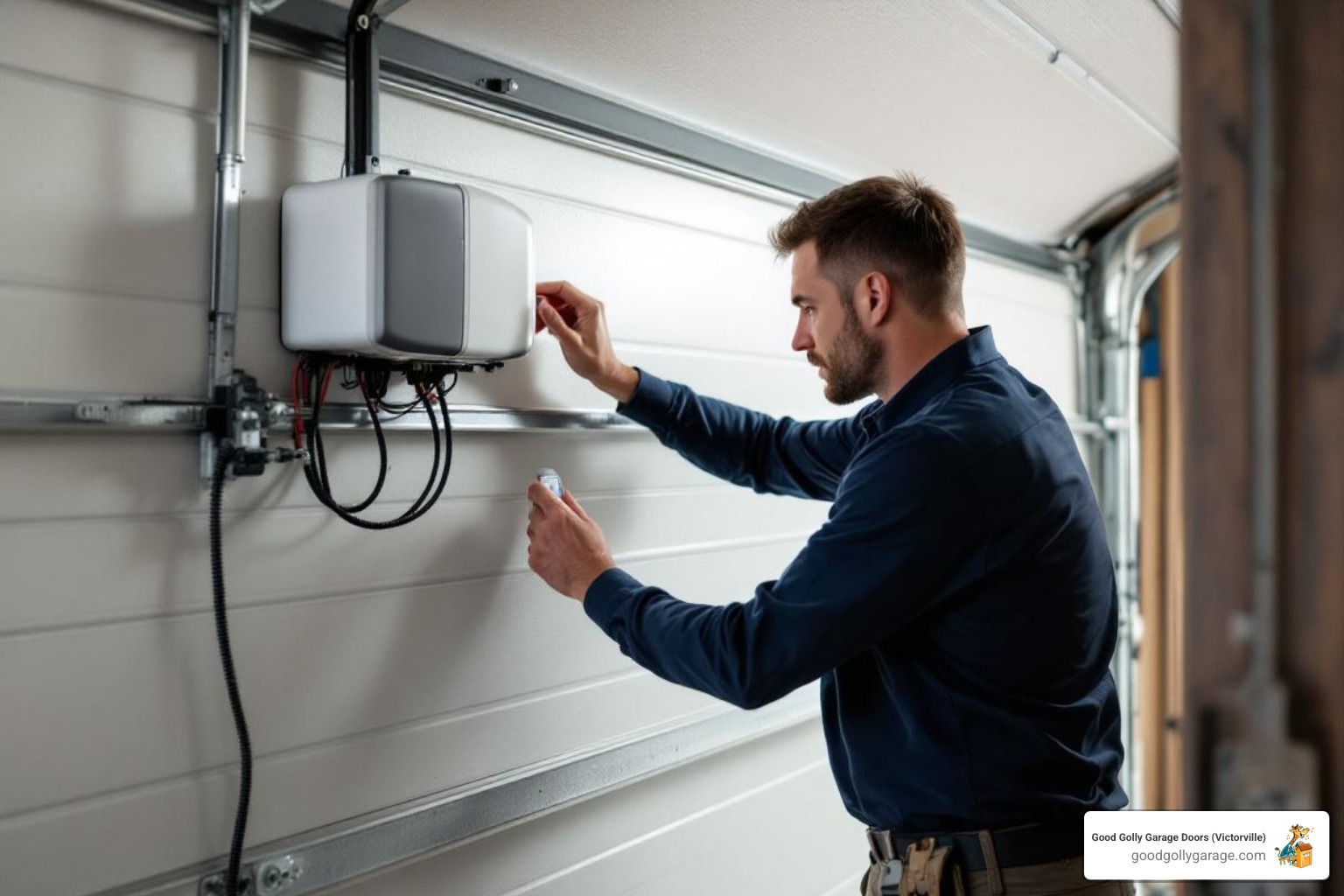
These visuals are custom-created to walk Spring Valley Lake homeowners through the top reasons a garage door will not open and to support the step-by-step diagnostics in the rest of this guide.
Start with Simple Checks: Your First 5 Minutes of Troubleshooting
When your garage door decides to take an unscheduled break, it’s easy to jump to conclusions about major repairs. However, many issues can be resolved with a few simple checks. We always recommend starting here before diving into more complex diagnostics.
First, let’s talk about your remote control. If your garage door remote isn’t working, the most common culprit is a dead battery. It sounds obvious, but it’s often overlooked! Try replacing the battery in your remote control. If you have multiple remotes, test them all. Sometimes, a remote might only work when you’re right up against the door, indicating a weak battery or signal interference. Remote transmitter and wireless keypad batteries should be replaced at least every five years, or sooner if you notice decreased signal strength, especially in cold weather which can drain batteries faster. Also, check for any corrosion inside the battery compartment of your remote or keypad.
Next, turn your attention to the wall switch. Is it functioning correctly? Sometimes, the wall button itself can be faulty, or its wires might have come loose. A quick visual inspection for loose connections on the wall button can sometimes reveal the problem.
Another quick check is to ensure the manual lock isn’t engaged. Many garage doors have a slide lock on the inside, or an exterior keyed lock. If either of these is engaged, your opener won’t be able to move the door. Attempting to force the door open with an engaged manual lock can strip the nylon drive gear in your opener or damage the top section of the door. Always open up these before trying to use the opener!
Then, consider the emergency release cord. This is typically a red rope hanging from your garage door opener. If this cord has been pulled, it disengages the door from the opener, allowing you to operate it manually. This is great during a power outage, but if it’s accidentally pulled, your opener will run, but the door won’t move. To re-engage it, ensure the door is fully closed, then pull the cord straight down and towards the opener. You should hear a distinct click when it locks back into place. If the trolley is stuck in the open position, pull the cord further until it pops back into place.
Finally, check for a “vacation mode” or “lock” button on your wall control. Many modern openers have a master lock-out button that prevents all connected devices – remotes, keypads, and even some smart home integrations – from operating the opener. This feature is handy when you’re away or if a remote is lost, but it can sometimes be pressed inadvertently by children or while cleaning. Simply press it again to deactivate it.
For more information on how we can assist with your garage door needs in the area, visit our dedicated Spring Valley Lake services page: More info about our services in Spring Valley Lake CA.
Power, Sensors, and Electrical Culprits
If the simple checks did not get your door moving, it is time to investigate deeper into power, sensors, and other electrical issues. These problems can often be a bit more complex, but still within the field of homeowner troubleshooting.
First and foremost, make sure your garage door opener is receiving power. Check if the opener is securely plugged into the ceiling outlet. Vibrations from a busy household or even a room above the garage can sometimes cause the plug to wiggle loose. Next, head to your electrical panel and check for a tripped circuit breaker. Garage door openers are often on their own circuit, and sometimes an overload (perhaps from plugging in too many devices) can trip it. Resetting the breaker is a simple flip of a switch. If your outlet is a GFCI (Ground Fault Circuit Interrupter), check if it needs to be reset. If the opener is plugged in and the breaker has not tripped, try plugging another small appliance into the outlet to confirm it is working. If the outlet has no power, you might have a blown fuse or damaged wiring, which warrants professional attention.
Modern garage doors are equipped with crucial safety sensors, often referred to as photo eyes, located near the bottom of your door tracks. These sensors project an invisible infrared beam across the garage door opening. If anything breaks this beam while the door is closing, the door automatically reverses to help prevent accidents. However, if these sensors are blocked, dirty, or misaligned, they can prevent the door from opening or closing entirely.
Misaligned sensors are a frequent cause of frustration. Even a slight bump can knock them out of alignment. Look for two LED lights on each sensor – if one or both are blinking or off, it usually indicates a problem. To realign them, gently adjust the sensors until both LED lights glow steadily. Most sensors have wingnuts you can loosen to make minor adjustments.
Dirty or blocked sensor lenses are another common issue. Dust, spiderwebs, leaves, or even small debris can obstruct the beam. Simply wipe off the sensor lenses with a clean, soft cloth. In dusty environments like Spring Valley Lake, regular cleaning of these sensors is a must.
Lastly, inspect the sensor wiring. Damaged sensor wiring, perhaps chewed by a rodent or accidentally severed, can also prevent your door from operating. Look for any visible damage or loose connections. If you suspect damaged wiring, it is best to call a professional, as electrical issues can be tricky and potentially hazardous.
Why Is My Garage Door Won’t Open In Spring Valley Lake CA: A Deeper Dive Into Mechanical Failures
This section addresses the most common and dangerous mechanical issues that require attention.
When your garage door simply will not budge, or moves only a little, the problem often lies in the intricate mechanical components that do the heavy lifting. These are not only crucial for operation but can also be quite dangerous if mishandled.
The Heart of the System: Broken Garage Door Springs
The springs are arguably the most vital components of your garage door system. They counterbalance the immense weight of the door, making it feel light enough for the opener to lift. There are two main types: torsion springs, mounted horizontally above the garage door opening, and extension springs, located along the sides of the door tracks. Both are under tremendous tension.
The most tell-tale sign of a broken spring is a loud “bang” that sounds like a gunshot. This often happens when the door is closed, as torsion springs spend most of their idle time under tension in that position. Following this sound, you will likely find your garage door will not open at all, or only opens a few inches before stopping. If you can visually inspect the springs, a broken torsion spring will typically have a visible gap, usually an inch or two wide, in the coiled metal. For extension springs, one or both might be visibly stretched out or separated. You might also notice cables popping off or the door appearing crooked. If your garage door opens a little then stops, it could very well be due to malfunctioning springs.
Garage door springs are rated for an industry standard of 10,000 cycles. With most doors being used 3-4 times daily, this translates to an average lifespan of about 7 years. Given the workload, it is not uncommon for springs to eventually give out.
It is absolutely crucial to understand the dangers of high tension springs. Attempting garage door spring repair without the right tools, knowledge, and experience is extremely hazardous. These springs contain enough force to cause serious injury or even death if they snap back unexpectedly. This is one repair that should never be a DIY project. Our team at Good Golly Garage Doors are experts in safely handling and replacing these high-tension components. For a more detailed look at what to do if you suspect a broken spring in Spring Valley Lake, check out our guide: A Guide To Broken Garage Doors In Spring Valley Lake.
Snapped Cables and Their Role
Working in tandem with the springs are the lifting cables. These steel cables wind around drums near the top of the door, transferring the spring’s tension to lift and lower the door smoothly. If your garage door will not open and appears crooked, or if one side seems heavier than the other, you might have snapped or frayed cables.
A broken spring often leads to cable issues, as the sudden loss of tension can cause cables to jump off their drums or even snap. If cables are broken or have slipped off the drums, the lifting force is lost, and you or your opener will have to lift the full dead weight of the door. This is not only difficult but can also damage your opener. If you notice cables off the drum, do not use your opener until the cables are reset by a professional.
Off-Track: Issues with Tracks and Rollers
The tracks are the pathways that guide your garage door as it moves up and down. If these tracks are not in the right position, or if there is an obstruction, your door might not open. Bent or damaged tracks can occur from being hit by a vehicle or simply from wear and tear. Even a slight misalignment can cause the door to bind or come off its path. It is essential for tracks to be even, flush, and level for optimal operation.
Debris or obstructions are common culprits. Tools, toys, or even just accumulated dirt and dust can block the tracks, preventing rollers from moving freely. This is particularly relevant in Spring Valley Lake, where dust and sand can easily accumulate. Regularly clearing debris from the tracks is a simple maintenance step that can prevent major headaches.
Your garage door’s rollers move along these tracks. If rollers are worn, broken, or have fallen out of the tracks, the door will struggle or stop altogether. Worn rollers can cause squealing noises, and if their internal bearings are failing, they might even fall out, causing the door to grind or catch.
If your garage door roller has come off the track, do not try to force the door. We have some excellent tips for dealing with noisy garage doors, which often stem from track and roller issues, on our blog: Tips For A Noisy Garage Door In Spring Valley Lake CA.
Environmental Factors: Why Is My Garage Door Won’t Open In Spring Valley Lake CA?
Living in Spring Valley Lake means dealing with the unique High Desert climate, which can play a significant role in garage door malfunctions.
Extreme heat, common during our long summers, can cause metal components of your garage door and opener to expand. This expansion might lead to binding, making the door stick or struggle to move. Conversely, cold snaps, even in the High Desert, can cause metal to contract, leading to similar binding issues. If moisture gets into the section joints and freezes, it can effectively glue your door shut.
Dust and debris buildup is another major factor. The windy conditions in our area can quickly fill tracks, sensors, and other moving parts with fine dust and sand. This grit acts like sandpaper, accelerating wear on components and causing rollers to seize. Regular cleaning of tracks and sensors is especially important here.
The Brains of the Operation: Garage Door Opener Issues
This section focuses on problems within the motor unit itself.
If you’ve checked the basics and the mechanical components, the problem might be with the garage door opener unit itself – the “brains” of your operation.
Troubleshooting Why Is My Garage Door Won’t Open In Spring Valley Lake CA
One of the most common and puzzling issues is when the motor runs, but the door doesn’t move. This often indicates a problem within the opener’s drive system.
A frequently seen issue is a disconnected trolley carriage. As we mentioned earlier, if the emergency release cord was pulled, the trolley (the part that connects the opener to the door) will be disengaged. The motor will hum away, but it won’t be able to lift the door. To re-engage it, ensure the door is closed, then pull the red cord straight down and towards the opener until you hear a click.
Another reason the motor might run without the door moving is stripped opener gears. Many residential openers use nylon drive gears. These gears are often designed to be a “sacrificial part,” meaning they are intended to fail before more expensive components or the door itself are damaged, especially if the opener is over-stressed (e.g., trying to lift a door with a broken spring or an engaged manual lock). If these gears are stripped, the motor will spin freely without transferring power to the chain or belt.
A worn-out motor itself can also be the culprit. Garage door openers have an average lifespan of 10 to 15 years. If your opener is older and struggling, making unusual noises, or simply refusing to work, the motor might be nearing the end of its life.
Finally, a faulty circuit board can cause all sorts of erratic behavior, or simply render the system unresponsive. The logic board controls all the opener’s functions. These can fail due to old age, but a common reason, especially in areas prone to electrical storms, is a nearby lightning strike causing a power surge. We recommend installing a surge protector for your opener to protect this vital component. Diagnosing a faulty circuit board usually requires a professional.
DIY vs. Calling a Professional: Know Your Limits
When your garage door won’t open, it’s tempting to try and fix everything yourself. While we encourage homeowners to perform basic troubleshooting, it’s crucial to understand your limits, especially when safety is involved.
Here’s a list of safe DIY checks you can confidently perform:
- Replacing batteries in remote controls and keypads.
- Cleaning dirt and debris from safety sensor lenses.
- Clearing obstructions from the garage door tracks.
- Checking if the opener is plugged in and securely connected.
- Resetting a tripped circuit breaker or GFCI outlet.
- Reprogramming your remote controls or keypad (refer to your owner’s manual).
- Visually inspecting wires for obvious loose connections (without touching live wires).
However, there are significant risks associated with trying to fix certain garage door components on your own. The most dangerous are the high-tension components, primarily the garage door springs. As we discussed, these springs are under immense pressure and can cause severe injury or even death if mishandled. Attempting to repair or replace them without specialized tools and training is extremely dangerous. Similarly, dealing with electrical hazards beyond checking an outlet or circuit breaker can be risky. Ignoring electrical problems can lead to more significant damage or even a fire.
So, when is it necessary to call a professional garage door technician? If you’ve tried all the basic troubleshooting steps and your door still won’t open, or if you suspect issues with springs, cables, bent tracks, or internal opener mechanisms like stripped gears or a faulty circuit board, it’s definitely time to call us. Our team has the expertise, specialized tools, and safety equipment to diagnose and repair these complex issues safely and effectively. We proudly serve homeowners throughout Victorville, Spring Valley Lake, and surrounding High Desert communities. For more detailed information about our services in Victorville, please visit: More info about our services in Victorville CA.
Get Your Spring Valley Lake Garage Door Moving Again
We understand how frustrating it is when your garage door won’t open, especially in a busy community like Spring Valley Lake. We’ve walked through common issues from simple remote battery problems to complex mechanical failures, and even how our unique High Desert environment can play a role.
Remember to always prioritize safety first. Start with the simple checks: remote batteries, wall switch, manual locks, emergency release cord, and power supply. Then move on to safety sensors, ensuring they are clean, aligned, and have intact wiring. For mechanical issues like broken springs, snapped cables, bent tracks, or worn rollers, or if your opener motor runs but the door doesn’t move, it’s often best to call in the experts. The dangers associated with high-tension springs and electrical components are simply not worth the risk of a DIY attempt.
The good news is that many of these problems can be prevented with regular maintenance. Lubricating moving parts, cleaning tracks and sensors, and performing routine inspections can significantly extend the life of your garage door system and prevent unexpected breakdowns.
At Good Golly Garage Doors, we’re dedicated to providing reliable, fast, and transparent service to our neighbors in Spring Valley Lake and across the High Desert. We’re here to help you get your garage door moving smoothly and safely again.
Don’t let a stubborn garage door ruin your day. If you need expert assistance, we’re just a call or click away. You can reach out to us for professional garage door service in your area: Contact us for expert garage door service in your area.
 All Service Areas