

Garage Door Off Track? Here’s Why It Happens in Spanish Oaks, TX
Expert Garage Door Services Powered by Good Golly Garage Doors
What To Do When Your Garage Door Goes Off Track
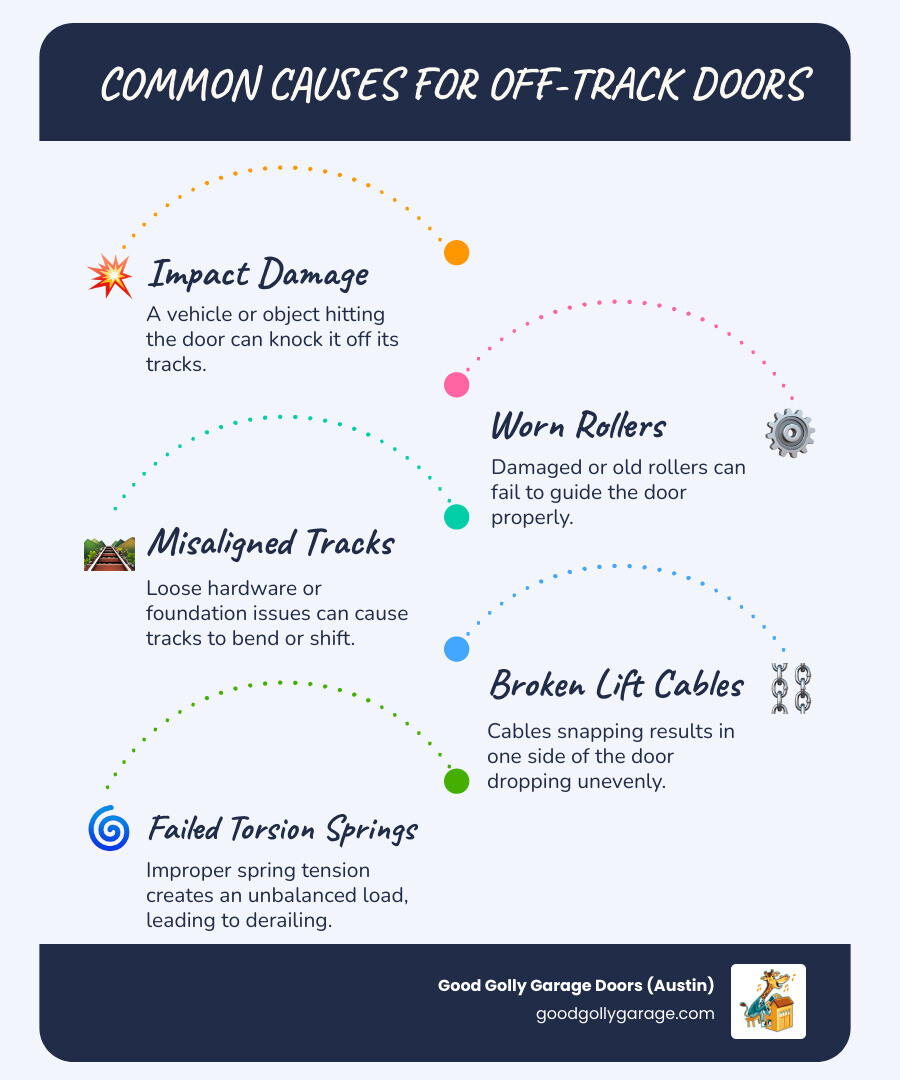
Why Is My Garage Door Off Track In Spanish Oaks TX? Your garage door likely went off track due to one or more of these common causes:
- Impact Damage from a vehicle or object hitting the door
- Worn Or Broken Rollers that can no longer guide the door properly
- Damaged Or Misaligned Tracks caused by loose hardware or foundation settling
- Broken Lift Cables that allow one side of the door to drop
- Failed Torsion Springs creating unbalanced weight distribution
- Obstructions like dirt, debris, or tools blocking the track path
When your garage door jumps its track in Spanish Oaks, it’s more than an inconvenience—it’s a safety hazard and a security risk. An off-track door can’t protect your home, may trap your vehicle inside, and poses serious injury risks if components fail completely. The U.S. Consumer Product Safety Commission reports thousands of garage door-related injuries annually, many involving systems that were already showing signs of failure like track misalignment.
Spanish Oaks homeowners face unique challenges with garage door systems. The intense Texas heat causes metal components to expand and contract repeatedly, accelerating wear on tracks, rollers, and hardware. Combined with the area’s humidity, this climate speeds up the deterioration that leads to off-track emergencies. Understanding why your door derailed and what to do next can prevent further damage and keep your family safe.
I’m Jason Henderson, and I’ve spent years leading service-based companies where operational excellence and safety are non-negotiable. Through my work understanding Why Is My Garage Door Off Track In Spanish Oaks TX and similar issues across the Austin area, I’ve seen how quickly a small misalignment can become a major problem when ignored.
A garage door system is a marvel of engineering, working like a synchronized mechanical ecosystem. When one part fails—like a roller coming out of the track—the entire system becomes unstable, leading to a door that looks slanted, stops moving, or gets stuck. This problem needs to be fixed quickly, and understanding the root cause is the first step.
Why Is My Garage Door Off Track In Spanish Oaks, TX? Common Causes
When your garage door in Spanish Oaks, TX, decides to take an unplanned detour off its tracks, it’s rarely without a reason. Often, several factors conspire to derail its smooth operation. These common culprits appear time and again:
-
Impact Damage: This is probably the most straightforward cause. A vehicle, a bicycle, or even a child’s toy hitting the garage door with enough force can bend a section of the track or dislodge a roller. Even a slight bump can cause the precise alignment needed for smooth operation to go awry. Pulling out too quickly before the door is fully open can have costly consequences.
-
Worn Or Broken Rollers: Rollers are the unsung heroes of your garage door, guiding it along the tracks. Over time, these small but mighty components can wear out, crack, or even break. When rollers are no longer smooth or intact, they can jump out of the track, especially if they’re not rolling properly due to lack of Lubrication or simply old age.
-
Damaged Or Misaligned Tracks: The tracks themselves can be the problem. If they become bent, even slightly, due to impact, or if the mounting brackets holding them to the wall come loose, the rollers no longer have a clear, straight path. Loose bolts on horizontal tracks are a frequent culprit, allowing the track to wobble and increase the risk of rollers coming off. Sometimes, even the natural settling of your home’s foundation can subtly shift the tracks out of alignment.
-
Broken Lift Cables: Located on each side of the door, these cables wind around a drum attached to a steel shaft, carrying a significant portion of the door’s weight. If a cable frays or breaks, often due to age or wear, one side of the door will lose its support and drop unevenly. This sudden imbalance almost guarantees the door will go off track.
-
Torsion Springs Failure: These powerful springs are under extreme tension and carry approximately 90% of your garage door’s weight. If a torsion spring breaks (often with a loud bang), the door becomes dead weight, and the opener struggles to lift it, if it can at all. The unbalanced strain on the system can easily cause the door to twist and jump its tracks.
-
Obstructions In The Track: Sometimes, the simplest explanation is the right one. Dirt, debris, pebbles, leaves, or even tools left too close to the door can block the track’s path, causing a roller to snag and pop out.
Spanish Oaks Climate Considerations
Living in Spanish Oaks, it is clear that the local climate plays a significant role in the wear and tear on your garage door system. The relentless Texas heat is not just uncomfortable for people; it is tough on metal components.
- Metal Expansion And Contraction: The extreme temperature fluctuations—hot days, cooler nights—cause the metal tracks and hardware to repeatedly expand and contract. This constant movement accelerates wear on all moving parts and can gradually loosen bolts, leading to misaligned tracks over time.
- Accelerated Wear On Parts: High temperatures can also dry out lubricants more quickly, leading to increased friction on rollers and hinges. This speeds up their deterioration, making them more prone to failure.
- Humidity And Rust: While Spanish Oaks is not on the coast, local humidity levels, especially during summer, can contribute to rust and corrosion on metal components. Rust on tracks can create resistance, forcing rollers to work harder and increasing the likelihood of them jumping out.
These specific challenges highlight why regular maintenance is so crucial for garage doors in this area.
Signs Your Garage Door Is Off Track
Your garage door usually does not jump off its tracks without giving you some hints first. Paying attention to these signs can help you address the issue before it becomes a full-blown emergency:
- Crooked Or Uneven Movement: This is often the most obvious sign. If your door appears to be opening or closing at an angle, or if one side seems to be lower than the other, it is a strong indicator that it is no longer properly seated in the tracks.
- Grinding Or Scraping Noises: A healthy garage door should operate relatively smoothly and quietly. If you start hearing loud grinding, scraping, or squealing noises, it means metal is rubbing against metal where it should not be. This friction often signals misaligned tracks or rollers struggling to move.
- Visible Gaps Between The Door And Frame: When your door is supposed to be closed, but you can see light or gaps along the sides or top, it suggests the door is not sitting flush against the frame. This could be due to a roller being out of its track, causing a section of the door to pull away.
- Door Gets Stuck Mid-Operation: If your garage door stops abruptly partway through its cycle, or struggles to move at all, it could be binding in the tracks. This happens when rollers are out of place or the tracks are bent, preventing smooth movement.
Immediate Safety Precautions and First Steps
When you find your garage door is off track in Spanish Oaks, TX, your immediate priority should be safety. This isn’t a problem to ignore or delay. A typical garage door weighs over 150 pounds, and its spring system is under extreme tension. The U.S. Consumer Product Safety Commission reports over 20,000 garage door-related injuries annually, many of which involve DIY attempts or malfunctioning doors.
Here’s what you need to do right away:
- Stop Using the Door Immediately: Do not try to open or close the door, either manually or with the opener. Operating a door that’s off track can cause further damage to the door, opener, and tracks, and significantly increase the risk of injury.
- Disconnect the Automatic Opener: Unplug the garage door opener from the electrical outlet or trip the circuit breaker. This prevents anyone from accidentally trying to operate the door while it’s in a dangerous state.
- Do Not Try to Force the Door: Resist the urge to push, pull, or try to force the door back into place. Garage doors are heavy, and if components like torsion springs are involved, they can release energy with devastating force.
- Clear the Area of People, Pets, and Vehicles: Ensure that children, pets, and any vehicles are moved to a safe distance away from the garage door. The door could fall unexpectedly.
Immediate Safety Steps for an Off-Track Garage Door in Spanish Oaks, TX
For our neighbors in Spanish Oaks, Lakeway, and the wider Austin area, we always emphasize these critical first steps:
- Assess from a Distance: Take a moment to look at the situation from a safe vantage point. Note which side is off track, if any cables are broken, or if springs appear damaged. This information will be helpful when you call for professional assistance.
- Secure the Door If Possible: If the door is partially open and stable, you might carefully use C-clamps or locking pliers to secure it to the track above the highest roller on each side. This can help prevent it from falling further, but only attempt this if it feels safe and the door is not precariously balanced.
- Unplug the Opener Unit: As mentioned, this is crucial. Make sure the power supply to the opener is completely cut off.
- Do Not Touch Broken Springs or Cables: These components are under immense tension. A broken spring can snap violently, and cables can whip dangerously if disturbed. Leave these to the experts.
What NOT to Do with an Off-Track Door:
- Do not attempt to operate the door with your automatic opener.
- Do not try to force the door back onto its tracks by yourself.
- Do not touch or try to repair broken springs or frayed cables.
- Do not allow children or pets near the compromised door.
- Do not assume the problem will fix itself or wait to address it.
DIY Vs. Professional Repair: The Safest Choice
The urge to tackle a home repair yourself can be strong. A quick fix might seem like it could save you time, but when it comes to an off-track garage door, it is usually not worth the risk. This is about your safety and the longevity of your garage door system.
- Garage Door Weight: Garage doors are incredibly heavy, often exceeding 150 pounds, and some can weigh much more. Trying to manipulate such a heavy object without proper support or tools can easily lead to serious injury, from crushed fingers to broken bones.
- Extreme Spring Tension: The Torsion Springs are the most dangerous components of your garage door system. They are under extreme tension, designed to counterbalance the door’s weight. If these springs snap or are mishandled during a DIY repair, they can cause devastating injuries. The U.S. Consumer Product Safety Commission reports thousands of garage door-related injuries each year, many involving DIY attempts related to spring failures.
- Specialized Tools: Professional technicians use specialized tools, such as winding bars for torsion springs, to safely handle these high-tension components. Without the right tools and training, you put yourself at enormous risk.
- Risk Of Further Damage: A well-intentioned but inexperienced DIY attempt can often worsen the problem, leading to more extensive repairs later. You might bend tracks further, damage rollers, or even harm the garage door opener motor if the door is pulled unevenly.
Why Is My Garage Door Off Track In Spanish Oaks, TX And Should I Fix It Myself?
For homeowners in Spanish Oaks asking, “Why Is My Garage Door Off Track And Should I Fix It Myself?” the answer, for the vast majority of cases, is no for anything beyond the most superficial of issues.
- DIY Risks: Your safety is paramount. The U.S. Consumer Product Safety Commission reports thousands of garage door-related injuries annually, many involving DIY attempts. These injuries range from cuts and bruises to severe trauma, and even fatalities.
- When To Call A Professional: It is absolutely necessary to call a professional for garage door off-track issues in Spanish Oaks, TX, in the following scenarios:
- Broken Springs Or Cables: These are high-tension components that require expert handling.
- Severely Bent Tracks: If the tracks are significantly deformed, they need precise realignment or replacement, which is best left to a professional.
- The Door Has Fallen Completely: This indicates a major system failure and requires comprehensive assessment and repair by trained technicians.
- Anytime You Feel Uncomfortable Or Unsure: If you are not completely confident in your ability to safely and effectively diagnose and fix the problem, contact a professional. Trained technicians use specialized tools and follow strict safety protocols to ensure the job is done correctly and safely.
The underlying problem for an off-track door is often not just the track itself but failing hinges, worn rollers, or loose cable drums. A professional will perform a comprehensive assessment of the entire mechanical system—spring balance, roller wear, drum alignment, track level, opener force settings, and hardware—to help ensure the door will not fall off again and to prevent long-term damage to your opener or panels.
How to Prevent Your Garage Door from Going Off Track
An ounce of prevention is worth a pound of cure, especially when it comes to your garage door. Regular maintenance is key to keeping your door on track and preventing those frustrating, and potentially dangerous, derailments. For our customers in Spanish Oaks, Lakeway, and Cedar Park, proactive care can save you a lot of hassle.
- Regular Visual Inspections: Make it a habit to visually inspect your garage door system once a month. Look for signs of wear and tear on rollers, tracks, cables, and springs. Are rollers cracked or wobbly? Are tracks bent or loose? Do cables appear frayed? Catching these issues early can prevent them from escalating.
- Keep Tracks Clean and Clear: Dirt, debris, and even insect nests can accumulate in the tracks, creating obstructions that cause rollers to snag and jump out. Regularly wipe down the tracks with a damp cloth to remove any buildup. Ensure the path of the door is always clear of tools, toys, or other objects.
- Test Safety Features: Your garage door has important safety features designed to prevent accidents. Test your auto-reverse mechanism monthly by placing a 2×4 on the ground where the door closes. The door should reverse upon contact. Also, test your photo-eye sensors by waving your hand through the beam while the door is closing. The door should immediately stop and reverse. If these features aren’t working, it could indicate a problem that might indirectly lead to the door going off track.
- Professional Annual Tune-Ups: Just like your car, your garage door benefits from regular professional service. We recommend an annual tune-up by a qualified technician. During these appointments, we inspect all components, lubricate moving parts, check balance, and make any necessary adjustments or minor repairs. This is an investment in the longevity and safety of your door.
Simple Maintenance You Can Perform
While complex repairs are best left to professionals, there are a few simple maintenance tasks you can perform yourself to help prevent your garage door from going off track:
- Lubrication of Moving Parts: Every six to twelve months, apply a silicone-based lubricant to moving parts like hinges, rollers (especially the bearings, not the wheel surface), and springs. This reduces friction and extends the life of your hardware. Important: Do NOT use WD-40 or grease, as these can attract dust and grime, which will worsen the problem over time. Use a product specifically designed for garage doors.
- Tightening Loose Nuts and Bolts: Over time, the vibrations from the door’s operation can cause nuts and bolts to loosen, particularly those holding the tracks to the wall. With a wrench, carefully tighten any loose hardware you find. Be gentle; overtightening can strip threads or warp components.
- Checking Door Balance: A properly balanced garage door should stay put when you manually lift it halfway. To test this, disconnect the opener using the emergency release cord (only if the door is fully closed and appears stable!) and manually lift the door to about waist height. If it drifts up or down, it’s out of balance, indicating a spring issue that needs professional attention.
- Replacing Remote Batteries: In addition to going off track, a dead remote battery can lead to frustration and sometimes, attempts to manually force a door that you think is “stuck,” when it’s just a communication issue. Replace remote and keypad batteries twice a year, perhaps when you change your smoke detector batteries.
Frequently Asked Questions About Off-Track Garage Doors
Homeowners in Spanish Oaks, TX, often have similar questions when their garage door goes off track. Here are answers to some of the most common ones:
Can I Manually Open My Garage Door If It Is Off Track?
You can manually open your garage door if it is off track, but only under very specific and safe conditions. Most doors have a manual release cord (usually a red handle) that disconnects the door from the opener. However, you should only use this if you are absolutely certain the door is stable and appears to be in one piece, with no broken springs or cables.
- Manual Release Cord Risks: If the Torsion Springs are broken or the door is severely off its tracks and unstable, releasing the opener can cause the heavy door to crash down suddenly and violently.
- When It Is Unsafe: If you see broken parts, hear grinding noises, or the door is hanging at an odd angle, it is much safer to wait for a professional.
- Broken Spring Danger: If a spring is broken, the door becomes dead weight. Once disconnected from the opener, it will be extremely heavy and difficult, if not impossible, to lift safely without assistance. Trying to do so can cause serious injury.
- Door Stability Assessment: Always assess the door’s stability first. If there is any doubt, do not attempt to manually open or close it.
How Do I Know If My Rollers Or Tracks Are The Problem?
Differentiating between roller and track issues can sometimes be tricky, as they are interconnected. However, here are some inspection tips:
- Inspecting Rollers For Cracks: Open your garage door manually (if safe to do so) and examine each roller. Look for cracks in the plastic or nylon wheels, flat spots, or excessive wear. If a roller is visibly damaged or not spinning freely, it is likely contributing to the problem. Worn rollers can cause a grinding noise as they move.
- Checking Tracks For Bends Or Dents: Look closely at the metal tracks running along the sides of the door. Are there any visible bends, dents, or crimps? Even a small deformation can impede a roller. Check for loose mounting bolts that might allow the track to wobble. If the door moves unevenly, or scrapes heavily, it could be a track alignment issue.
- Signs Of Wear And Tear: Listen for grinding or scraping noises, or observe if the door is moving unevenly. If the door appears crooked, or if there are visible gaps when the door is closed, both rollers and tracks could be at fault. Often, a problem with one component puts strain on the other.
How Often Should I Have My Garage Door Serviced In Spanish Oaks?
Given the unique climate challenges in Spanish Oaks, a proactive approach to garage door maintenance is wise:
- Annual Professional Tune-Up: A professional garage door tune-up at least once a year is strongly recommended. During this service, technicians will inspect all components, lubricate moving parts, check the door’s balance, test safety features, and identify any potential issues before they become major problems.
- Semi-Annual Homeowner Checks: In addition to professional service, homeowners should perform simple visual inspections and basic maintenance (like lubrication and tightening loose bolts) every six months. This helps you stay on top of any developing issues.
- Climate Impact On Maintenance Schedule: The intense Texas heat and occasional humidity can cause metal parts to expand, contract, and wear faster. This means that components might need lubrication or adjustment more frequently than in milder climates. If you notice your door operating less smoothly or making new noises, do not wait for your annual check-up—schedule service promptly.
Get Your Spanish Oaks Garage Door Back On Track Safely
Dealing with a garage door that is off track is a significant safety and security concern for your home in Spanish Oaks. These heavy, complex systems can be dangerous when they malfunction. From the risk of serious injury due to powerful springs and heavy doors to the vulnerability of an unsecured garage, it is not a problem to take lightly or try to fix with guesswork.
When your garage door is off track, it disrupts your daily routine and compromises the safety of your family and belongings. Prompt, professional attention is essential. Service from experienced technicians brings the right tools and a commitment to safety to every job in Spanish Oaks and the greater Austin area.
Do not let an off-track garage door become a bigger problem. Restore your home’s security and your peace of mind.
Contact Us For Professional Garage Door Repair In The Austin Area
 All Service Areas