
Emergency Garage Door Repair in Georgetown, TX
Stuck with a faulty garage door in Georgetown? Contact us for immediate, safe, and effective emergency repair services. Restore your home's security today.
Is Your Garage Door Stuck Open or Refusing to Close?
Is your garage door stuck halfway, completely unresponsive, or showing visible damage after a recent storm or heavy usage? A malfunctioning garage door is more than an inconvenience; it compromises the security of your home and disrupts your entire daily schedule in Georgetown. If you are trapped inside your garage or cannot secure your home for the night, call us immediately to dispatch a technician to your location.
We understand that mechanical failures rarely happen at convenient times. Whether it is a snapped spring at dawn or a derailment late at night, you need a solution that restores functionality and security without delay.
- Rapid response team on-site to diagnose the failure immediately.
- Expert solutions using certified technicians and fully stocked service trucks.
- Effective, long-lasting repairs guaranteed to restore safe operation.
All repairs are fully licensed, insured, and come with a comprehensive service warranty to ensure the problem does not return.
Immediate Solutions for Critical Garage Door Failures
When a garage door fails, the priority is securing the opening and ensuring the heavy mechanism does not pose a physical threat to people or vehicles. Emergency service is distinct from standard maintenance because it addresses acute failures that render the door inoperable or dangerous.
In Georgetown, residents frequently encounter specific types of mechanical trauma that require urgent intervention. Our service focuses on identifying the root cause within minutes of arrival and implementing a fix during the same visit. We arrive with industrial-grade components, including high-cycle springs, reinforced cables, and commercial-grade rollers, ensuring that we do not just patch the problem but upgrade the failed component.
Common emergencies we resolve immediately include:
- Snapped Torsion or Extension Springs: If you heard a loud bang like a gunshot, your spring has likely broken. This component bears the weight of the door. Without it, the door becomes “dead weight” and cannot be lifted by the opener or manually without extreme risk.
- Derailment and Off-Track Doors: If a vehicle bumps the door or a cable snaps, the rollers may slip out of the track. Attempting to force the door back down can bend the tracks and destroy the panels. We secure the door, realign the vertical and horizontal tracks, and reseat the rollers.
- Snapped Lift Cables: When a cable breaks, the door may tilt aggressively to one side. This puts uneven tension on the remaining hardware, threatening to collapse the entire system. We replace both cables simultaneously to ensure balanced tension.
- Opener Logic Board and Gear Failure: Lightning strikes and power surges can fry the internal electronics of a garage door opener. Alternatively, stripped internal gears can cause the motor to hum without moving the chain or belt. We replace logic boards and gear assemblies on the spot.
- Impact Damage: Accidental backing into the door usually damages the bottom section. If the damage is structural, we reinforce the strut to allow the door to close securely until a panel replacement can be arranged.
The Emergency Repair Process: What to Expect
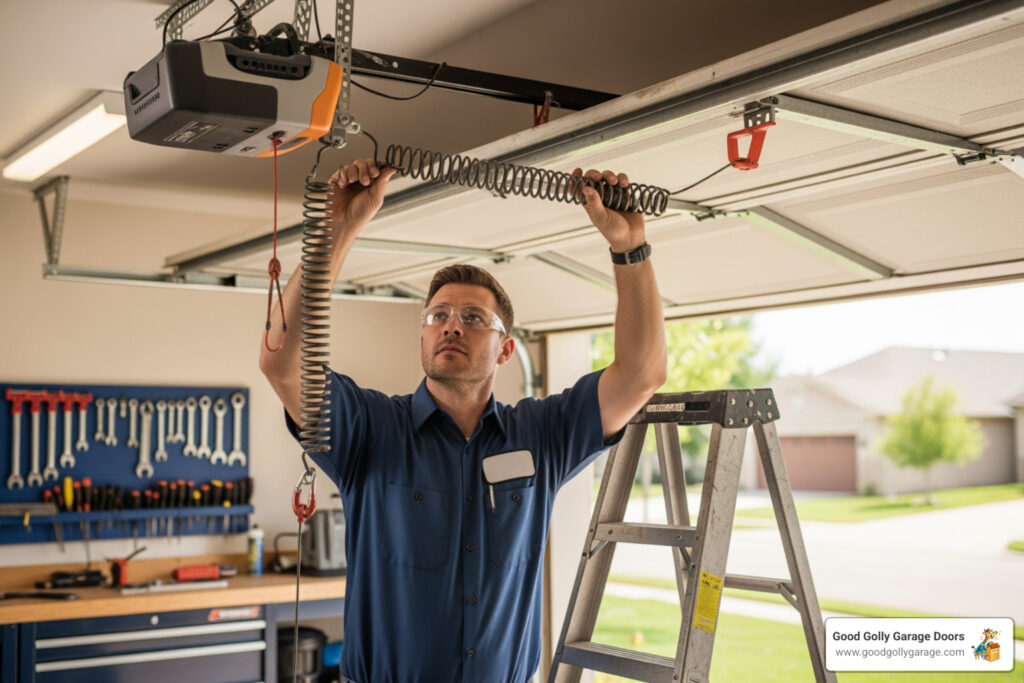
We utilize a systematic approach to emergency repair to ensure safety and efficiency. Unlike scheduled maintenance where we might inspect cosmetic issues, emergency calls are triaged to address functionality and safety first.
- Site Safety Assessment: Upon arrival, the technician first secures the area. If a door is hanging precariously or a spring is under partial tension, we establish a safety zone to prevent injury during the repair.
- Diagnostic Troubleshooting: We isolate the failure. For openers, we check voltage and sensor alignment. For mechanical issues, we inspect the counterbalance system. This ensures we are fixing the cause, not just the symptom.
- Immediate Stabilization: If the door is stuck open, we manually release the mechanism safely and lower the door to secure the home. This is the first priority for evening or night calls.
- Component Replacement: We remove the damaged parts—whether they are frayed cables, shattered rollers, or broken springs—and install new, manufacturer-rated components. We match the weight and cycle rating of the new parts to your specific door model.
- Tensioning and Balancing: Installing the part is only half the job. We wind the springs to the precise tension required to lift the door so that it balances neutrally in the opening. A balanced door puts less strain on the opener.
- Safety Inspection and Cycle Test: We run the door through multiple full cycles to verify the travel limits and force settings. We test the auto-reverse safety features to ensure the door complies with modern safety standards.
Repair vs. Replacement: Making the Right Decision
In an emergency scenario, the immediate goal is often just to get the door closed. However, depending on the age and condition of your system, a repair might be a temporary patch on a dying system. We provide honest assessments on whether a repair is cost-effective or if the system requires a full overhaul.
Good Golly Garage Doors technicians look at specific indicators to guide this decision.
When to Repair:
- Isolated Component Failure: If the door is relatively new (under 10 years) and a single part like a spring or cable has failed due to normal wear, a repair is the most logical and cost-effective choice.
- Cosmetic Damage Only: If a panel is dented but the door still moves smoothly in the tracks and seals the opening, a repair or single-panel swap is sufficient.
- Opener Issues on a Modern Unit: If the opener was manufactured after 2013 and has compliant safety sensors, replacing a logic board or capacitor is worth the investment.
When to Replace:
- Structural Integrity Loss: If the door has been hit and the tracks are twisted or the sections are buckling under their own weight, a repair cannot restore the structural integrity. A compromised door is a safety hazard in high winds.
- Cost Prohibitive Repairs: If the cost of the emergency repair (springs, cables, rollers, and labor) approaches 50% of the cost of a brand-new door system, replacement offers better long-term value and resets the warranty clock.
- Outdated Safety Standards: If your system lacks safety sensors (eyes) or the reversing mechanism is inconsistent, and the opener is over 15 years old, federal safety standards suggest a full replacement is necessary for liability and safety reasons.
- Rust and Rot: In older wooden or non-galvanized steel doors, extensive rot or rust at the bottom seal means the door can no longer keep out weather or pests. Patching this is rarely successful long-term.
Environmental Factors Affecting Garage Doors in the Region
Local climate conditions in Georgetown play a significant role in how garage doors fail and how they must be repaired. Understanding these environmental stressors helps us prevent future emergencies.
- Extreme Heat and Electronics: The intense Texas heat, particularly in the summer where garage temperatures can soar well above 100 degrees, wreaks havoc on opener electronics. Capacitors can swell and burst, and logic boards can overheat. We use high-temperature rated lubricants and recommend insulated doors to lower the ambient temperature in the garage, protecting the mechanical opener.
- Humidity and Moisture: Spring rains and general humidity can lead to the swelling of wooden door frames or headers. If the wood swells, it pushes against the tracks, causing the door to bind or stick. For steel doors, humidity accelerates rust on unlubricated springs and cables. We utilize galvanized torsion springs and synthetic, water-resistant lubricants to combat this corrosion.
- Foundation Shifting: Soil conditions in the area can cause foundations to shift slightly over time. This movement can throw a garage door frame out of square. If your door suddenly starts catching or binding without visible breakage, the tracks may need to be re-leveled to account for structural shifting.
- Freeze/Thaw Cycles: While winters are generally mild, occasional freezes can cause the bottom rubber seal to freeze to the concrete floor. If you attempt to open the door while it is frozen shut, the opener may strip its main gear or burn out the motor. We install weather stripping designed to resist freezing adhesion.
Local Codes and Permitting Considerations
For standard emergency repairs—such as swapping a broken spring, replacing a cable, or changing a circuit board—permits are generally not required. These are considered maintenance tasks. However, if the emergency results in the need for a full structural replacement of the door system, compliance with local building codes becomes relevant.
This area is subject to specific wind load requirements due to storm potential. If a door must be replaced, the new unit must meet specific wind ratings to ensure it does not buckle during high-velocity wind events. A failure of the garage door during a storm can lead to roof lift-off and catastrophic home damage. We ensure that any replacement hardware or panels used during a repair maintain the wind-load rating of the original installation. We also verify that all electrical work regarding the opener meets the current National Electrical Code (NEC) standards for GFCI protection in garage spaces.
Why Professional Intervention is Critical
Garage door repair is consistently ranked as one of the most dangerous home improvement tasks for untrained individuals. The torsion spring system is under immense tension—enough to lift a 300-pound door with ease. When these springs or cables are mishandled, the stored energy is released instantly.
- Personal Safety: DIY attempts to wind torsion springs or reattach bottom brackets (which are connected to the cables) frequently result in severe hand and facial injuries. Our technicians have the proper winding bars and containment tools to manage this tension safely.
- Security Assurance: A garage door that is not closed properly is an invitation to intruders. An emergency repair ensures the door is locked down tight, protecting your tools, vehicles, and the entry to your home.
- Warranty Preservation: Attempting to fix a door yourself or using a handyman often voids the manufacturer’s warranty on the door and opener. Professional repair maintains your warranty coverage.
- Proper Calibration: It is not enough to just replace the part; the door must be balanced. An unbalanced door forces the opener to work harder, leading to premature motor failure. We ensure the door is “floating” in the opening before we leave.
When your garage door fails, you need a solution that is fast, safe, and technically sound. Good Golly Garage Doors provides the expertise required to turn a major headache into a resolved issue.
Restore your home’s security and functionality now. Contact us to schedule your emergency repair.
Proudly Serving Austin, TX, and Surrounding Areas
From the neighborhoods of Austin to Round Rock and Buda, we provide the best garage door services you can find across the area. Whether it’s the impact of Texas heat and sudden storms on garage door components, we ensure our solutions are tailored to your needs. Wherever you are, Good Golly Garage Doors is ready to deliver.
View All Cities
 All Service Areas